Prewriting for Problem-Solution Essays
A problem-solution essay begins, of course, with a problem that you want to understand and solve. Fortunately, problems aren't shy: They tend to leap right out at you. You may already have a topic in mind from the "pain points" warm-up at the beginning of this unit. If not, these activities will help you find a topic.
Prewriting to Think About Problems
Problems are everywhere in life. You can start to think about problems by considering any aspect of life, from food to families to fun, and think about the problems that can come up in those areas. Start by consulting the Basics of Life List. This list contains all of the essentials of life—general subject areas. Pick one or two subjects that interest you. Then list problems that relate to that subject. You can click on any of these subject areas to find more resources related to it.
Basics of Life
Animals
Art
Books
Career
Communication
Community
Culture
Education
Energy
Entertainment
Environment
Exercise
Family
Fantasy
Fashion
Food
Freedom
Friends
Fun
Future
Geography
Goals
Government
Health
History
Holidays
Home
Imagination
Language
Law
Life
Literature
Love
Medicine
Money
Music
Nature
Occupation
People
Personality
Plants
Play
Recreation
Rights
Rules
Science
Seasons
Self
Sports
Technology
Transportation
Travel
Vehicles
Work
One student selected the subject "Personality" to write about and created a cluster to explore pain points with personality. Afterward, the student chose to write about his own struggles with anxiety, depression, and seasonal affective disorder, and the solutions he has found to help him manage his mood states.
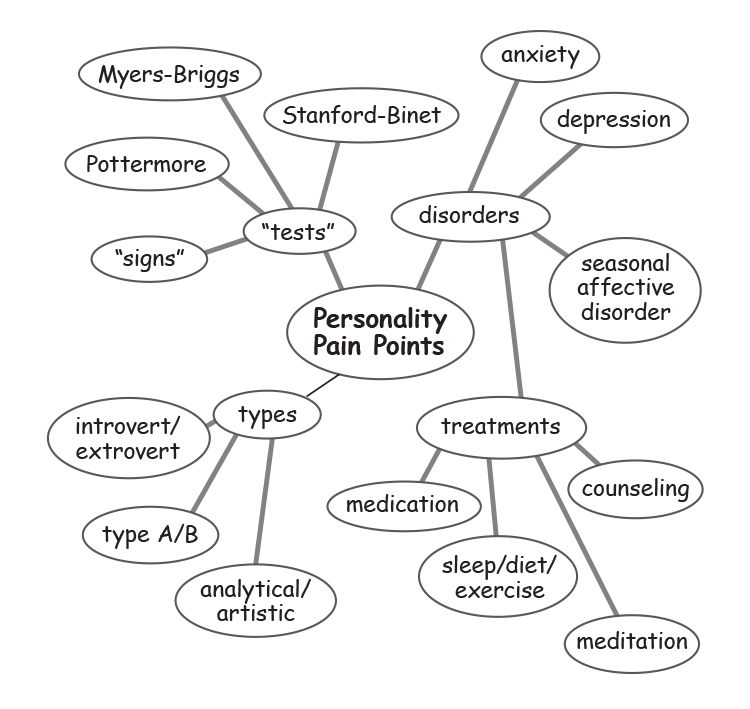
Explore pain points.
Review the Basics of Life List and select a general subject area that interests you. Write the subject area and the words "Pain Points" in the middle of a piece of paper and circle them. Then create a cluster around these words, thinking of problems and solutions you could write about. Choose a topic for your problem-solution essay.
Prewriting to Explore Your Topic
You probably know a good deal about your topic already—after all, you chose it because it interests you. You should start thinking about your topic by writing down everything you know about the problem and brainstorming about the solution. After you finish this process, you'll know the issues that you need to research futher.
Problem: Affective Disorders
|
Problems |
Solutions |
|
|
Analyze problems and brainstorm solutions.
Write down the problem you want to explore. Under it, create a T-chart, listing everything you know about the problem in the left-hand column and brainstorming solutions in the right-hand column.
Teaching Tip
This exercise activates students' prior knowledge about the topic. The next activity will help them research the topic to find out more about it.
Prewriting to Research Problems/Solutions
A strong problem-solution paper reaches beyond what you already know about your topic, drawing in information from a variety of reliable sources. You can spur your research by searching for different types of information about your source.
Problem: Affective Disorders
|
Types of Information |
Sources |
|
Definitions/Examples |
Mayo Clinic: https://www.mayoclinic.org/diseases-conditions/mood-disorders/symptoms-causes/syc-20365057 National Institute of Mental Health: https://www.nimh.nih.gov/health/topics/anxiety-disorders/index.shtml |
|
Causes/Effects |
Healthline.com: https://www.healthline.com/health/affective-disorders#causes Johns Hopkins: https://www.hopkinsmedicine.org/healthlibrary/conditions/mental_health_disorders/ Psychology Today: https://www.psychologytoday.com/us/blog/the-red-light-district/201501/vitamin-d-and-seasonal-affective-disorder-symptoms |
|
Background/History |
eMedMD: http://www.emedmd.com/content/mood-disorders-historical-introduction-and-conceptual-overview |
|
Statistics |
National Institute of Mental Health: https://www.nimh.nih.gov/health/statistics/any-mood-disorder.shtml |
|
Solutions |
PsychGuides.com: https://www.psychguides.com/guides/mood-disorder-treatment-program-options/ Mayo Clinic: https://www.mayoclinic.org/diseases-conditions/seasonal-affective-disorder/diagnosis-treatment/drc-20364722 University of Michigan Depression Center: http://www.depressiontoolkit.org/takecare/ Mindful.org: https://www.mindful.org/mindfulness-for-anxiety-research-and-practice/ |
Research problems and solutions.
Search for and list sources of information about your topic. Look for definitions/examples, causes/effects, background/history, statistics, and solutions.
Teaching Tip
Let students know that they will need to cite sources in their problem-solution essays. After they use material from a source, they should provide the author's name or the first word or two of the title in parenthesis in the text. They should also list the sources at the end of their papers. They do not have to worry about creating correct MLA style for source citations until they are editing their revised drafts.