Editing Problem-Solution Essays
After you finish revising your problem-solution essay, you should make sure you have correctly cited all sources of information and included a works-cited entry for each, using the style of the Modern Language Association (MLA).You should also edit for punctuation, mechanics, grammar, usage, and spelling. The following activities will help you.
Editing for MLA Citation Style
Whenever you use ideas from others, you need to credit the source. You do so to show who originated an idea, to avoid plagiarism, and to allow readers to explore the same materials.
All credits begin with an in-text citation that names the source and page number (if there is one). The simplest in-text citation gives the source in the sentence itself.
Roland Zahn, M.D., explains his recent study in Archives of General Psychology: “Our research provides the first brain mechanism that could explain the classical observation by Freud that depression is distinguished from normal sadness by proneness to exaggerated feelings of guilt or self-blame."
If the sentence doesn't give readers enough information to find the correct work-cited entry, provide the last name of the author in parentheses before the end punctuation. If the source has no author, use the first significant word(s) of the title, in italics for longer works or quotation marks for shorter works.
Mayo Clinic defines major depressive disorder as "prolonged and persistent periods of extreme sadness" and defines seasonal affective disorder as "a form of depression most often associated with fewer hours of daylight in the far northern and southern latitudes from late fall to early spring" ("Mood Disorders").
If the material came from a specific page number, include it in the parenthetical reference.
The classic work The Interpretation of Dreams notes, "One of the sources from which the dream draws material for reproduction—material which is not recalled or employed in waking —is to be found in childhood" (Freud 11).
At the end of your essay, you should include a separate works-cited page. Center the words Works Cited at the top and double-space the list of sources you cited in your essay. Works-cited entries should appear in alphabetical order, with the first line flush left and the runover lines indented half an inch. Include each of the following elements that apply:
Author's last name, First name. Title of Source. Title of Container, Other Contributors, Version, Number, Publisher, Publication Date, Location.
- Author: Write the last name followed by a comma and the first name. For a second author, write "and" followed by the name in the usual order. For three or more authors, write "et al" after the name of the first author (instead of the names of the other authors). Place a period after this element.
- Title of Source: Write titles of longer works in italics and shorter works in quotation marks. Use title capitalization. Place a period after this element, inside the end quotation marks if there are any.
- Title of Container: After the title of shorter works, indicate the container that holds them, such as an anthology or Web site. Place the container name in italics and use title capitalization. Use a comma after this element.
- Other Contributors: List any significant contributors, such as the director of a film or editor of a set of letters. Place a comma after this element.
- Version: List a version, if one exists, with a comma after it.
- Number: List a number, if one exists, with a comma after it.
- Publisher: Name the publisher, followed by a comma.
- Publication Date: For books, provide the year of publication; for time-sensitive materials, give the full date in European style: Day Month Year. If this is the final element, place a period after it. Otherwise, use a comma.
- Location: When possible, indicate exactly where information came from, for example giving a page number or URL. Place a period after this element.
Check your source citations.
Read over your essay, making sure you have given credit to sources of information. Use the tips above and the sample works-cited pages in this unit to make sure your citations follow MLA style.
Editing for Semicolons, Colons, and Dashes
You are probably quite familiar with using commas to create a momentary pause in the flow of a sentence. But commas aren't strong enough for more significant shifts in sentences. What punctuation marks can you use?
A semicolon is stronger than a comma and weaker than a period. You can remember that fact because it looks like a period stacked on top of a comma. You can use a semicolon to join two related sentences (a comma alone is too weak and would cause a "comma splice").
Dopamine affects depression; adrenaline affects anxiety.
When items in a series already contain commas, you can use semicolons to show greater divisions.
Those with depression should eat a diet that balances proteins, carbohydrates, and fats; drink plenty of water; avoid caffiene, alcohol, and recreational drugs; and get sufficient sleep.
A colon functions like an equal sign. You can remember that fact because it looks like an equal sign formed from two stacked periods. In email and memo headers, a colon separates a general category from a specific instance, such as "Subject: Problem-Solution Essay Sources." When used in text, a colon separates a complete sentence that introduces an idea from a specific example of the idea—often a list or quotation.
You can combat anxiety with an arsenal of strategies that have a single name: mindfulness.
A colon often introduces a formal quotation or list. However, make sure the words before the colon form a complete sentence. Do not use a colon between a verb and its object or between a preposition and its object.
Incorrect One in ten Americans last year experienced: a mood disorder.
Correct One in ten Americans last year experienced a mood disorder.
Incorrect Medications can treat: anxiety, depression, and bipolar disorder.
Correct Medications can treat anxiety, depression, and bipolar disorder.
A dash looks like a long hyphen and can function as a semicolon or colon. It is weaker than a period and stronger than a comma. It sets off words that already contain commas or marks an often dramatic pause.
If you perform self-care—eating right, drinking water, and sleeping enough—you can lessen the effects of depression.
Medications for depression target dopamine—the neurotransmitter that lets us experience happiness.
When writing narratives, you can use dashes liberally to create drama, but you should use them more sparingly when writing analyses and arguments.
Check punctuation.
Correct each sentence below by inserting the punctuation mark indicated afterward in parentheses.
-
A person suffering from depression has numerous options: counseling, medication, light therapy, diet, exercise, and sleep. (colon)
-
Two natural chemicals affect mood disorders: the neurotransmitter dopamine and the hormone adrenaline. (colon)
-
People with depression suffer from reduced excitement; people with anxiety suffer from excess excitement. (semicolon)
-
Practicing mindfulness— focusing on breath, meditating, and relaxing muscle groups— can lessen anxiety. (dashes)
-
Counselors— doctors, psychologists, teachers, and even friends and family— can help people deal with depression and anxiety. (dashes)
-
People with mood disorders should watch their dietary habits by eating a balance of proteins, carbohydrates, and fats; drinking plenty of water; and keeping regular meal times. (semicolons)
-
People with mood disorders also should keep relationships strong by talking with counselors, friends, and family members; engaging in social activities such as games, events, and conversations; and avoiding isolating circumstances. (semicolons)
-
Those with depression should avoid nonprescription mood-altering substances: caffeine, alcohol, and recreational drugs. (colon)
-
One free, natural remedy reduces both anxiety and depression: sunlight. (colon)
-
Effective treatments for mood disorders come down to one golden rule— be kind to yourself. (dash)
Editing in Action
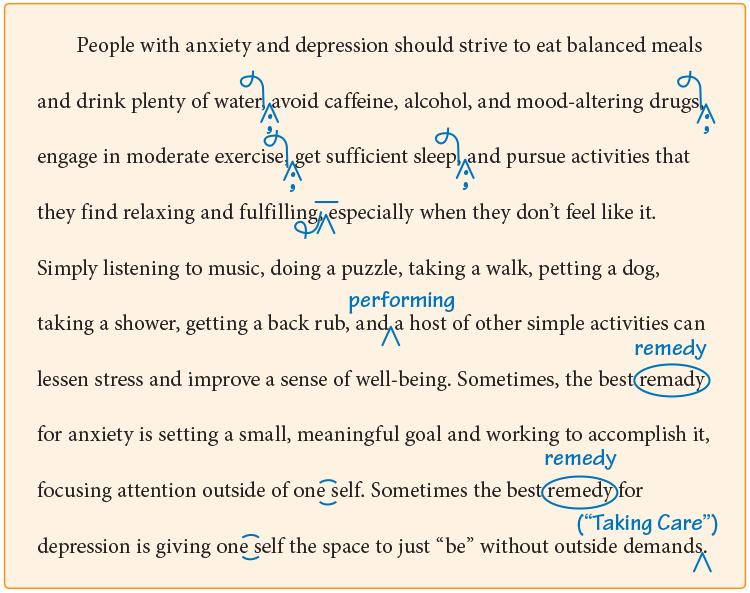
After you check your MLA citations and semicolons, colons, and dashes, you should also make sure your problem-solution essay has correct sentences, punctuation, capitalization, spelling, usage, and grammar. Make corrections to ensure that your work is error free.
-
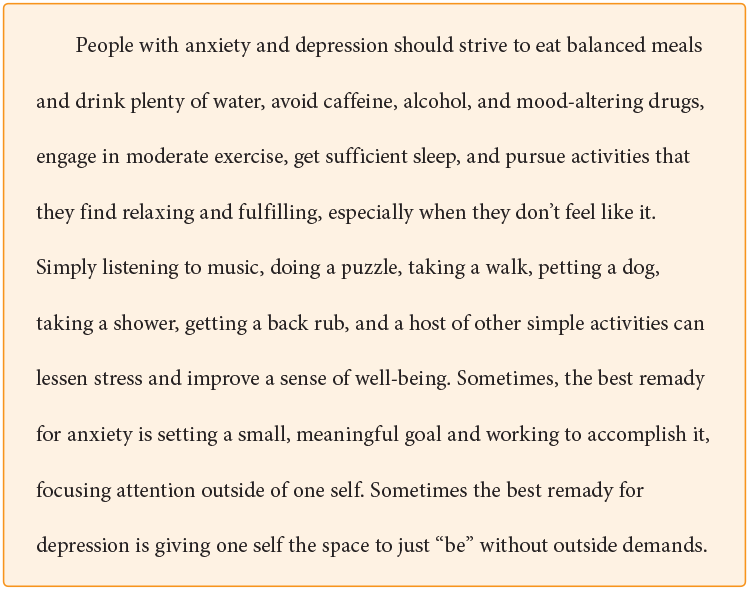
Paragraph Before Edits
-
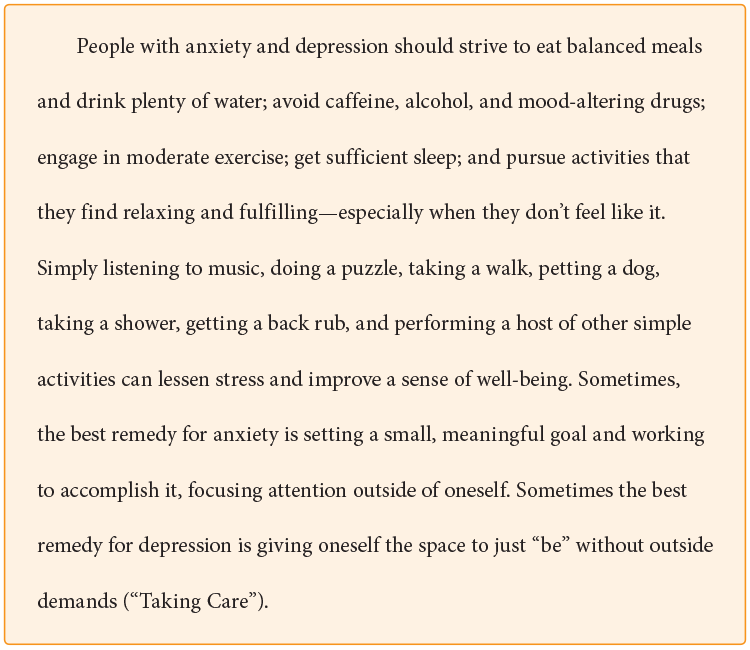
In-text citations are improved; spelling, usage, and punctuation errors are corrected.
-
Paragraph After Edits
Edit with a checklist.
Use the following checklist to edit your problem-solution essay. When you can answer a question with a yes, check it off. Continue editing until each line is checked.
Sentences
- Do sentences read smoothly, with varied lengths and styles?
- Are sentences correct, without run-ons, comma splices, or fragments?
Punctuation
- Do semicolons appear between complete sentences that have been joined together?
- Do semicolons mark larger breaks in series that already include commas?
- Do colons follow complete introductory sentences to introduce specific examples, lists, or quotations?
- Do colons never separate verbs from objects or prepositions from objects?
- Are dashes used sparingly to indicate pauses stronger than commas but weaker than periods?
- Do all entries in the works-cited page have correct punctuation and format?
Mechanics
- Are proper nouns and the first words in sentences capitalized?
- In titles, are the first and last words capitalized as well as all words in between except coordinating conjunctions (and, but, or), articles (a, an, the), and short prepositions (in, of, at, with, on)?
- Have I checked spellings of the names and technical terms (such as dopamine or adrenaline)?
- Have I checked spelling using a dictionary or the spell checker on my computer?
Grammar
- Do subjects and verbs agree in number?
- Do pronouns and antecedents agree in number, person, and gender?
Usage
- Are commonly confused words used correctly (your/you’re, their/they’re, its/it’s)?
Publishing Problem-Solution Essays
Publishing is simply the act of making your work public. That's why publishing takes so many different forms. First, you need to make a clean final copy of your work. Then you should find ways to share your writing with classmates, your teacher, your family, and your friends.
Publishing a Final Copy
Create a final copy of your problem-solution essay.
Include your revising and editing changes and read over your work a final time. (If you are working on a computer, spell-check your work.)
Reflecting on Your Writing
Reflect on your writing.
Complete the following sheet to reflect on writing a problem-solution essay.