Writing for Literature Assessment
When you respond to a writing prompt, you should start by carefully reading and analyzing the prompt using the PAST questions. Then you should jot down a quick outline of your response. Do these activities in the first five minutes or so of the time you have. (If the prompt includes a reading, take more time with this step.) You'll spend the bulk of your time creating a beginning, a middle, and an ending. Afterward, you'll want to review your answers to the PAST questions and read your response, making sure it is on target. In the last five minutes or so, revise and edit your work. This abbreviated version of the writing process needs to fit into the total time you are given (often between 30 and 90 minutes).
Viewing a Sample Prompt and Response
Read the following prompt, and view one student's PAST analysis, outline, and beginning, middle, and ending. Then you'll get a chance to read and respond to a prompt of your own.
Sample Writing Prompt
"Romance Sonambulo" by Federico Garcia Lorca focuses on the color green. What does it mean in this poem? How does the poet use it to construct images and tell a story? Write an essay that analyzes the use of green in "Romance Sonambulo" and cites evidence from the poem.
Listen to "Romance Sonambulo"
Hide audio
Romance Sonambulo
(Sleepwalking Ballad)
by Federico Garcia Lorca
Green, how I want you green.
Green wind. Green branches.
The ship out on the sea
and the horse on the mountain.
With the shade around her waist
she dreams on her balcony,
green flesh, her hair green,
with eyes of cold silver.
Green, how I want you green.
Under the gypsy moon,
all things are watching her
and she cannot see them.
Green, how I want you green.
Big hoarfrost stars
come with the fish of shadow
that opens the road of dawn.
The fig tree rubs its wind
with the sandpaper of its branches,
and the forest, cunning cat,
bristles its brittle fibers.
But who will come? And from where?
She is still on her balcony
green flesh, her hair green,
dreaming in the bitter sea.
—My friend, I want to trade
my horse for her house,
my saddle for her mirror,
my knife for her blanket.
My friend, I come bleeding
from the gates of Cabra.
—If it were possible, my boy,
I’d help you fix that trade.
But now I am not I,
nor is my house now my house.
—My friend, I want to die
decently in my bed.
Of iron, if that’s possible,
with blankets of fine chambray.
Don’t you see the wound I have
from my chest up to my throat?
—Your white shirt has grown
thirsty dark brown roses.
Your blood oozes and flees a
round the corners of your sash.
But now I am not I,
nor is my house now my house.
—Let me climb up, at least,
up to the high balconies;
Let me climb up! Let me,
up to the green balconies.
Railings of the moon
through which the water rumbles.
Now the two friends climb up,
up to the high balconies.
Leaving a trail of blood.
Leaving a trail of teardrops.
Tin bell vines
were trembling on the roofs.
A thousand crystal tambourines
struck at the dawn light.
Green, how I want you green,
green wind, green branches.
The two friends climbed up.
The stiff wind left
in their mouths, a strange taste
of bile, of mint, and of basil.
My friend, where is she—tell me—
where is your bitter girl?
How many times she waited for you!
How many times would she wait for you,
cool face, black hair,
on this green balcony!
Over the mouth of the cistern
the gypsy girl was swinging,
green flesh, her hair green,
with eyes of cold silver.
An icicle of moon
holds her up above the water.
The night became intimate
like a little plaza.
Drunken “Guardias Civiles”
were pounding on the door.
Green, how I want you green.
Green wind. Green branches.
The ship out on the sea.
And the horse on the mountain.
Prewriting (5 Minutes)
Answer the PAST questions.
Purpose? Analyze "Romance Sonambulo" for its use of green
Audience? The reader of the test
Subject? "Romance Sonambulo" by Federico Garcia Lorca
Type? Analysis essay
Write a thesis statement.
In "Romance Sonambulo," the color green becomes a symbol of dreaming desire, the wish of a dying soldier to live with a beautiful woman on a green balcony.
List supporting details.
—The poet desires green, but applies it to many things that are not naturally green.
—Green becomes desire itself, a surreal color that identifies everything the poet dreams of.
—The center two stanzas show a very different world, one of battle and death, with no green.
—The dying soldier dreams somewhat deliriously of his green girl with green hair on her green balcony.
Writing (Most Time)
Write a beginning that leads to the focus statement.
Federico Garcia Lorca plainly states the meaning of his poem "Romance Sonambulo" in the first line: "Green, how I want you green." However, this straightforward statement is anything but clear. How does one want a color? Does he want things that are green, like plants and the sea? Yes, sort of. Does he want things that are symbolically green, like wealth or envy of what others have? Well, perhaps . . . Does he want things that aren't supposed to be green, like green breezes and green flesh and green hair? Those too, apparently. In "Romance Sonambulo," the color green becomes a symbol of dreaming desire, the wish of a dying soldier to live with a beautiful woman on a green balcony.
Write a middle paragraph to develop each supporting point.
The first two stanzas of the poem overflow with desire for "green" things. The sleepwalker of the title dreams of green wind and green branches. He dreams of green ships and horses, and of green seas and mountains. He dreams of a balcony with a girl that has green flesh and green hair. Everything that he desires is green. The color comes to represent desire itself, a delirious longing that cannot be fulfilled. Strange, then, that this girl with green flesh and hair has eyes of "cold silver." Her eyes are immediately associated with the "gypsy moon" in the line "all things are watching her and she cannot see them." Watching whom, the girl or the moon? The answer is both. All people watch the cold silver moon, but she sees none of them, and the dreamer watches the dreaming green girl, but she cannot see him. Though he wants her, she is as oblivious as the moon. . . .
Write an ending paragraph to wrap up the essay.
After the conversation, we understand that the dreamer is mortally wounded in battle. He wishes he could trade his horse and saddle and knife for life at peace with the dreamed-of girl. He wishes that he could at least die in bed. But he and his comrade are no longer the people they once were, their homes no longer belonging to them. So, the man dreams of returning, of climbing with his comrade toward that balcony with the green girl. He has a moment of clarity in which her hair turns once again black. But then his dreams get mixed with memories of drunken police "pounding on the door." Afterward, he lapses into his pleasant green dream as he likely succumbs to his wound.
Revising and Editing (5 Minutes)
Add, cut, rewrite, and rearrange to fix errors.
-
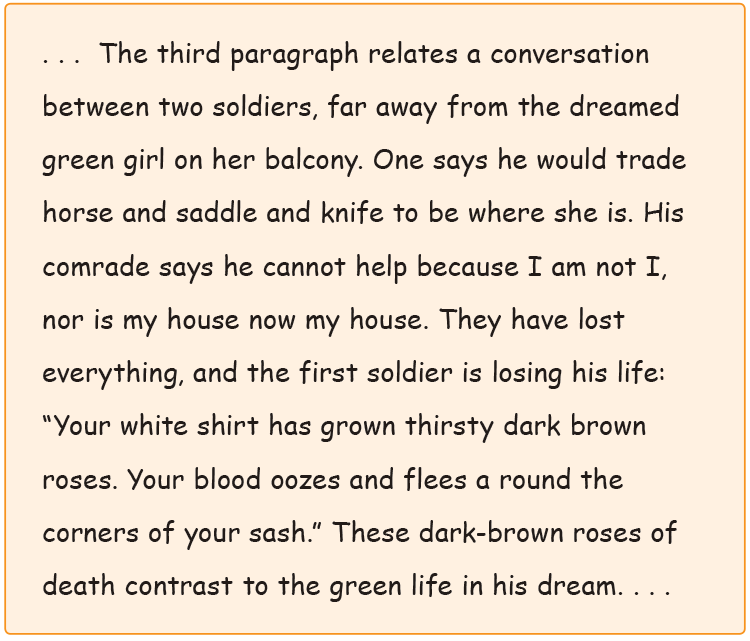
Sentence Before Edits
-
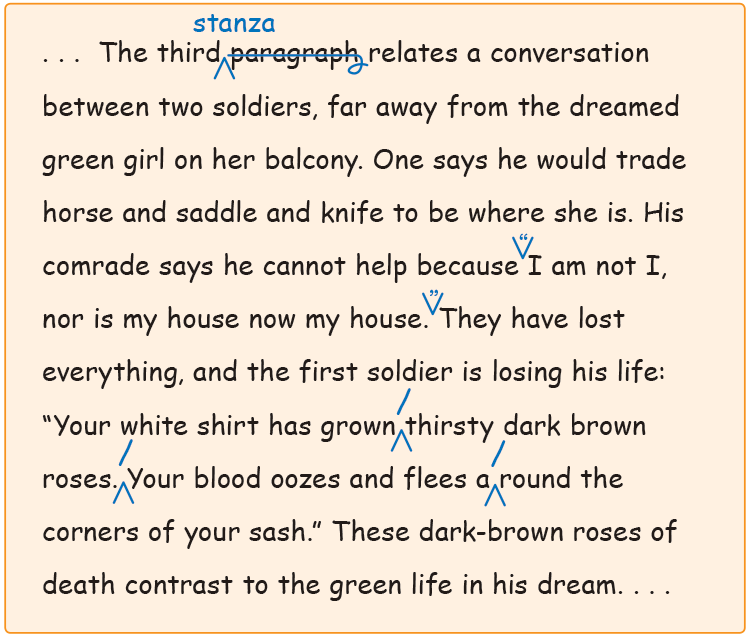
Punctuation and word choice are improved.
-
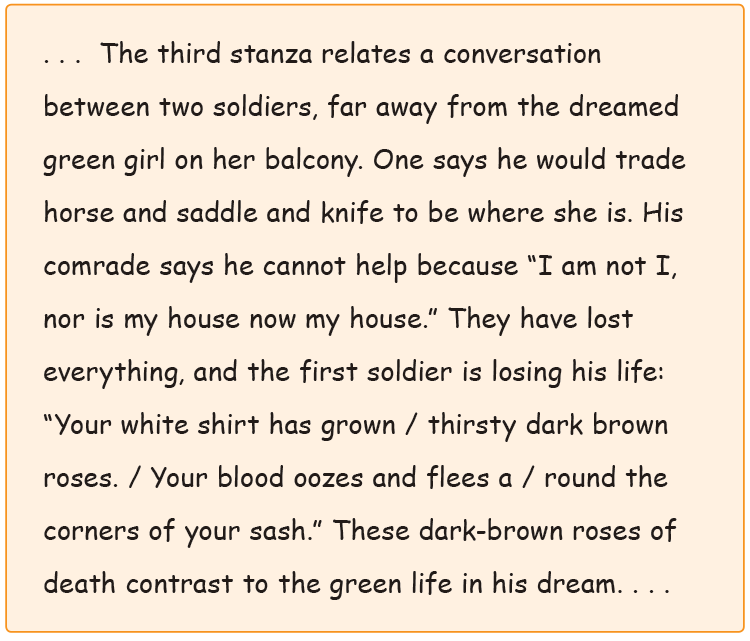
Sentence After Edits
Responding to a Practice Literary Prompt
Respond to a writing prompt.
Read the writing prompt that follows and create an essay response.
Listen to "When You Are Old"
Hide audio
Sample Writing Prompt
In "When You Are Old" by William Butler Yeats, the poet imagines a time when the woman he loves will be elderly, reflecting on her life. Read the poem and then write an essay that analyzes how Yeats uses words, sounds, and images to create the scene. What themes do you discover in the poem?
When You Are Old
by William Butler Yeats
When you are old and grey and full of sleep,
And nodding by the fire, take down this book,
And slowly read, and dream of the soft look
Your eyes had once, and of their shadows deep;
How many loved your moments of glad grace,
And loved your beauty with love false or true,
But one man loved the pilgrim soul in you,
And loved the sorrows of your changing face;
And bending down beside the glowing bars,
Murmur, a little sadly, how Love fled
And paced upon the mountains overhead
And hid his face amid a crowd of stars.
Purpose?
Audience?
Subject?
Type?
Write a thesis statement.
List supporting details.
Draft your essay.
Teaching Tip
This prompt provides students a brief text to read and respond to. Other prompts ask students to draw on prior knowledge, citing examples from literature they have already read. Both types of prompts appear on high-stakes assessments.
Revise and edit your essay.
Read your essay and ask yourself the following questions. Correct any problems you find.
- Is my essay on target with the prompt and the PAST questions?
- Do I have a clear thesis statement and topic sentences?
- Do I support them clearly with a variety of details from the literature?
- Are my beginning, middle, and ending paragraphs effective?
- Have I checked my spelling?
- Are all of my sentences complete (no fragments or run-ons)?