Warm-Up for Comparison-Contrast Essays
People often say, "You can't compare apples and oranges." Of course you can. Apples and oranges are both fist-sized fruits with an outer protective covering, sweet inner flesh, and seeds. Both grow on trees and appear in supermarkets. Both come in delicious varieties. These fruits are different in many ways as well: color, texture, taste, vitamins, acidity, availability, seasons, and so on. By comparing and contrasting apples and oranges, you learn more about each.
This kind of analytical thinking can help you understand just about any two topics, whether protagonists in novels or types of respiratory systems in animals or generals in the Civil War. In this unit, you'll select two topics from your own areas of study or from personal interest and compare and contrast them.
What Are Comparing and Contrasting?
Listen to "What Are Comparing and Contrasting?"
Hide audio
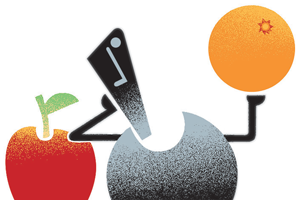
When you compare two topics, you find the similarities between them. When you contrast them, you focus on differences. Yes, you can compare and contrast apples and oranges, but your thinking needs to use parallel structure. In other words, you compare and contrast the appearance of both, and then the taste, and then the color. You shouldn't say, "While an orange has a tangy, slightly acidic taste, an apple comes in different colors." You shouldn't compare the taste of the orange to the color of the apple.
As you can see, a comparison-contrast essay needs to keep ideas neatly sorted. You have two separate topics, the similarities and differences between them, and the many points of comparison and contrast. This unit will help you manage all of this complexity, thinking effectively about your topics and developing a clear, thorough, and compelling essay.
You can warm up your thinking by comparing and contrasting yourself and one of your friends or family members.
Thinking About People
You may have a lot in common with a friend or family member, or very little in common, or some combination. You can analyze the similarities and differences between yourself and a person you like by writing about each of you, point by point. One student compared and contrasted himself to his best friend by completing the following chart.
|
Points of Comparison |
Me |
Wade |
|
Appearance |
Hair buzzed on top; brown eyes, brown skin; tall, thin, strong; like to dress nice; kind of serious |
Hair parted and light brown; blue eyes, white skin, medium height, wiry; jeans and T-shirts; always grinning |
|
Personality |
Focused and serious, hard working, quiet, rule follower |
Random and joking, hard working, always talking, pushing people's buttons |
|
Interests |
Hunting, fishing, camping, stargazing |
Hunting, fishing, camping |
|
Talents |
Science and math |
Music, writing, science, telling stories, making jokes, making friends |
|
Background |
Grew up in the city, only child |
Grew up on a farm, third of five kids |
|
Goals |
Become an engineer |
Be a comedian, actor, or writer |
|
Fears |
Failure |
He doesn't seem to be afraid of anything or anybody |
Compare yourself to someone you like.
For each point of comparison, write details about yourself and someone you like. In what surprising ways are you different? In what surprising ways are you the same?
Teaching Tip
This activity helps students focus on two topics, analyze them point by point, and discover similarities and differences. Trying out this process with familiar topics (themselves and their friends or family members) will help students use a similar approach with more challenging topics as they research for their essays.