Viewing and Writing Nonfiction Assessment IV
Some Common Core and AP assessments present you with visuals that you must analyze and respond to. Remember that every visual is a form of communication with a sender and receiver (who), a message (what and why), a medium (how), and a context (where and when).
View and analyze source 1.
Closely read the ad from the Seattle Brewing and Malting Company, which originally appeared on the back of a brochure for the Argus Alaska-Yukon-Pacific Exposition, 1909. Note especially the ideas presented visually through illustrations, type selection, layout, and so on. Afterward, analyze the visual by answering the questions.
Listen to "Malt Rainier"
Hide audio
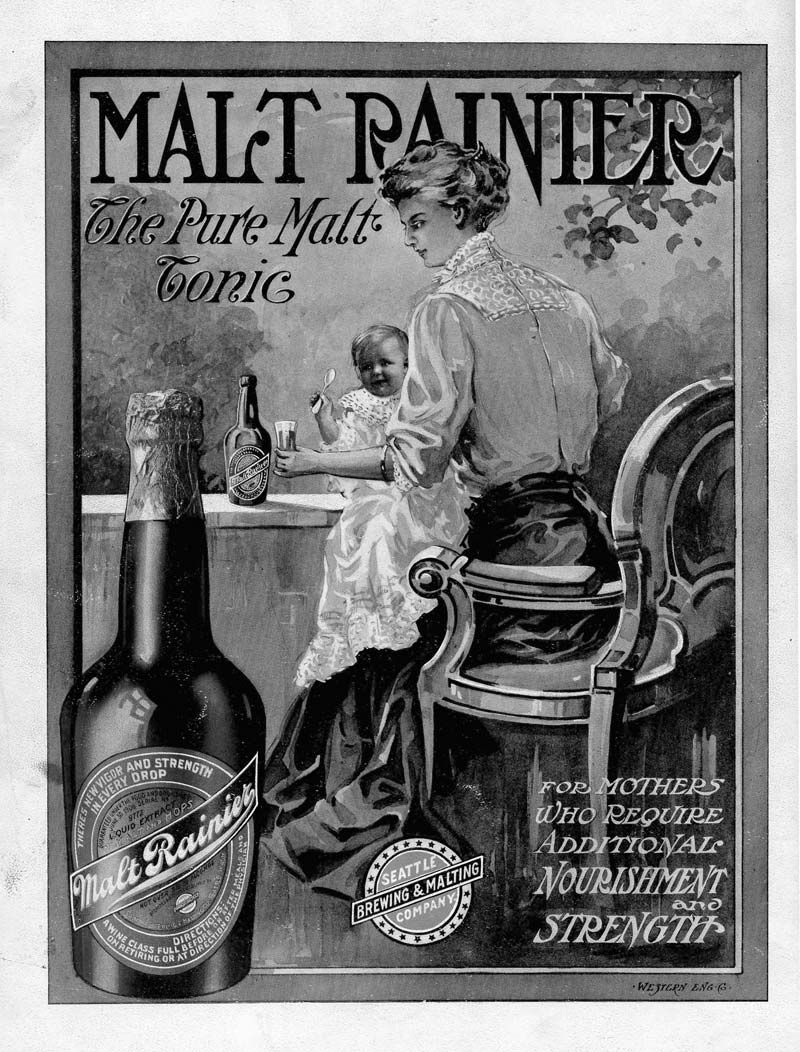
Note: The text on the bottle reads “There’s new vigor and strength in every drop / Guaranteed under the Food and Drugs Act / June 30 1908 Serial No 9772 / Liquid Extract of Malt and Hops / Malt Rainier / Not over 5 1/2% alcohol / Prepared and bottled exclusively by / Seattle Brewing & Malting Co Seattle Wash. / Directions: A wine glass full before or after meals and on retiring or at direction of the physician.”
-
Who does this ad target?
A. Lower-class women
B. Exhausted mothers
B. Exhausted mothers
C. Beer drinkers
D. Medical professionals who can prescribe tonics
-
What best describes Malt Rainier Tonic?
A. Medicine
B. Liquid extract of malt and hops not over 5 1/2 percent alcohol
B. Liquid extract of malt and hops not over 5 1/2 percent alcohol
C. Nourishment
D. Strength for mothers
-
Infer why the ad shows a well-dressed, upper-class woman with nicely-styled hair.
A. Advertisers wanted to make their tonic seem like legitimate medicine rather than simply malt liquor.
B. Advertisers knew that all mothers would aspire to be wealthy, upper-class, beautiful, and respectable.
C. Advertisers wanted to sell their product to only this type of mother.
D. Both A and B might be reasons.
D. Both A and B might be reasons.
-
Which of the following can you infer about the Food and Drugs Act of 1908?
A. The United States has always carefully safeguarded the health of mothers.
B. The Food and Drug Administration was founded in 1908.
C. In 1908, laws governing the marketing of alcohol were different than they are today.
C. In 1908, laws governing the marketing of alcohol were different than they are today.
D. The Seattle Brewing and Malting Company had paid off federal investigators.
-
For modern viewers, what is the most shocking claim of this advertisement?
A. Mothers should drink alcohol while caring for their children.
A. Mothers should drink alcohol while caring for their children.
B. Malt Rainier contains no more than 5 1/2 percent alcohol.
C. Malt Rainier provides nourishment and strength.
D. Exhausted mothers often attend the Argus Alaska-Yukon-Pacific Exposition.
View and analyze source 2.
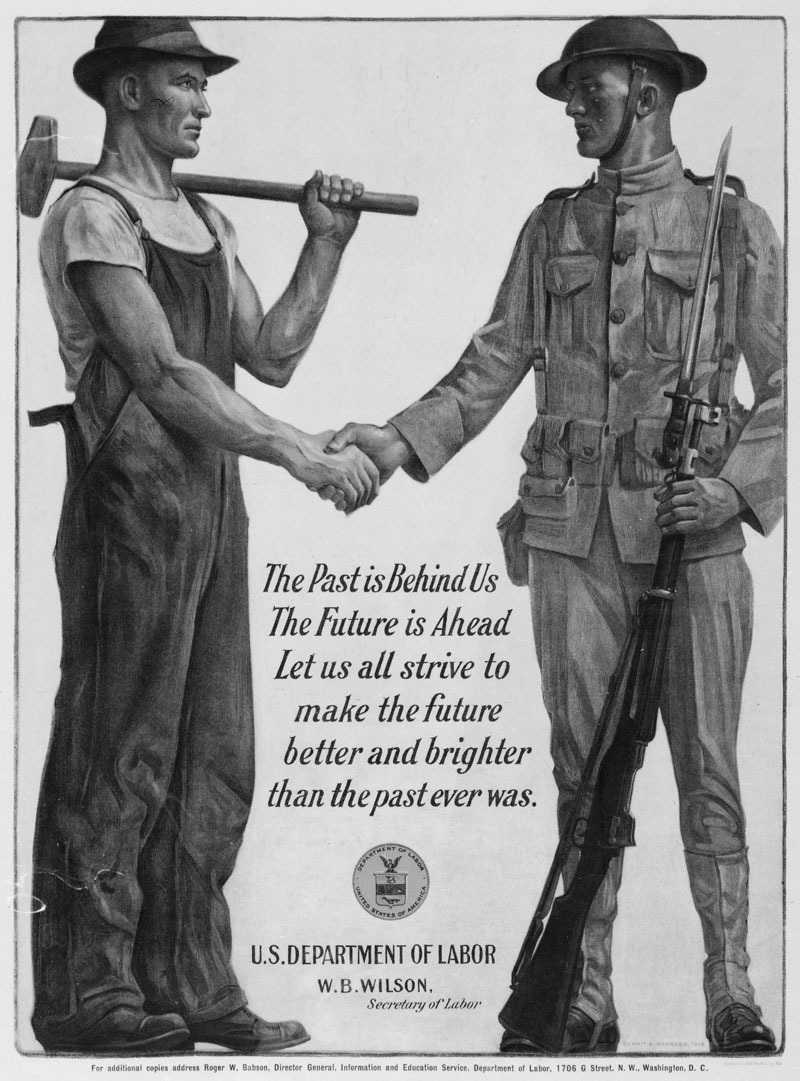
Closely read the ad from the U.S. Department of Labor, a poster produced in 1918 after World War I and the flu epidemic that killed 18 million people. Note especially the ideas presented visually through illustrations, type selection, layout, and so on. Afterward, analyze the visual by answering the questions.
Listen to "The Past Is Behind Us"
Hide audio
-
Who does this ad target?
A. Soldiers
B. Workers
C. U.S. citizens
C. U.S. citizens
D. U.S. allies in World War I
-
What best describes the message of this ad?
A. We should no longer fight wars
B. We should put war behind us and make our country productive.
B. We should put war behind us and make our country productive.
C. Workers should thank soldiers for their service.
D. Soldiers should thank workers for provisioning them during war.
-
Infer why the poster shows a worker and a soldier shaking hands.
A. The nation was transitioning from fighting World War I to the post-war economy.
A. The nation was transitioning from fighting World War I to the post-war economy.
B. Most Americans were workers or soldiers.
C. The two occupations were critical to winning World War I.
D. Worker and soldiers had the highest casualty rates in World War I.
-
Which of the following can you infer from the call to action "Let us make the future better and brighter than the past ever was"?
A. Woodrow Wilson was running on this platform for re-election.
B. The United States government was preparing citizens for the "Roaring Twenties."
C. Winning World War I set up the U.S. for a prosperous "peace dividend."
D. The U.S. Labor Department wanted to move past the traumas of war and epidemic into a prosperous future.
D. The U.S. Labor Department wanted to move past the traumas of war and epidemic into a prosperous future.
-
Which of the following does the poster imply?
A. The United States is strong in terms of military might and economic productivity.
B. Citizens should cooperate to move into a brighter future.
C. U.S. workers should make a trade deal with the U.S. armed forces.
D. The poster implies both A and B.
D. The poster implies both A and B.
Writing an Essay for Assessment IV
Some tests ask you to write an essay response to visuals and text that you have closely read. The following activity will help you practice.
Analyze and respond to an essay prompt.
Read the following prompt, analyze it using the PAST questions, and write an essay response.
Ads try to persuade people using a variety of tactics. Some ads promote a good cause or product using fair appeals. Other ads promote terrible ideas or products and use manipulative appeals. In an essay, analyze the ads in Source 1 and Source 2, comparing and contrasting them. Judge the value of the idea or product promoted in each ad, describe the types of appeals used to promote it, and evaluate how fair or unfair the ad is.