CCSS.ELA-LITERACY.RI.9-10.5

By Anonymous (not verified), 12 March, 2026

Understanding Controlling Sentences

As you read, watch for two types of controlling sentences.

A thesis statement tells what an essay or article is about. It usually appears in the first paragraph, often at the end.

       Why did writing get invented? To recount the exploits of great heroes like Gilgamesh and Odysseus? No, those epics are only 3,000 to 4,000 years old. To inscribe the laws of the land, as in the Code of Hammurabi? That's another good guess, but it wasn't the first reason. Writing began 5,000 years ago because of goats.

A topic sentence tells what a paragraph is about. It usually appears at the start of a middle paragraph.

       That practical business tool transformed human civilization. It marked the shift from prehistoric times (before written records) to modern times. Writing has come a long way since the days of clay tablets. Now we have emails, Facebook statuses, tweets, and texts, not to mention stock exchange tickers that robots can read faster than we can. . . .

Find controlling sentences.

In the following speech by Eleanor Roosevelt, underline each controlling sentence.
By Anonymous (not verified), 12 March, 2026

Closely Reading Nonfiction

Close reading is active reading. Instead of simply skimming over a text, you engage it, question it, and think about it. Yes, you might start by looking at the heading, noting the source, and trying to get a sense of what you are about to read. But then you should read carefully, annotating the text as you go: underline important concepts, jot notes in the margin, and write questions that occur to you. After you finish reading, you should ask and answer the 5 W's and H about the topic, making sure you fully understand the reading.

You can practice this process by closely reading the following passage and answering questions about it.

Closely read an excerpt.

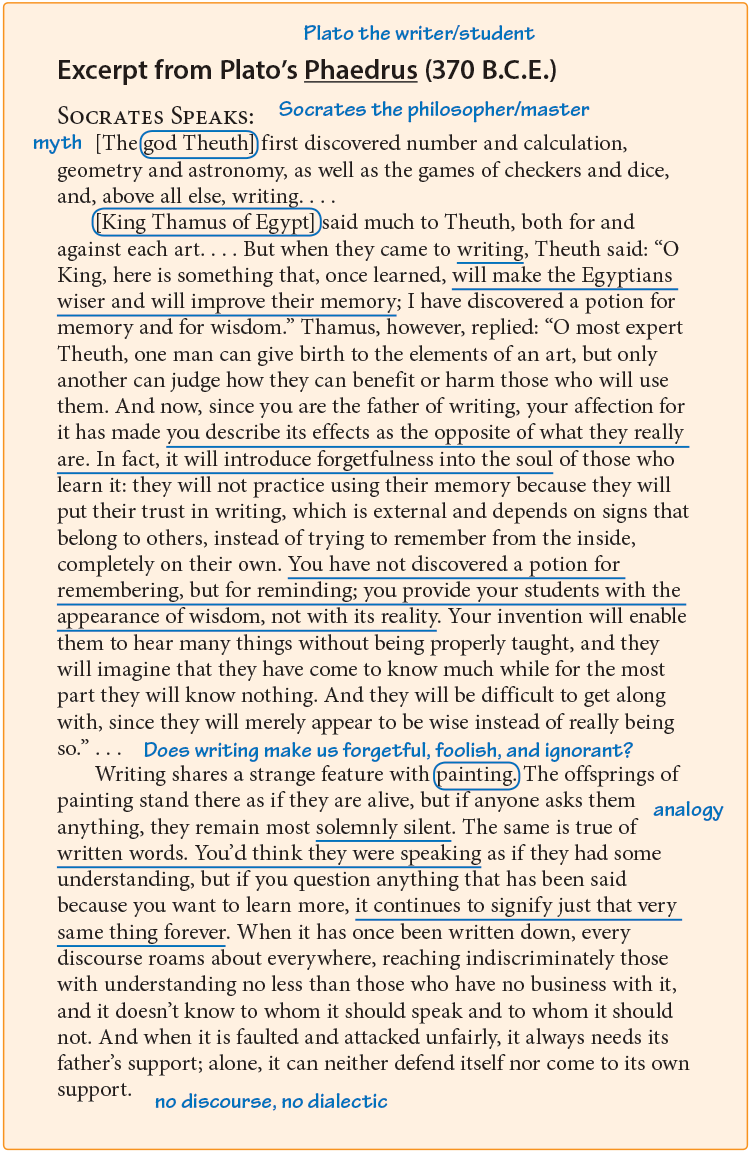
Read the following excerpt from Plato's Phaedrus, a dialogue in which the ancient Greek philosopher Socrates reflects on how writing changes people's thinking. First survey the piece, reading the heading and first sentences and getting a sense of what it is about. As you read, annotate the text, underlining key ideas and jotting down notes and questions. Afterward, answer the 5 W's and H about the reading.

Listen to "Excerpt from Plato's Phaedrus"

Your browser does not support the audio tag.

Hide audio

  • Editing
  • Editing
  1. Who wrote this piece, and who is featured as the narrator of the piece?
  2. What is the excerpt about?
  3. Where and when was this text originally written and read?
  4. Why did the writer create this text? (What was he trying to do?)
  5. How does the writer make his point? What literary devices does he use?
  6. Do you agree or disagree with the excerpt? Why?
By Anonymous (not verified), 12 March, 2026

Prewriting for Research Papers

When something fascinates you, studying it is simple. You naturally train all your attention on it and try to figure it out. Learning is easy because all the doors and windows of your mind are flung wide open. When something bores you, studying it is a chore. You can't stay focused. No one could pay you enough to care.

Since you need to closely study whatever topic you choose for your research paper, you should strive up front to find a topic that fascinates you. The next activity will help you find a strong topic, and the activities afterward will help you launch your research.

Prewriting to Select a Topic

The following "Basics of Life" list includes broad subject areas that are critical to life. You can click on any entry to find more resources about it. You can also apply these general subjects to a specific class in order to find a unique topic. For example, applying "Personality" to the Spanish-American War unit in AP U.S. History would suggest studying the irrepressible Teddy Roosevelt and his Rough Riders.

By Anonymous (not verified), 12 March, 2026

Reading a Research Paper

Before you start work on your own research paper, you should read a paper created by another student. As you read, note how the writer gathers interesting details from a variety of sources, both online and in print. Click on the side notes to study the different parts of the research paper.

Reading a Student Model

This research paper details what scientists know about Sagittarius A*, the supermassive black hole at the center of our galaxy. The overall structure of the paper includes a beginning paragraph, multiple body paragraphs, an ending paragraph, and a works-cited page. The writer uses in-text citations to credit sources.

By Anonymous (not verified), 12 March, 2026

Reading a Problem-Solution Essay

You notice a problem and analyze it. You brainstorm solutions and try one. That's the problem-solving process in a nutshell. It's also the outline of a problem-solution essay: introduce and analyze a problem, propose and explain a solution, and argue why it is the best course of action. Below, you'll see how one student built such an essay.

Reading a Student Model

Read the following problem-solution essay and respond to the reading afterward. In the beginning paragraph, the student grabs the reader's attention and delivers the opinion statement. The first middle paragraphs analyze the problem, and the later middle paragraphs propose, explain, and argue for a specific solution. The ending paragraph sums up the proposed solution and encourages the reader to help enact it. Click on the side notes to study the features of this essay.

By Anonymous (not verified), 12 March, 2026

Reading a College-Entrance Essay

Before you try your hand at writing a college-entrance essay, you should review a sample writing prompt and the essay that one student wrote in response. Note how the student uses the PAST strategy to analyze the prompt and develop an on-target response.

Reading a Student Model

Read the following prompt and the student's PAST analysis.

College-Entrance Writing Prompt

Our school motto is "Preparing the students of today to be the leaders of tomorrow." Leaders come in many forms, large and small. Write an essay that tells what leadership means to you and describes how you have shown leadership in your school and community. Provide specific examples and write about how you will show leadership when you join our campus community.

By Anonymous (not verified), 12 March, 2026

Reading an Argument Essay

To understand how an argument essay works, you can read an example written by another student. He uses logic to build his case, and his voice shows investment in his position but at the same time fairly treats the views of others.

Reading a Student Model

Read the following argument essay and respond to the reading afterward. In the beginning paragraph, the student grabs the reader's attention and delivers the position statement. The middle paragraphs provide strong reasons in support of the position and answer objections from opponents. The ending paragraph sums up the argument and encourages the reader to agree with the position. Click on the side notes to study the features of this essay.

Listen to "Ballot Boxes and Band Aids"

Your browser does not support the audio tag.

Hide audio

By Anonymous (not verified), 12 March, 2026

Reading a Definition Essay

Before you write your own definition essay, you should read and review an essay written by another student. You'll see how the student defines and explores a term using a variety of details. You'll also note how the writer's explanatory voice shows interest in the topic.

Reading a Student Model

Read the following definition essay, in which Julie explores the meaning of the word courage. Note how she catches the reader's attention and introduces the term and then develops paragraphs that explore the meaning and history of the word. Click on the side notes to see the different features of this definition essay.

Caught in the Net “Hello. My name is Kim. I’m an online-aholic.” There. I’ve said it. I guess I’ve been addicted for quite some time now, but I have just begun to realize it. My first interaction with the “Net” began when I was only 15 years old. My dad was the computer coordinator at our school, so he wanted to try Internet access at home before installing it at school. We became America Online members in 1993. None of my friends had email back then. My relationship with email started like a Romeo/Juliet conspiracy.
Internet Plagiarism Not all thieves lurk in dark alleys and parks. Some sit with their faces lit by the glow of their computer monitors, copying, pasting, and printing. It may seem like just another helpful source of information, but the Internet has taken the theft of “intellectual property” to a new level. Part of the problem is that most students don’t really know the exact definition of plagiarism or its consequences.