CCSS.ELA-LITERACY.W.9-10.1.E

By Anonymous (not verified), 12 March, 2026

Assembling Your Narrative Argument

By now you have completed drafts of an argument essay and a narrative. Great work! The two main components of your narrative argument are ready to go. Now comes the fun part—combining both forms into a single paper. Finding the right mix is not an exact science. You'll need to experiment with different arrangements to create your strongest argument. The activities in this lesson will help.

Combining Argument and Narrative

Follow these steps to blend your two separate essays into a narrative argument. As you work through the steps, remember that you can add, cut, rewrite, and rearrange parts of both original pieces as needed.

  1. Make your original argument essay the base of your paper.
  2. Read over both pieces one more time.
  3. Decide what portions of your narrative support your argument.
  4. Experiment with different combinations of narration and argumentation. Here are three common ways to organize a narrative argument:
    • One-After-Another: Start with your full narrative and transition to your full argument or vice versa.
    • Start-and-End: Start with a portion of your narrative, transition to your argument, and then return to your narrative.
    • Back-and-Forth: Start with your narrative or argument and transition back and forth multiple times between both pieces.
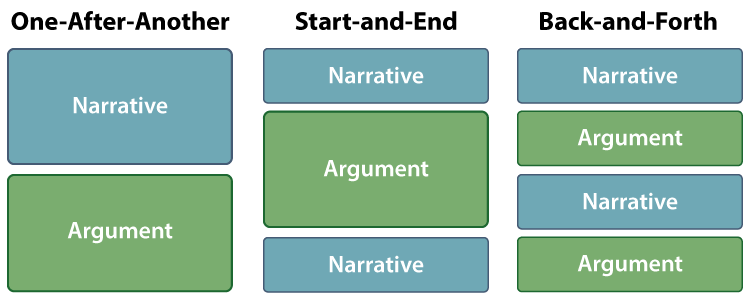
Narrative Argument Organizer

  1. Evaluate the results. Which pattern most effectively strengthens the argument? Which pattern is easiest to follow? Which pattern will most likely get readers to empathize with your position?
  2. Choose a pattern.
  3. Add parts (or all) of your narrative to your argument essay. If you are working in a word-processing program, you can simply copy and paste the parts. Reword sections as needed to improve the flow.

By Anonymous (not verified), 12 March, 2026

Writing an Argument Essay

You've researched controversial topics in your school, community, nation, and world. You've stated a position and explored reasons for and against it. You've even outlined your argument and responded to objections. Now it's time to write your first draft. The following activities will guide you.

Writing the Argument Beginning

The beginning first needs to grab the reader's attention. Then it should introduce your topic and provide background leading up to your position statement. To get started with your beginning paragraph, you can experiment with different lead-writing strategies.

Write a lead sentence.

Write a different lead sentence(s) for each strategy to capture the reader's attention. Use the examples as inspiration.

  1. Ask a provocative question.

    Why is gender such a taboo subject in high school?

  2. Provide a fascinating quotation.

    "True equality means holding everyone accountable in the same way, regardless of race, gender, faith, ethnicity, or political ideology."
    ― Monica Crowley

  3. Provide a surprising fact.

    Did you know more than half of female students in grades 7-12 report experiencing some form of sexual harassment?

  4. Directly address the issue.

    Recently a wave of women's empowerment has swept across the country, but it hasn't seemed to reach high schools.

Write your beginning paragraph.

Start with your lead, and then provide background and develop a paragraph leading to your position statement.

Writing the Middle Paragraphs

Develop a middle paragraph for each reason that supports your position statement. Organize these paragraphs using your outline (for a receptive audience) or follow a pattern for a resistant audience.

By Anonymous (not verified), 12 March, 2026

Revising Résumés and Cover Letters

So you've done the hard part, actually writing the résumé and cover letter. Take a little break if you can. Then come back to them. You want to make sure these two documents do the best job of representing you to a potential employer. Is there some critical piece of information that you forgot to include? Is there some extraneous piece of information that you don't need? In revision, you can make sure your documents have all the "right stuff."

Revising for Key Details

Remember that your cover letter and résumé are really meant for the employer, not for you. You already know who you are. The employer needs to know, so these documents should provide the key details without distraction. You can check for details by reviewing item 3 on the prewriting activity "Take the Employer's Perspective."

3. What kind of employee would make life better for this contact person?

A part-time reporter who can take any assignment, attend an event, interview those involved, take photos, research carefully, check facts, write a news article or feature article, create an effective headline, and digitally submit materials on or before deadline.

What employer needs did you fail to address in your cover letter and résumé? For example, Joyce realized that she forgot to mention that she is a skilled photographer, so she can provide images for her articles. She added a line to the "Skills and Qualifications" section of her résumé.

By Anonymous (not verified), 12 March, 2026

Writing Your Résumé

If you've done your prewriting work, creating a résumé should be fairly straightforward. Simply fill in each section with your information. The activities below will help you use parallel construction and telegraphic style.

Writing with Parallel Structure and Telegraphic Style

All similar elements in your résumé should use parallel structure, which means the same grammatical form. For example, each work experience item should list job title, employer, dates of employment, and duties—in that order, with the same punctuation and treatment for each element. By contrast, lists of skills and qualifications might all be adjectives:

WORK EXPERIENCE

  • Lifeguard—Campground Pool, Summers 2016 to present: Work closely with manager and liaison, guard Olympic-sized pool, . . .
  • Stocker/bagger—Rioldi's Market, Fall-Spring 2017 to present: Work closely with store manager, stock shelves, . . .
By Anonymous (not verified), 12 March, 2026

Writing for Assessment

A writing assessment gives you a short time to write in response to a prompt.

"Imagination is more important than knowledge." —Albert Einstein

How can this quotation be true? As a child, you spent much time immersed in imagination, but now as a high school student, you've spent 13+ years pursuing knowledge. What's the relationship between imagination and knowledge? Write an essay that defines each term and tells how they relate. Explain Einstein's position but then state your own position, supporting it with logic and evidence.

To do so, you should use a shortened form of the writing process:

Prewriting (5 Minutes)

Answer the PAST questions.

Purpose? Define imagination and knowledge, tell how they relate, explain Einstein's position and state and support your own.

Audience? The reader of the test

Subject? Imagination and knowledge

Type? Position/argument essay

Write a focus statement.

Imagination and knowledge are like energy and matter: the knowledge is the solid stuff, and the imagination sets it into motion.

By Anonymous (not verified), 12 March, 2026

Warm-Up for Reading and Writing Assessments

Writing a Personal Narrative
© Thoughtful Learning 2016

Reading is the process of turning 26 letters and a dozen punctuation marks into meaning. Viewed that way, it's almost a form of magic. You decode symbols and transform them into thoughts. But how did those symbols get there in the first place? Writing, of course. Someone had a set of insights and rendered them on the page using just 26 letters and a dozen punctuation marks. The encoding process of writing is just as magical and powerful as the decoding process of reading.

Reading and writing help you learn and think about any subject. They let you succeed in high school, college, and career. Not surprisingly, these skills loom large in all of the key assessments you take now and into the future: the Common Core assessments for high school English, the ACT and SAT, and the AP English assessments. Don't worry. Reading and writing might seem like magic, but you can practice these skills using the specific strategies in this unit. They will help you succeed on assessments and launch into a bright and thoughtful future.

What Is Assessment?

Listen to "What Is Assessment?"

Your browser does not support the audio tag.

Hide audio

The word assess means to "judge the value" of something. It originally meant "sit beside a judge" to determine the value of a piece of property for tax purposes. In its modern sense, an assessment is a test to measure the value of a set of skills, in this case reading and writing. You've been reading and writing from your earliest days in school, and all that work will help you succeed on the coming assessments you will face. You can also hone your skills with the specific strategies in this unit.

In the following activities, you’ll learn about close reading—reading to understand the thesis statement, topic sentences, details, and vocabulary of the nonfiction texts you’re assigned. You’ll also learn about writing for assessment—writing to express your own ideas during a test. Strong reading skills help you write and vice versa.

In this unit, you’ll learn the reading and writing skills that you need to succeed in nonfiction assessment. If you’d like to use these skills on a simulated assessment, see the unit “Practice Test for Reading and Writing.”

Thinking About Close Reading

To read closely, you need to think about the ideas in a text. You can do this by asking and answering questions:

  • Who wrote this text? Who was meant to read it?
  • What is it about?
  • Why did the person write it (to provide information, to argue for a position, to tell a story, to make people laugh or think)?
  • How does the writer communicate the ideas in the text?
  • Where and when did this text originally fit? Where and when does it fit now?
By Anonymous (not verified), 12 March, 2026

Revising Problem-Solution Essays

Okay, you have your first draft. Congratulations! You might feel tempted just to spell-check it and hand it in, but remember that a great first draft is often a lousy final draft. Revision lets you make big improvements to your writing. In this lesson, you'll elaborate your key explanations and arguments, using transitions to connect ideas. You'll also use a peer response and a checklist to improve your work.

By Anonymous (not verified), 12 March, 2026

Writing a Problem-Solution Essay

You've selected a problem, explored your prior knowledge about it, and conducted research to discover additional details. Now it's time to write your problem-solution essay. This two-part essay first analyzes a problem with definitions, examples, causes, and effects. Then it proposes and argues for a specific solution or set of solutions. The following activities will help you write your essay.

Writing the Beginning Paragraph

The beginning first needs to grab the reader's attention. Then it introduces the topic and provides background leading up to your opinion statement. To get started with your beginning paragraph, you can experiment with different lead-writing strategies.

Write a lead sentence.

Write a different lead sentence for each strategy to capture the reader's attention. Use the examples as inspiration.

  1. Present a startling statistic.

    According to the National Institute of Mental Health, 1 in 10 Americans had a mood disorder last year, and 21 percent will experience one during their lifetimes.

  2. Open with an engaging quotation.

    “I try not to worry about the future—so I take each day just one anxiety attack at a time.” 
    ― Tom Wilson, American Cartoonist

  3. Create an interesting scenario.

    Imagine that your life had a movie soundtrack. Now imagine that it was the nerve-racking soundtrack to a suspenseful movie. That's what anxiety and depression feel like.

  4. Focus on causes.

    Adrenaline is great for fight-or-flight situations, when you need to energize muscles and put nerves on high alert. Adrenaline is less great when there's no threat, but you feel jittery and paranoid anyway, all the time.

By Anonymous (not verified), 12 March, 2026

Revising Argument Essays

During a verbal argument, you have to respond in the moment, so you often have regrets afterward: "I wish I had said ________. I wish I hadn't said ________. " In an argument essay, you don't need regrets because you can add whatever you left out and remove whatever you shouldn't have said. That's revising. You can also eliminate any faulty logic and make sure your voice is persuasive. The following activities will help.

Revising to Avoid Logical Fallacies

From the first Greek philosophers to today, thinkers have been on the lookout for specific flaws in reasoning—logical fallacies. These errors crop up constantly in advertising, political debates, and lunchroom discussions. You should learn to recognize the following forms of fuzzy logic in the thinking of others and eliminate them from your own thinking.

Logical Fallacies

Ad Hominem Attack

"Ad hominem" is Latin for "to the person." An ad hominem attack goes after the person making the argument instead of the argument itself. Keep personalities out of the issue and instead focus on the controversial topic.

Fallacy: It's not surprising Jake from Jake's Roadhouse opposes food trucks since Jake is a selfish crook.

Better: It's not surprising restaurant owners oppose food trucks, but they should not be allowed to prevent fair competition.

Appeal to Ignorance

An appeal to ignorance cites a lack of evidence as if it were evidence. Support your argument with actual facts, statistics, examples, and so on.

Fallacy: No one has any idea whether food trucks would cause a problem in Waterford, so we can't outlaw them.

Better: Upper Forks, a city about the size of Waterford, passed a balanced food-truck ordinance, and five years later, their brick-and-mortar restaurants are thriving due to the new foodie culture.

Bandwagon

Long ago, people promoting a specific cause would put a band on a wagon and march through town with it, handing out pamphlets urging people to join the cause. The modern bandwagon fallacy is telling people they should do or believe something because everyone else is. Remember, a mob is often wrong. Instead, use careful logic and truthful examples to show why your position is strong.

Fallacy: All of our neighbor cities allow food trucks, so we should also.

Better: We can study the food truck ordinances and operations in our neighbor cities to learn what works and what doesn't before we create our own law.

Broad Generalization

A broad generalization occurs when one limited case is taken to represent all cases everywhere. Instead, present a complete picture of the situation.

Fallacy: Every student at my lunch table would rather eat from a food truck than have another cafeteria meal, so all of Waterford is crying out for this change.

Better: A recent survey by the Waterford Examiner showed that 73 percent of citizens polled indicated a desire to have food trucks available within the city.

By Anonymous (not verified), 12 March, 2026

Writing an Argument Essay

You've researched controversial topics in your school, community, nation, and world. You've stated a position and explored reasons for and against it. You've even outlined your argument based on whether your audience is receptive or resistant. Now it's time to write your first draft. The following activities will guide you.

Writing the Beginning Paragraph

The beginning first needs to grab the reader's attention. Then it introduces the topic and provides background leading up to your position statement. To get started with your beginning paragraph, you can experiment with different lead-writing strategies.

Write a lead sentence.

Write a different lead sentence for each strategy to capture the reader's attention. Use the examples as inspiration.

  1. Ask a provocative question.

    What if Waterford had more dining options, including exotic foods from Africa, the South Pacific, and the Middle East?

  2. Provide a fascinating quotation.

    “If you are lucky enough to have lived in Paris as a young man, then wherever you go for the rest of your life, it stays with you, for Paris is a moveable feast.” 
    ― Ernest Hemingway, A Moveable Feast

  3. Provide a surprising fact.

    Food trucks have evolved from ice cream and hot dogs to Kobe steaks and calamari.

  4. Directly address the issue.

    Most people would agree that special interest lobbies meant to restrict competition result in unfair laws—except when the topic is "food trucks."

Write your beginning paragraph.

Start with your lead, and then provide background and develop a paragraph leading to your position statement.

Writing the Middle Paragraphs