Narrative Writing

By Anonymous (not verified), 12 March, 2026

Writing a College-Entrance Essay

You've done a lot of reflecting on who you are and who you want to be in the future. You've researched a few schools that can help you achieve that future and have gathered details about your qualifications. It's time to start the application process. Remember that last word: process. You probably won't be able to complete everything all at once. Online applications allow you to log in, save work, and return as you get the pieces pulled together. Fill out what you can, supply your transcripts, and arrange for whatever fees you might have.

Most importantly, take some time analyzing the college-entrance prompt and writing your response. Do your work in a separate document and go through revisions and edits before pasting everything back into the application. The following activities will support you as you draft your response.

Writing to Analyze the Prompt

Before you can write a college-entrance essay, you need to understand what the college wants you to write about and why. Carefully read and analyze the prompt by asking the PAST questions about it:

Write an essay that introduces us to who you are. Tell us about a particular life experience, talent, commitment, or interest you have. Explain how your presence will enrich life on campus.

  • Purpose: Why am I writing? (to introduce myself, telling how I will enrich life on campus)
  • Audience: Who will read my writing? (admissions officers)
  • Subject: What am I writing about? (a particular life experience, talent, commitment, or interest I have)
  • Type: What form should my writing take? (an essay)
Analyze the college-entrance prompt.

Copy the college-entrance prompt. Then write answers to each of the PAST questions.

College-entrance prompt:

  • Purpose: Why am I writing?
  • Audience: Who will read my writing?
  • Subject: What am I writing about?
  • Type: What form should my writing take?

By Anonymous (not verified), 12 March, 2026

Prewriting for College-Entrance Essays

Thinking about your next step after high school can be overwhelming. You may suffer "paralysis by analysis"—too many options and too little direction. You can find some direction by thinking about yourself—strengths, experiences, hopes, and dreams.

By Anonymous (not verified), 12 March, 2026

Reading a College-Entrance Essay

Before you try your hand at writing a college-entrance essay, you should review a sample writing prompt and the essay that one student wrote in response. Note how the student uses the PAST strategy to analyze the prompt and develop an on-target response.

Reading a Student Model

Read the following prompt and the student's PAST analysis.

College-Entrance Writing Prompt

Our school motto is "Preparing the students of today to be the leaders of tomorrow." Leaders come in many forms, large and small. Write an essay that tells what leadership means to you and describes how you have shown leadership in your school and community. Provide specific examples and write about how you will show leadership when you join our campus community.

By Anonymous (not verified), 12 March, 2026

Warm-Up for College-Entrance Writing

Heading from high school to an even higher education can be a daunting prospect. You'll go from being the oldest and most experienced student to the youngest and least experienced. You'll also need to find the right school to help you achieve your goals. Finding that school—and making sure that school finds you—is a process.

One key part of the process is the college application. You'll provide all kinds of information about yourself, including your high school transcripts, standardized test scores, letters of recommendation, and intended field of study. On most applications, you'll be asked to write one or more essays focusing on some aspect of your life or education and how it relates to your goals. Providing an on-target response begins with understanding the college-entrance prompt.

What Is a College-Entrance Prompt?

Listen to "What Is a College Entrance Writing Prompt?"

Your browser does not support the audio tag.

Hide audio

Writing Literary Analysis
© Thoughtful Learning 2018

A college-entrance prompt is a brief set of instructions telling you what to write about on a college application. To analyze a prompt, you can use the PAST questions:

  • Purpose: Why am I writing? (to explain, to define, to narrate, to show?)
  • Audience: Who will read this? (admissions officers, fellow freshmen, college community?)
  • Subject: What am I writing about? (leadership, community service, education, vision?)
  • Type: What form should my writing take? (personal essay, biographical essay, reflection?)
In this unit, you'll learn to use the PAST mnemonic to analyze any college-entrance prompt or any other writing assignment you receive. First, though, you should warm up your thinking by reflecting on your goals after high school.

Thinking About the Past and Future

Before you start applying to schools, you should think about your past and future. A reflection chart can help you track how you are changing over time.

By Anonymous (not verified), 12 March, 2026

Editing Personal Essays

After you have made major improvements during the revision stage, you need to return to your text to polish it. Errors in punctuation, capitalization, spelling, usage, and grammar can distract readers from the events you are trying to present. They also, of course, are embarrassing. The activities on this page will help you.

Editing Dialogue

One key component of an effective narrative is dialogue—the words people say. Handling dialogue can be tricky.

When two or more people are having a conversation, start a new paragraph whenever you have a new speaker:

"How about the library?" he asked one day, rightly seeing that I was bored.

"Why not?"

On the drive there, Grandpa said, "You see that woman on the corner with the baby?"

I glanced out the window. "Yep."

"She's actually a spy. That baby is a walkie-talkie. She's sending in my coordinates. Better turn here to throw her off the track."

Note that a comma separates words like said or asked from the quoted material. A period separates a complete sentence from quoted material.

When one person speaks, or the spoken words are details included in a larger idea, you can embed them in the paragraph.

He'd ridden the wave from the early days to the eventual fold-up and collapse. "We're fine, buddy," he told me. Between a high former salary and severance, we had money enough to find something new. . . .

Place quotation marks before and after quoted material. When periods or commas follow quoted material, always put them inside the close quotation marks. When exclamation points or question marks follow quoted material, place them inside if they punctuate the quotation and outside if they punctuate the whole sentence. Note the correct punctuation in the following dialogue.

"Box it or toss it," Dad said, dragging the shrieking tape gun over yet another box. "We're going to have to ship everything to storage while I look for a place. You'll stay with Grandpa till then."

"Grandpa," I echoed. I didn't know much about him. He was on Facebook, but not Snapchat, so we were not in each others' worlds. He lived in Ohio, but not in Columbus—in a little city called Marion. "How long?"

"However long it takes," Dad replied, flashing an apologetic smile.

What did he mean, "However long it takes"?

Check dialogue.

In the dialogue below, place punctuation where needed. Afterward, check the dialogue in your personal essay to make sure punctuation and paragraphing are correct.

By Anonymous (not verified), 12 March, 2026

Revising Personal Essays

After completing a first draft of your personal essay, you should set it aside for a time if you can. Just as you can more easily understand a long period of time by reflecting on it afterward, you can better understand your writing when you get some distance. Then return to revise with fresh eyes.

Revising for Pace

You can't go into great depth about everything that happened over a few months' time. The essay would turn into an endless novel. Imagine Jake's journey across the Great Plains if he reported every excruciating detail.

Too Much Detail

. . . We pass mile marker 193 in Kansas. The road goes on without a bend as far as the eye can see. Only the heat coming off makes it waver. On both sides, corn stretches to the horizon. A farm clusters to the left. An exit leads to a county road. We stay on the Interstate. We pass mile marker 194. . .

Appropriate Detail

. . . then the even longer plains. It was as if the world was saying, "You really want to keep going? There's pretty much nothing that direction." Finally, we left the brown lands and got where things were greening up. Flat gave way to hills, and they to the mighty Mississippi. . .

On the other hand, you can't tell an effective story if you just gloss over everything. Imagine Jake's whole personal essay rendered that way.

Too Little Detail

After Dad lost his job in San Francisco, I lived with Grandpa in Marion, Ohio, until we could find a place to rent just outside of Columbus.

You need to dive into deep detail in an important moment and then provide a quick summary of other action before diving into detail again. Focus on significant events. The trip to the library, the trip to Goodwill—these changed the writer, while mile marker 193 in Kansas did not.

Review your pacing.

Reread your personal essay. If an important event gets glossed over, add details that bring it alive for readers, slowing down the pace so they can experience it firsthand. If an unimportant event drags on, delete some details, or replace the passage with a single summary sentence. Continue working until all parts have effective pacing.

By Anonymous (not verified), 12 March, 2026

Writing a Personal Essay

After listing events on a time line and gathering different details about them, you are ready to write your personal essay. But a personal essay is more than a chronological list of events. It is a true-life story with you as the hero, so you need to build it like a story. The activities on this page will help.

Writing the Beginning

The beginning of your essay has a number of jobs:

  • Catch the reader's attention
  • Introduce the character (yourself)
  • Describe the setting (time and place)
  • Create conflict

You can click on the side notes of this excerpt to see how the sample student essay does all of these things in a compact space:

Catch Attention Winter wouldn't let go. Tired gray snow clung to the curbs. Tired gray clouds clung to the sky. The lion of March still prowled, growling its storms and hissing its sleet, and Introduce Character I wondered why Mom ever chose to move to Wisconsin.

Create Conflict A job. I got it. A break-up. Yeah. Life happened. She started over, and so did I. Again.

Describe Setting This time, I changed schools mid-semester, which meant I lost half my credits and had to play catch-up in every class. I knew nobody and didn't have any real desire to make friends. How long would we be here? I trudged to school and trudged home and sat in that gray apartment flipping through Snapchats to see the full-color lives of my friends back in Florida.

"I'm taking a second job," Mom told me one night. "So I won't be home most evenings."

This excerpt catches the reader's attention by creating an intriguing mood. You can experiment with other opening strategies.

Write the beginning.

Experiment with strategies for capturing the reader's interest. Use the examples below for inspiration. Then develop a beginning that introduces you, describes the setting, and creates conflict.

  1. Start in the middle of the action.

    A lump in my throat, I grabbed a script and took the stage in front of a theater filled with strangers. Old strangers. How did I wind up here?

  2. Use interesting dialogue.

    "If you get cast in this show, you're going to have to swear. Onstage. Loudly."

  3. Pose a fascinating question.

    Do caterpillars know what they are doing when they entomb themselves in a chrysalis, or do they just figure they've finally gone crazy? I felt slightly crazy when I buried myself in two months of rehearsals for On Golden Pond.

  4. Make a startling statement.

    Sometimes guts are smarter than brains.

By Anonymous (not verified), 12 March, 2026

Prewriting for Personal Essays

The word recall means exactly what it says: "call a memory back into mind." The word recollect is much the same: "collect memories again." Even the word remember means "put the parts back together again." So, the first part of the process of writing a personal essay is calling back and collecting and reassembling the many memories you have of key periods in your life. You'll start by selecting a specific period to explore.

By Anonymous (not verified), 12 March, 2026

Reading a Personal Essay

You've probably written many personal narratives over the course of your schooling, but this may be your first personal essay. Instead of focusing on one brief event in your life, you will focus on a series of events over a longer period. As a result, you'll need to be selective about what events you report, and you'll need to tie them together so that they create a clear narrative arc. You can get a sense of how to do so by reading another student's personal essay.

Reading a Student Model

Read the following personal essay, in which Carson reflects on a winter of discontent and the surprising creative outlet that he discovered. Note how he zooms in to specific events with description and dialogue before zooming out with transition sentences to show the progress of time. Click on the side notes to see the different features of this personal essay.

Teaching Tip

This is a long personal essay, and some less-experienced students might feel daunted by it. They are often worried about what the page count or word count should be for their own writing. Put them at ease. The length of the narrative doesn't matter, only that it tells a compelling story about a significant period that changed who they are. Tell students to take as much—or as little—space as they need to tell their stories. Also encourage them to dig in to the events, showing readers just what this time period meant to them.

By Anonymous (not verified), 12 March, 2026

Warm-Up for Personal Essays

What is your very first memory? Was it splashing in a bathtub with little plastic boats, or sharing a cookie with the kid who lived next door, or seeing a reindeer in a holiday parade? People say that your very first memory says a lot about who you are. Why? Because the experience meant something to you at the time and still means something to you now—since you've held onto it all these years.

In fact, the reason we can't remember our earliest years is that we hadn't yet begun to develop what psychologists call autobiographical memory. You probably learned to walk when you were very young but have no memory of it. That's because you didn't start to fashion a mental narrative of your life until you were about three years old. At that point, you started remembering experiences because they helped to explain who you are. Your very sense of self is tied to the memories you have and the stories you tell about them.

You can explore an especially important period in your life by writing a personal essay.

What Is a Personal Essay?

Listen to "What Is a Personal Essay?"

Your browser does not support the audio tag.

Hide audio

Writing Literary Analysis
© Thoughtful Learning 2018

A personal essay is a narrative about an important time in your life, showing how it shaped who you are. Instead of focusing on just one event, a personal essay relates a number of events over an extended time frame, weaving them together into a "story of you." It won't be enough just to put details in chronological order—first this happened . . . then that happened . . . and afterward this other thing. . . . Instead, you need to show the significance of each event and build them into a narrative arc. You'll learn how in the coming lessons. First, though, you can warm up by imagining you have a time machine.

Thinking About Your Past

In the book Harry Potter and the Prisoner of Azkaban, chronic overachiever Hermione Granger uses a "time-turner" to jump back in time and attend a second class while her first self was busy studying in a different class. Now imagine that you have your own time-turner—but you won't be using it to attend classes.

Also, your time-turner works a bit differently. It takes you back to relive three months of your life. You don't watch yourself from the outside. You experience everything again, only this time with your memories of the future riding along. What time period would you choose? Why?

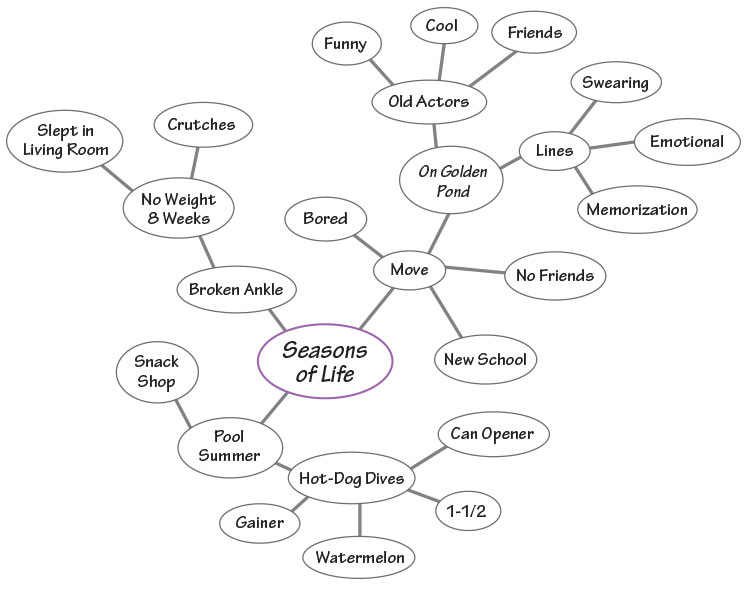
You can use a cluster to explore possible times. Think of "seasons of your life" (approximately three months) and write down at least three such time periods. Then explore each season by adding images, thoughts, actions, and sensations. Use this student cluster as inspiration:

Cluster Diagram