Editing Personal Essays
After you have made major improvements during the revision stage, you need to return to your text to polish it. Errors in punctuation, capitalization, spelling, usage, and grammar can distract readers from the events you are trying to present. They also, of course, are embarrassing. The activities on this page will help you.
Editing Dialogue
One key component of an effective narrative is dialogue—the words people say. Handling dialogue can be tricky.
When two or more people are having a conversation, start a new paragraph whenever you have a new speaker:
"How about the library?" he asked one day, rightly seeing that I was bored.
"Why not?"
On the drive there, Grandpa said, "You see that woman on the corner with the baby?"
I glanced out the window. "Yep."
"She's actually a spy. That baby is a walkie-talkie. She's sending in my coordinates. Better turn here to throw her off the track."
Note that a comma separates words like said or asked from the quoted material. A period separates a complete sentence from quoted material.
When one person speaks, or the spoken words are details included in a larger idea, you can embed them in the paragraph.
He'd ridden the wave from the early days to the eventual fold-up and collapse. "We're fine, buddy," he told me. Between a high former salary and severance, we had money enough to find something new. . . .
Place quotation marks before and after quoted material. When periods or commas follow quoted material, always put them inside the close quotation marks. When exclamation points or question marks follow quoted material, place them inside if they punctuate the quotation and outside if they punctuate the whole sentence. Note the correct punctuation in the following dialogue.
"Box it or toss it," Dad said, dragging the shrieking tape gun over yet another box. "We're going to have to ship everything to storage while I look for a place. You'll stay with Grandpa till then."
"Grandpa," I echoed. I didn't know much about him. He was on Facebook, but not Snapchat, so we were not in each others' worlds. He lived in Ohio, but not in Columbus—in a little city called Marion. "How long?"
"However long it takes," Dad replied, flashing an apologetic smile.
What did he mean, "However long it takes"?
Check dialogue.
In the dialogue below, place punctuation where needed. Afterward, check the dialogue in your personal essay to make sure punctuation and paragraphing are correct.
-
One night on the front porch, I asked, " Where would you travel if you could go anywhere?"
-
"I've always wanted to see the Great Pyramid of Khufu," responded Grandpa. "Where would you go?"
-
I thought for a moment. " I'd like to see Stonehenge. It was actually built before the pyramids."
-
"Did you know," he said conspiratorially, " that these rocking lawn chairs are actually time-and-space machines?"
-
"How do they work?"
-
"Think of where and when you want to go," Grandpa responded. " Picture it in your mind. Then rock exactly once per second. Synchronize your heart. Then you will land wherever you imagine."
-
"Let's go to the same place!"
-
"Stonehenge or the pyramids?"
-
Hadn't Grandpa said, " I've always wanted to see the Great Pyramid of Khufu"?
-
"Let's go to the pyramids," I replied. " Here we come, Khufu!"
Editing for Verb Tense
Just as you control time, moving backward and forward as you need to in your narrative, you also need to control your verb tense. It's okay to shift tense when you shift time, but the tense shifts need to be intentional and consistent. Make sure everything that needs to be in a certain tense is in that tense. Watch for these tenses when you edit your personal essay.
- Past tense works for most of your essay: "It all began six months earlier in San Francisco when Dad got laid off from his tech startup."
- Past perfect tense (using had) tells that something occurred before the time you are talking about: "He'd ridden the wave from the early days to the eventual fold-up and collapse."
- Present tense indicates actions taking place now or that are always the case: "You never know how much stuff you have until you have to box it all up."
- Future tense (using will) tells what might happen in the future: "I will never forget our adventures as super spies."
- Modal verbs (such as would, should, could) tell what happened regularly or what could happen: "Instead of taking a picture of Lombard Street in Frisco and the arrow-straight sidewalks in Marion, I should have taken before-and-after selfies. Those photos couldn't have been any more different, either."
Teaching Tip
Students who speak English as a second language would have an easier time with checking tenses if you provide them a list of irregular verbs in present, past, and past participle forms. A quick Internet search will provide a variety of options.
Check your verb tenses.
Reread your personal essay, watching for verb tenses. Make sure most verbs are consistently in simple past tense. When the verb tense shifts, make sure it does so intentionally and remains consistent.
Editing in Action
After you check your dialogue and verb tenses, you should also make sure your personal essay has correct punctuation, capitalization, spelling, usage, and grammar. Keep editing until your essay is error free.
-
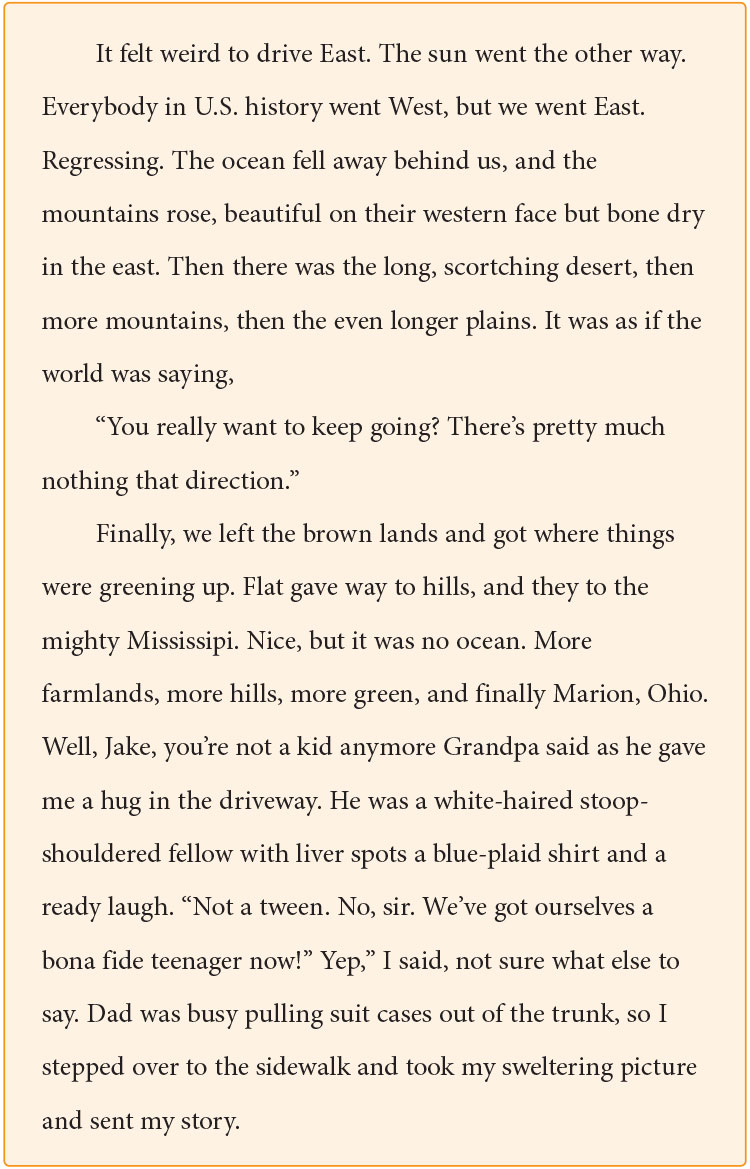
Text Before Edits
-
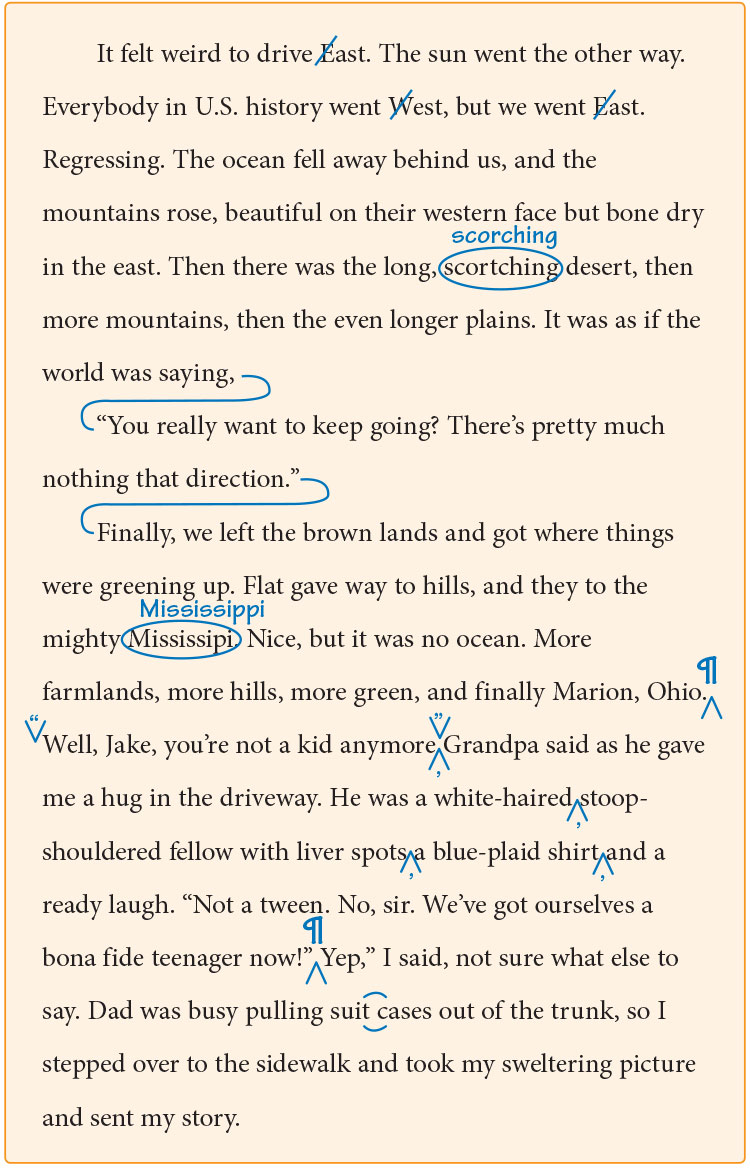
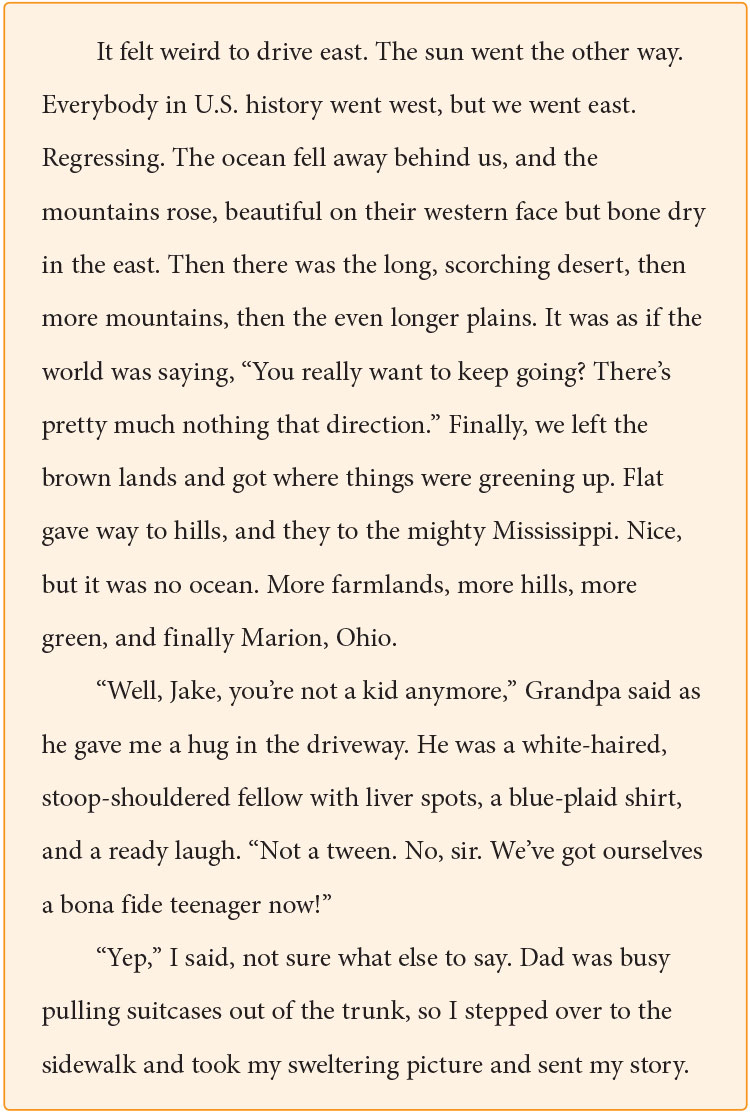
Punctuation and paragraphing of dialogue is corrected, along with errors in capitalization and spelling.
-
Text After Edits
Edit with a checklist.
Use the following checklist to edit your personal essay. When you can answer a question with a yes, check it off. Continue editing until each line is checked.
Sentences
- Do sentences read smoothly throughout the essay?
- Are sentences correct, without run-ons, comma splices, or fragments?
Punctuation
- Do periods and commas after quoted material appear inside the end quotations marks?
- Do question marks and exclamation points after quoted material appear inside the end quotation marks if they belong to the quotation?
- Do commas follow introductory clauses and longer introductory phrases (four words or more)?
Mechanics
- Are proper nouns and the first words in sentences capitalized?
- Are specific names of people, cities, states, and institutions as well as other proper nouns capitalized?
- Have I checked spellings of the names of all people, places, and so on?
- Have I checked spelling using a dictionary or spell checker?
Grammar
- Do subjects and verbs agree in number?
- Do pronouns and antecedents agree in number, person, and gender?
Usage
- Have I chosen words with effective connotations?
- Are commonly confused words used correctly (your/you’re, their/they’re, its/it’s)?
Publishing Your Personal Essay
"Publishing" really means just "making public"—sharing your writing with the people around you. Since this essay explains how an important period shaped who you are, sharing can help you connect with the people in your life. You'll want to make sure your essay is in the best possible shape!
Publishing the Final Copy
Create a clean final copy.
Once you have completed all of your revisions and edits, print a clean final copy of your personal essay. Share it with your teacher, classmates, and family members.
Reflecting on Your Writing
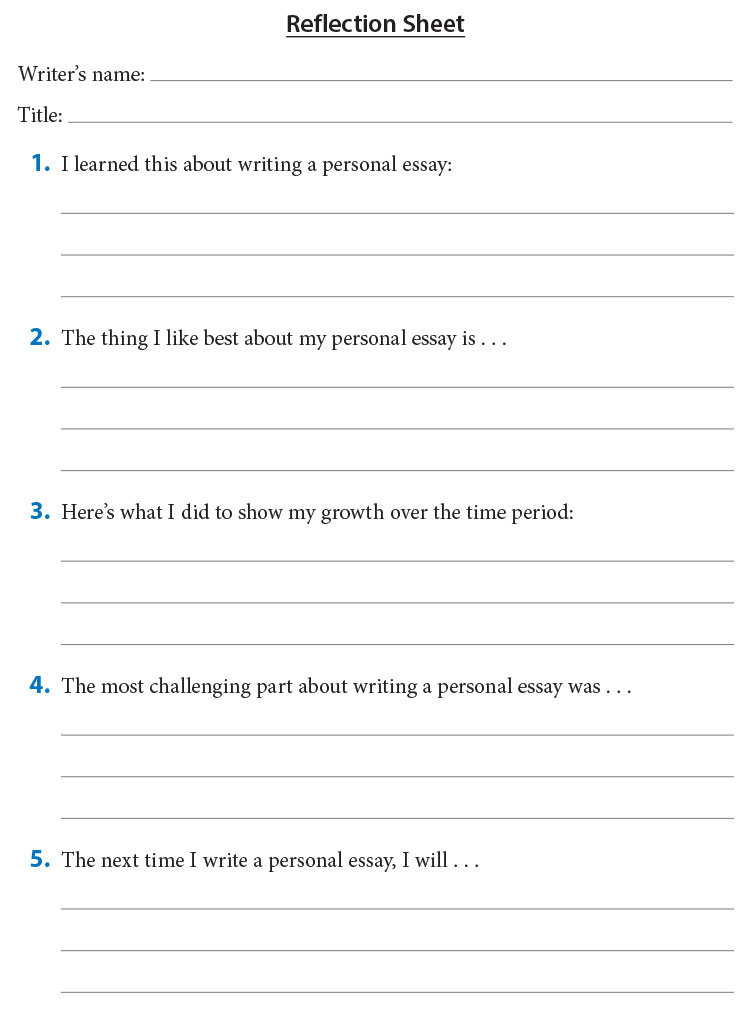
Reflect on your writing.
Complete the following sheet to reflect on writing a personal essay.