CCSS.ELA-LITERACY.L.9-10.3

By Anonymous (not verified), 12 March, 2026

Answering Multiple-Choice Questions Nonfiction Assessment VI

The PARCC and Smarter Balanced assessments and other tests of the Common Core English standards use multiple-choice questions to check your ability to revise and edit texts. The SAT and ACT also include these sorts of questions.

The following multiple choice questions test your understanding of conventions: punctuation, spelling, grammar, and sentences. Then you will find a reading and a set of questions to test your paragraph-revision skills.

Respond to questions about conventions.

Carefully read each question and possible response before selecting your answer. If the underlined section is already correct, select NO CHANGE.

By Anonymous (not verified), 12 March, 2026

Editing Literary Research Papers

Once you complete major improvements to your research paper, you can focus on every word, letter, and punctuation mark. Editing helps you correct errors in punctuation, mechanics, spelling, grammar, and usage. You'll also want to make sure that you have correctly used Modern Language Association (MLA) style. The following activities will help you.

Editing In-Text Citations for MLA Style

Whenever you use ideas or direct quotations from others, you need to credit the source. You do so to show who originated an idea, to avoid plagiarism, and to allow readers to explore the same materials in their own research.

All credits begin with an in-text citation that names the source and page number (if there is one) and refers to a complete entry on the works-cited page. The simplest citation names the title and author in the text and provides the page number in parentheses after the borrowed material, before the period.

In "On Faerie Stories," Tolkien argues that Alice's Adventures in Wonderland and Through the Looking Glass are not actually fantasy because they are framed by a dream. Everything in Wonderland is unreal, and the reader knows that it is. Also, Gulliver's Travels is not fantasy because the tiny people and giants Gulliver encounters are in the Primary World, simply removed by distance (5).

By Anonymous (not verified), 12 March, 2026

Editing Narrative Arguments

After you complete major revisions to your narrative argument, you should edit it to make sure every word and punctuation mark is correct. Among other issues, you'll want to look closely at pronoun agreement and punctuation of dialogue. The activities that follow will help. You'll also use a checklist to finalize your editing.

Editing for Pronoun Agreement

A pronoun is a word that stands in the place of a noun or another pronoun (its antecedent). The most familiar pronouns are I, me, my; we, us, our, ours; you, your, yours; he, she, it, they, their, theirs. A pronoun needs to agree with its antecedent. That means both need to have the same person (first, second, or third), the same number (singular or plural), and the same gender (masculine, feminine, neuter, or indeterminate).

Agreement

Merida drove her car. (Merida and her are both third person, singular, and feminine: they agree.)

I rode my bike. (I and my are both first person, singular, and indeterminate.)

Other friends relied on ride-share apps using their phones. (Other friends and their are both third-person, plural, and indeterminate.)

By Anonymous (not verified), 12 March, 2026

Editing Comparison-Contrast Essays

After making the large-scale improvements of revision, you can focus on specific words and punctuation marks. The following activities will help you correctly use comparative and superlative modifiers and punctuate compound sentences. You'll also find a checklist to help you catch any errors in punctuation, capitalization, spelling, usage, and grammar.

Editing Comparatives and Superlatives

Modifiers have special forms that help you compare topics. A comparative adjective can show which of two topics is bigger, faster, less messy, or more cost-effective. A superlative adjective can show which of three or more topics is biggest, fastest, least messy, or most cost-effective. Add er to most one-syllable words to make the comparative form, and add est to make the superlative form.

Most One-Syllable Adjectives

Positive

deep

old

strange

Comparative

deeper

older

stranger

Superlative

deepest

oldest

strangest

For most adjectives of two syllables or more, add more or less for comparative forms and most or least for superlative forms. (Note that some two-syllable adjectives can still take er and est.)

By Anonymous (not verified), 12 March, 2026

Editing Résumés and Cover Letters

Often, a potential employer will "meet" your cover letter and résumé before actually meeting you. They are your first interview. Just as you wouldn't show up for a face-to-face interview with your hair a mess and a mustard stain on your shirt, you don't want to send out documents with errors. These activities will help you catch the most common (and costly) errors before employers can.

Editing to Check Facts

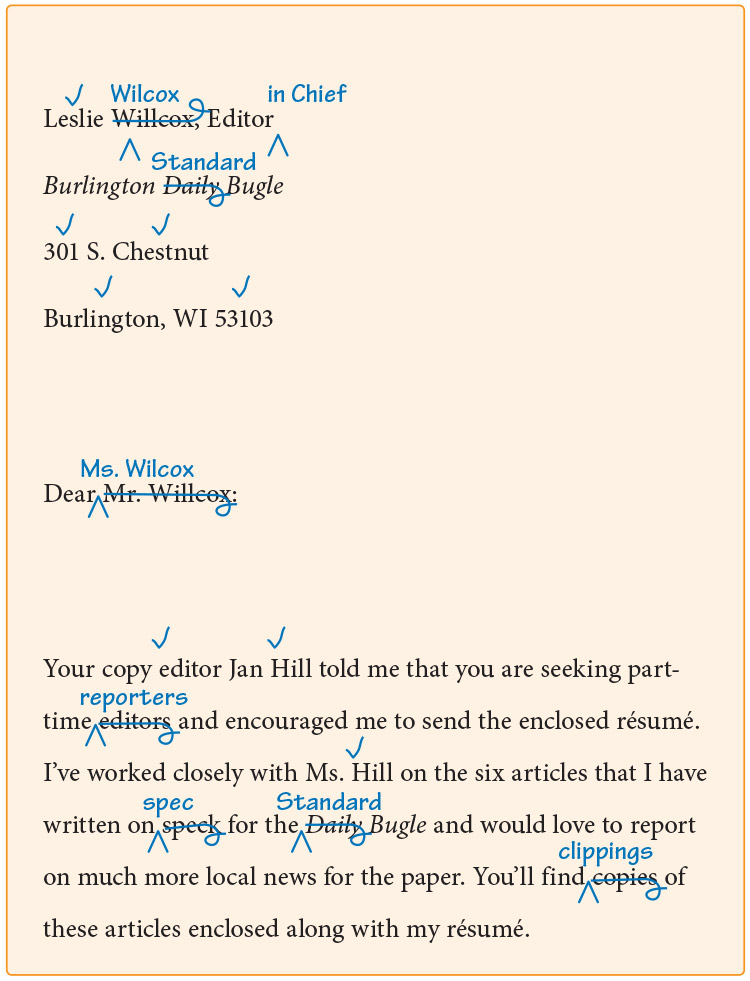
The quickest way to get rejected is to misspell the name of the reader, or botch the person's title, or mangle the company name. If you need to write to Ms. Leslie Wilcox, Editor in Chief of the Burlington Standard Bugle, but you instead write to Mr. Leslie Willcox, Editor of the Burlington Daily Bugle, you probably won't even get a reply, let alone a chance to interview.

You must fact-check every name, title, business, department, street address, email address, telephone number, job title, and job-specific term in your résumé and cover letter. Look up each one on the Internet, preferably using the employer's own Web site. Check off any detail you have fact-checked, and correct any that were incorrect.

Fact Check
By Anonymous (not verified), 12 March, 2026

Answering Multiple-Choice Questions

High-stakes assessments often include multiple-choice questions, which can be graded by machine. Questions may ask about thesis and support, inference and argument, definition and connotation, punctuation and usage, or anything in between. Follow these guidelines to score your best on multiple-choice questions:

  • Read questions first. Then you know what to watch for.
  • Note question order. Often the first question asks about the first line. Usually questions follow the order of the passage.
  • Treat each passage separately. You usually answer a bank of multiple-choice questions for each passage before being prompted to write about a set of passages together.
  • Be patient with short passages. They may take as long or longer to analyze than long passages.
  • Pay attention to footnotes. If there is a footnote, often there will be a question about it.
  • Analyze ideas and organization. Questions often focus on specific ideas and how they contribute to the whole passage. Think of what each idea accomplishes—summing, supporting, contrasting, questioning, and so on.
  • Analyze voice. Questions may ask about the writer's tone (feeling about the topic) or formality (relationship with the audience).
  • Analyze word choice and sentence fluency. Questions may focus on the writer's sentence style or on figures of speech.
  • Answer easy questions first. Eliminate obviously wrong answers.

Answering Multiple-Choice Questions About a Text

Often, high-stakes assessments will present you with a text, asking you to read it and analyze it by responding to multiple-choice questions.

Respond to questions about an article.

Carefully read the excerpt and then answer the questions that follow.

By Anonymous (not verified), 12 March, 2026

Editing Research Papers

You're almost there! You've conducted research, drafted your paper, and made major improvements. Now you're ready for editing, focusing on every word, letter, and punctuation mark. You can start by making sure you have correctly used Modern Language Association (MLA) style. You'll also want to correct errors in punctuation, mechanics, spelling, grammar, and usage. The following activities will help you.

By Anonymous (not verified), 12 March, 2026

Editing Character Analyses

After revising your character analysis, you should edit it for style and correctness. Now is the time to carefully review sentences, punctuation, capitalization, spelling, usage, and grammar. Use the following activities to edit your analysis.

Editing to Combine and Punctuate Sentences

When you combine sentences to create better flow, you need to make sure the sentences still have correct punctuation. You can join two sentences (independent clauses) together, but you need to use both a comma and a coordinating conjunction (and, but, or, nor, for, so, yet). You can also use just a semicolon.

Simple Sentences

Gatsby can’t change the past. Tom can’t make Daisy love him again.

Compound Sentences

Gatsby can’t change the past, and Tom can’t make Daisy love him again.

Gatsby can’t change the past; Tom can’t make Daisy love him again.

Leaving out the coordinating conjunction creates an error called a comma splice. Leaving out both the comma and the conjunction creates an error called a run-on sentence.

You can also combine two sentences using a subordinating conjunction (although, because, when, since, after, etc.). When the conjunction starts the sentence, place a comma after the clause. When the conjunction comes in the middle of the sentence, you usually don't need to set off the clause with a comma.

Simple Sentences

Myrtle is killed. Wilson loses everything else in his life.

Complex Sentences

After Myrtle is killed, Wilson loses everything else in his life.

Wilson loses everything else in his life after Myrtle is killed.
By Anonymous (not verified), 12 March, 2026

Editing College-Entrance Essays

If you were interviewing with a college-entrance officer, you wouldn't want your clothes to be rumpled and stained, your hair to be standing on end, and a bit of something to be hanging between your teeth. No, you'd use a mirror, a brush, a toothbrush, an iron—whatever it takes to make a good impression. In the same way, you want your college-entrance essay to be free of distracting and embarrassing errors before you submit it. These activities will help.

Editing to Fix Sentence Shifts

For the most part, you should stick to a specific tense (past or present) and a specific person (first or third) in your essay. Unnecessary shifts can be distracting or even confusing:

Shifting Tense and Person

Now, I had a choice. I can quit and rappel to the rocks below or keep climbing and reach the top. My friend Big Jake, who'd caught me in my trust fall on Day One, is at the bottom of the cliff as my anchor. Karl and Josiah were climbing next to me. Counselor Jones waits at the summit. The climber looked for handholds and footholds in stone, pauses to set a carabiner and thread a safety line, grabs a shoulder of rock, and pulls himself higher. Then I squeezed the brake and sat in the harness, trusting Big Jake with my weight while Karl and Josiah rose beside me. The three climbers nod. No reason to talk. All of them had plenty of work ahead. With muscle and grit and courage, we head to the top.

Consistent Tense and Person

Now, I had a choice. I could quit and rappel to the rocks below, or I could keep climbing and reach the top. My friend Big Jake, who'd caught me in my trust fall on Day One, was at the bottom of the cliff as my anchor. Karl and Josiah were climbing next to me. Counselor Jones waited at the summit. I looked for handholds and footholds in stone, paused to set a carabiner and thread a safety line, grabbed a shoulder of rock, and pulled myself higher. Then I squeezed the brake and sat in the harness, trusting Big Jake with my weight while Karl and Josiah rose beside me. We nodded. No reason to talk. All of us had plenty of work ahead. With muscle and grit and courage, we would get to the top.

By Anonymous (not verified), 12 March, 2026

Editing Literary Analyses

After revising your literary analysis, you should edit it for style and correctness. Now is the time to carefully review sentences, punctuation, capitalization, spelling, usage, and grammar. Use the following activities to edit your analysis.

Editing for Subject-Verb Agreement

When you write using the literary present tense, you need to make sure that subjects and verbs agree in number (singular or plural). Note these other tips for ensuring subject-verb agreement.

A singular subject needs a singular verb, and a plural subject needs a plural verb.

The warren sits high atop a dry hill.

The rabbits sit in the grass and graze.

Two or more subjects joined by and are always plural.

Hazel and Fiver see Watership Down in the distance.

When two or more subjects are joined by or or nor, the verb should agree with the last subject.

Neither the other rabbits nor Hazel understands Fiver's fear of Cowslip's warren.

Collective nouns treated as one thing are singular; those treated as a group of individuals are plural.

The Owsla prepares for battle.

The Owsla sharpen their claws.

When words come between the subject and verb, make sure to match the true subject.

A band of rabbits has many enemies.