Editing Character Analyses
After revising your character analysis, you should edit it for style and correctness. Now is the time to carefully review sentences, punctuation, capitalization, spelling, usage, and grammar. Use the following activities to edit your analysis.
Editing to Combine and Punctuate Sentences
When you combine sentences to create better flow, you need to make sure the sentences still have correct punctuation. You can join two sentences (independent clauses) together, but you need to use both a comma and a coordinating conjunction (and, but, or, nor, for, so, yet). You can also use just a semicolon.
Simple Sentences
Gatsby can’t change the past. Tom can’t make Daisy love him again.
Compound Sentences
Gatsby can’t change the past, and Tom can’t make Daisy love him again.
Gatsby can’t change the past; Tom can’t make Daisy love him again.
Leaving out the coordinating conjunction creates an error called a comma splice. Leaving out both the comma and the conjunction creates an error called a run-on sentence.
You can also combine two sentences using a subordinating conjunction (although, because, when, since, after, etc.). When the conjunction starts the sentence, place a comma after the clause. When the conjunction comes in the middle of the sentence, you usually don't need to set off the clause with a comma.
Simple Sentences
Myrtle is killed. Wilson loses everything else in his life.
Complex Sentences
After Myrtle is killed, Wilson loses everything else in his life.
Wilson loses everything else in his life after Myrtle is killed.
Combine and punctuate sentences.
Combine each set of sentences using a coordinating conjunction (and, but, or, nor, for, so, yet) or a subordinating conjunction (after, although, as, as if, as long as, as though, because, before, if, in order that, provided that, since, so that, that, though, till, unless, until, when, where, whereas, while). Correctly use commas as you combine.
-
Absalom confesses to these transgressions. He bears the penalty for them.
-
Absalom is simultaneously murderer and murdered. His story portrays the complex predicament of all South Africans.
-
He begins his life lost and fearful. He ends it in resolution and love.
-
He faces execution for his crimes. He marries her, making his son legitimate.
-
Absalom cannot escape his doom. His son can.
-
Absalom and his father suffer terrible loss. The next generation provides hope for the future.
-
Arthur is a white man slain by a black man. He had spent his life advocating for black South Africans.
-
James is the bereaved father. He befriends the father of his son’s killer.
-
The sun rises the next morning. The village still lies in deep shadow.
-
Absalom creates this unity between Stephen and James. They represent the hope of healing for South Africa.
Editing for Sentence Variety
When sentences all have the same style, they become boring. You should vary sentence style to suit the ideas you are expressing:
Vary Sentence Lengths
- Use medium-length sentences to express most ideas.
- Combine short sentences into longer constructions to convey complex ideas.
- Punctuate ideas with short sentences.
Vary Sentence Beginnings
- Start most sentences with the subject.
- Use an introductory phrase or clause to express more complex ideas or to link to previous ideas.
Edit to vary sentences.
Edit the following paragraph to improve the sentence flow. Leave some sentences alone, combine some into more complex constructions, and add an introductory phrase or clause where needed to smooth the flow. For editing ideas, look back to the full essay in the writing lesson plan (but don't copy it word for word).
Wilson blames God himself for his lot in life. He blames God for the death of his wife. Wilson is mired in the Valley of Ashes both literally and figuratively. He rails at the image of the all-seeing eyes: “ ‘You may fool me, but you can’t fool God!’ Standing behind him, Michaelis saw with a shock that he was looking at the eyes of Doctor T.J. Eckleburg, which had just emerged, pale and enormous” (160). God is watching over the destruction of Wilson’s life. Wilson has power to change only one thing in his life—to end it. He has more power than the other characters in the novel. Gatsby can’t change the past. Tom can’t make Daisy love him again. Nick can’t save his friends. Wilson is the only one who determines his destiny. Wilson wins this power struggle with God. He escapes the Valley of Ashes in a single, desperate act.
Editing in Action
When you edit, you check sentences, punctuation, capitalization, spelling, usage, and grammar. You make corrections to ensure that your work is error free.
-
Paragraph Before Edits
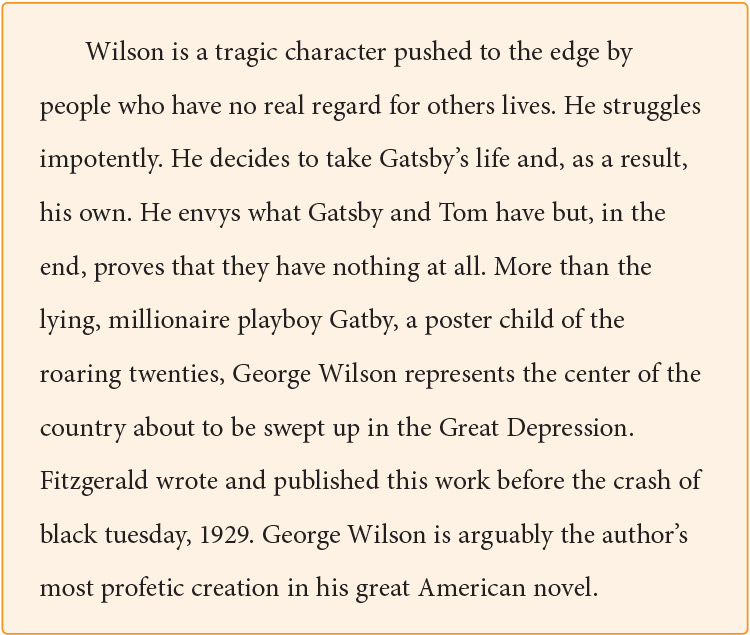
-
Sentence are combined, and punctuation and spelling are corrected.
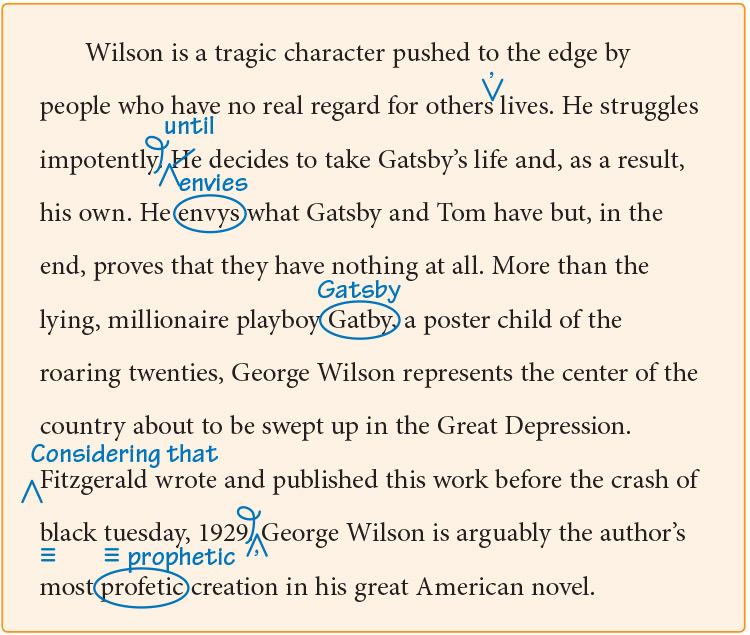
-
Paragraph After Edits
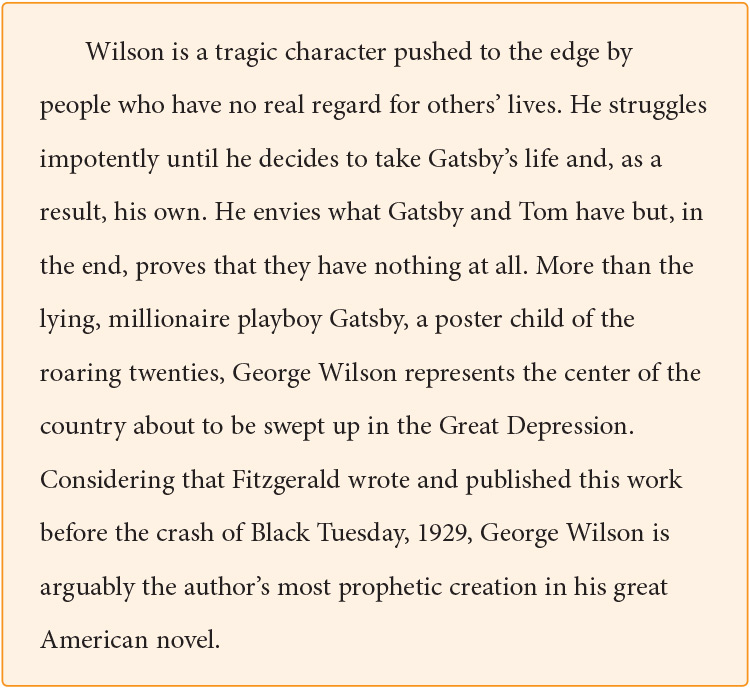
Edit with a checklist.
Read each line. When you can answer each question with a yes, check it off. Continue editing until each line is checked.
Sentences
- Do sentences read smoothly, with varied lengths and styles?
- Are sentences correct, without run-ons, comma splices, or fragments?
Punctuation
- Do commas appear before coordinating conjunctions (and, but, or, nor, for, so, yet) in compound sentences?
- Do commas follow introductory clauses and longer introductory phrases (four words or more)?
- Do double quotation marks surround exact words taken from the literature, with single quotes for dialogue within?
- Do parentheses cite the page number of the source of quoted material (with the text already providing the title and author)?
- Are the titles of book-length literature in italics and titles of short stories in quotation marks?
Mechanics
- Are proper nouns and the first words in sentences capitalized?
- In titles, are the first and last words capitalized as well as all words in between except coordinating conjunctions (and, but, or), articles (a, an, the), and short prepositions (in, of, at, with, on)?
- Have I checked spellings of the names of characters and locations in the literature?
- Have I checked spelling using a dictionary or the spell checker on my computer?
Grammar
- Do subjects and verbs agree in number?
- Do pronouns and antecedents agree in number, person, and gender?
- Are comparative and superlative forms of adjectives (good, better, best) and adverbs (rapidly, more rapidly, most rapidly) correctly formed?
Usage
- Are special terms from the novel correctly used in the discussion?
- Are commonly confused words used correctly (your/you’re, their/they’re, its/it’s)?
Publishing Character Analyses
Publishing is simply the act of making your work public. That's why publishing takes so many different forms. First, you need to make a clean final copy of your work. Then you should find ways to share your writing with classmates, your teacher, your family, and your friends.
Publishing a Final Copy
Create a final copy of your analysis.
Include your revising and editing changes and read over your work a final time. (If you are working on a computer, spell-check your work.)
Reflecting on Your Writing
Reflect on your writing.
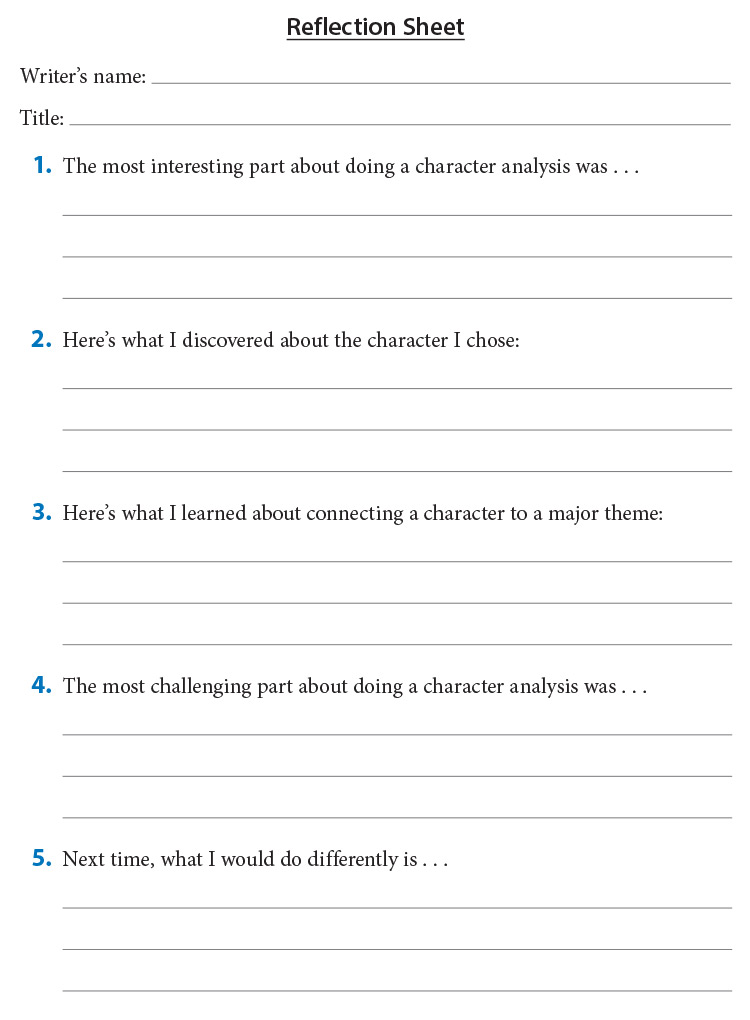
Complete the following sheet to reflect on analyzing characters from literature.