Editing Comparison-Contrast Essays
After making the large-scale improvements of revision, you can focus on specific words and punctuation marks. The following activities will help you correctly use comparative and superlative modifiers and punctuate compound sentences. You'll also find a checklist to help you catch any errors in punctuation, capitalization, spelling, usage, and grammar.
Editing Comparatives and Superlatives
Modifiers have special forms that help you compare topics. A comparative adjective can show which of two topics is bigger, faster, less messy, or more cost-effective. A superlative adjective can show which of three or more topics is biggest, fastest, least messy, or most cost-effective. Add er to most one-syllable words to make the comparative form, and add est to make the superlative form.
Most One-Syllable Adjectives
Positive
deep
old
strange
Comparative
deeper
older
stranger
Superlative
deepest
oldest
strangest
For most adjectives of two syllables or more, add more or less for comparative forms and most or least for superlative forms. (Note that some two-syllable adjectives can still take er and est.)
Most Adjectives with Two or More Syllables
Positive
beautiful
venerable
reasonable
surprising
happy
simple
Comparative
more beautiful
more venerable
less reasonable
less surprising
happier
simpler
Superlative
most beautiful
most venerable
least reasonable
least surprising
happiest
simplest
Some adjectives are irregular because they change form to create comparatives and superlatives.
Irregular Adjectives
Positive
good
bad
much/many
little
far
Comparative
better
worse
more
less
farther/further
Superlative
best
worst
most
least
farthest/furthest
You can apply the same basic rules to correctly form comparative and superlative adverbs.
Comparative and Superlative Adverbs
Positive
hard
fast
late
gently
slowly
serenely
badly
well
Comparative
harder
faster
later
more gently
more slowly
less serenely
worse
better
Superlative
hardest
fastest
latest
most gently
most slowly
least serenely
worst
best
Whenever you use comparative adjectives or adverbs, make sure your reader knows the two things you are comparing. To make the comparison clear, you may need to add a phrase or clause that starts with than.
Check comparatives and superlatives.
Correct the comparative and superlative modifiers in each sentence. Afterward, review your essay, making sure all comparatives and superlatives are correctly formed.
-
Martin Luther King Jr. was one of the most lovinglovingest people in the civil rights movement.
-
Malcolm X thought King and his followers should be angrier and more militantmilitanter.
-
His revolution would be bloodierbloody than King's.
-
Nonviolent protesters had to be more patientpatienter than their violent counterparts.
-
Over time, King's approach has proven more successfulsuccessfuller than Malcolm X's.
-
People with savant syndrome usually are more profoundlyprofoundlier challenged than those with Asperger's syndrome.
-
Savants paradoxically have more amazingmost amazing gifts than their counterparts.
-
Though people with Asperger's syndrome process information differently than neurotypicals, savants use even more aberrantaberranter neural pathways.
-
People with Asperger's syndrome have unique interests, but savant skills are even more idiosyncraticidiosyncraticer.
-
Savants skills are more surprising than those of people with Asperger's syndrome. (Add a "than" phrase or clause to complete the comparison.)
Editing Punctuation of Compound Sentences
Often when you compare two subjects or work with similarities and differences, you will create sentences with two parts. A compound sentence connects two independent clauses (two parts that could each stand as its own sentence). You can do so by using a comma and a coordinating conjunction (and, but, or, nor, for, so, or yet).
Compound Sentences with Comma and Coordinating Conjunctions
Martin Luther King Jr. drew from his Christian faith, and Malcolm X drew from his Muslim faith.
King called for his followers to resist nonviolently, but Malcolm X believed all revolutions required violence.
Both men wanted to end racism, yet they disagreed as to how.
If you leave out the coordinating conjunction, you create an error called a comma splice. (A comma alone is not strong enough to join two sentences.) If you leave out the comma, the compound sentence is incorrectly punctuated. (The reader doesn't know when one thought ends and the next one begins.) If you leave out both the comma and the coordinating conjunction, you have an error called a run-on sentence.
Sentence Errors
Martin Luther King Jr. drew from his Christian faith, Malcolm X drew from his Muslim faith. (comma splice)
King called for his followers to resist nonviolently but Malcolm X believed all revolutions required violence. (comma error)
Both men wanted to end racism they disagreed as to how. (run-on sentence)
You can fix these errors by adding the missing part (comma, coordinating conjunction, or both). You can also fix them by adding a semicolon.
Compound Sentence with a Semicolon
Both men wanted to end racism; they disagreed as to how.
Correct punctuation in compound sentences.
In each compound sentence below, correct the punctuation by using both a comma and a coordinating conjunction (and, but, or, nor, for, so, or yet) or by using a semicolon. Afterward, check the compound sentences in your essay to make sure they are correctly punctuated.
-
Apples have a thin skin, but oranges have a thick rind.
-
The seeds in an apple cluster around its core, yet those in an orange appear in the segments of fruit.
-
Scientists have bred seedless oranges; they have been less successful with seedless apples.
-
Apples grow well through temperate climates throughout the upper United States, but oranges need warmer conditions like those in Florida or California.
-
Many credit the profusion of apple trees throughout the country to the legendary Johnny Appleseed; , few realize the legend was based on the real-life orchardist John Chapman.
-
Early settlers could claim land by developing it, so Chapman planted groves of apple trees in the wild in order to claim the land.
-
The developed plots of land became Chapman's property, so he could sell the land to settlers for a large profit.
-
A similar strategy could have worked for Oliver Orangeseed, but he would have had to compete with cotton growers for space.
-
Apples and oranges may have many differences, but they have more in common with each other than with bananas.
-
Apples, oranges, and bananas have their own unique flavors, textures, and colors, yet they taste delicious together in a fruit salad!
Editing in Action
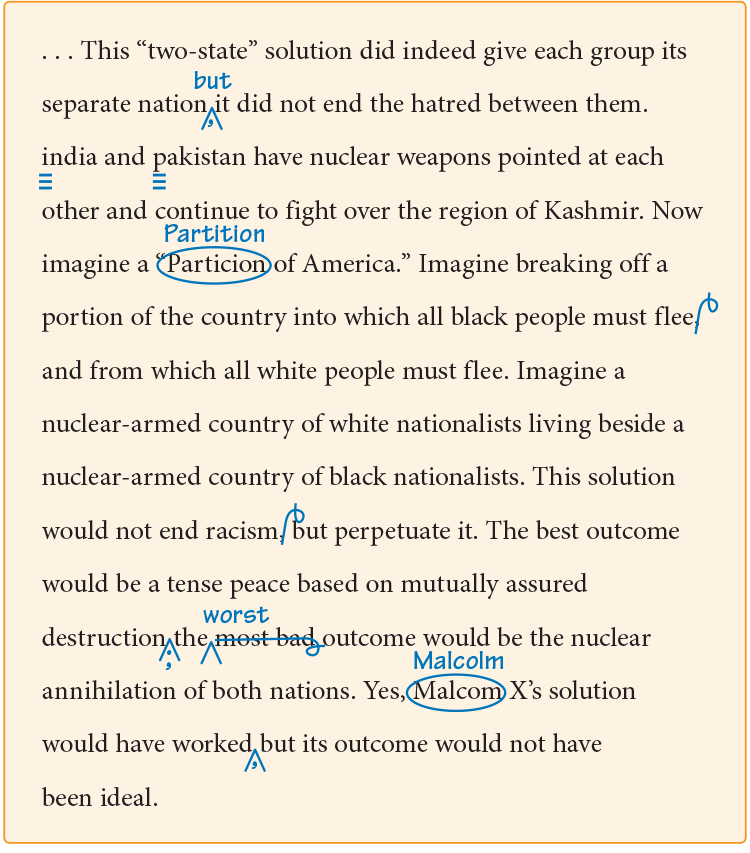
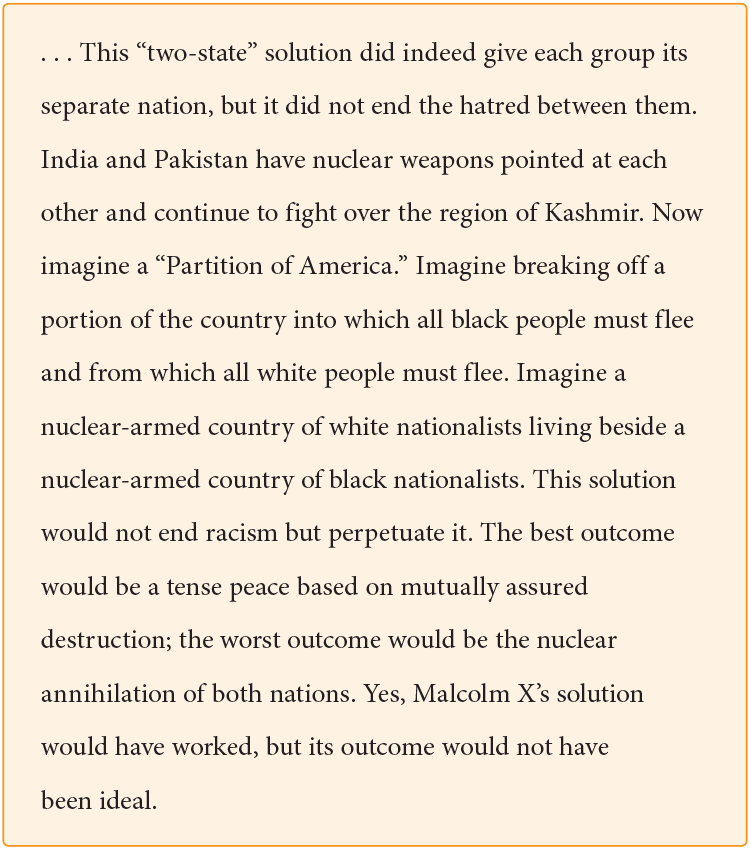
After you check your comparative and superlative modifiers and the punctuation of compound sentences, you should also make sure your comparison-contrast essay has correct punctuation, capitalization, spelling, usage, and grammar. Keep editing until your essay is error free.
-
Text Before Edits

-
Run-ons, comma splices, and comma errors are fixed as well as a superlative adjective.
-
Text After Edits
Edit with a checklist.
Use the following checklist to edit your comparison-contrast essay. When you can answer a question with a yes, check it off. Continue editing until each line is checked.
Sentences
- Do sentences read smoothly throughout the essay?
- Are sentences correct, without run-ons, comma splices, or fragments?
Punctuation
- Do periods and commas after quoted material appear inside the end quotation marks?
- Do question marks and exclamation points after quoted material appear inside the end quotation marks if they belong to the quotation?
- Do commas follow introductory clauses and longer introductory phrases (four words or more)?
Mechanics
- Are proper nouns and the first words in sentences capitalized?
- Are specific names of people, cities, states, and institutions as well as other proper nouns capitalized?
- Have I checked spellings of the names of all people, places, and so on?
- Have I checked spelling using a dictionary or spell checker?
Grammar
- Do subjects and verbs agree in number?
- Do pronouns and antecedents agree in number, person, and gender?
Usage
- Have I chosen words with effective connotations?
- Are commonly confused words used correctly (your/you’re, their/they’re, its/it’s)?
Publishing Your Comparison-Contrast Essay
Of course, you'll want to share your comparison-contrast essay with your instructor to get a good grade, but why stop there? If you are truly interested in the topics you have explored, you'll want to share your writing with classmates and family members and others you care about. First, you need to make sure your essay is in the best possible shape.
Publishing the Final Copy
Create a clean final copy.
Once you have completed all of your revisions and edits, print a clean final copy of your comparison-contrast essay. Share it with your teacher, classmates, and family members.
Reflecting on Your Writing
Reflect on your writing.
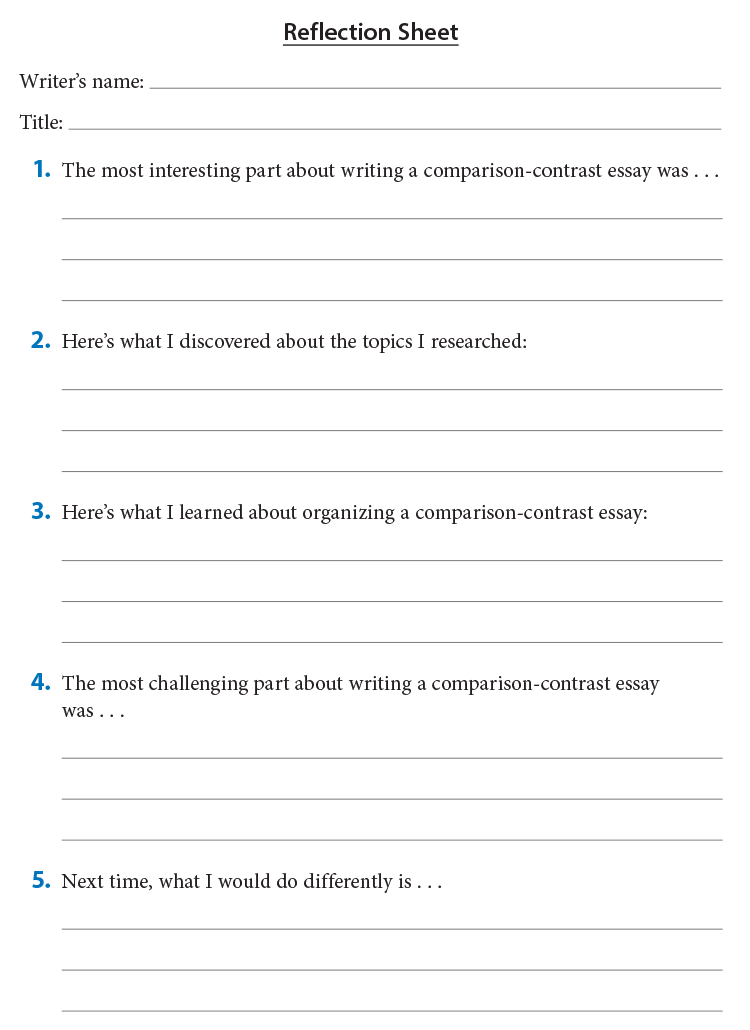
Complete the following sheet to reflect on writing a comparison-contrast essay.