Personal Narrative

By Anonymous (not verified), 12 March, 2026

Prewriting for Personal Essays

The word recall means exactly what it says: "call a memory back into mind." The word recollect is much the same: "collect memories again." Even the word remember means "put the parts back together again." So, the first part of the process of writing a personal essay is calling back and collecting and reassembling the many memories you have of key periods in your life. You'll start by selecting a specific period to explore.

By Anonymous (not verified), 12 March, 2026

Reading a Personal Essay

You've probably written many personal narratives over the course of your schooling, but this may be your first personal essay. Instead of focusing on one brief event in your life, you will focus on a series of events over a longer period. As a result, you'll need to be selective about what events you report, and you'll need to tie them together so that they create a clear narrative arc. You can get a sense of how to do so by reading another student's personal essay.

Reading a Student Model

Read the following personal essay, in which Carson reflects on a winter of discontent and the surprising creative outlet that he discovered. Note how he zooms in to specific events with description and dialogue before zooming out with transition sentences to show the progress of time. Click on the side notes to see the different features of this personal essay.

Teaching Tip

This is a long personal essay, and some less-experienced students might feel daunted by it. They are often worried about what the page count or word count should be for their own writing. Put them at ease. The length of the narrative doesn't matter, only that it tells a compelling story about a significant period that changed who they are. Tell students to take as much—or as little—space as they need to tell their stories. Also encourage them to dig in to the events, showing readers just what this time period meant to them.

By Anonymous (not verified), 12 March, 2026

Warm-Up for Personal Essays

What is your very first memory? Was it splashing in a bathtub with little plastic boats, or sharing a cookie with the kid who lived next door, or seeing a reindeer in a holiday parade? People say that your very first memory says a lot about who you are. Why? Because the experience meant something to you at the time and still means something to you now—since you've held onto it all these years.

In fact, the reason we can't remember our earliest years is that we hadn't yet begun to develop what psychologists call autobiographical memory. You probably learned to walk when you were very young but have no memory of it. That's because you didn't start to fashion a mental narrative of your life until you were about three years old. At that point, you started remembering experiences because they helped to explain who you are. Your very sense of self is tied to the memories you have and the stories you tell about them.

You can explore an especially important period in your life by writing a personal essay.

What Is a Personal Essay?

Listen to "What Is a Personal Essay?"

Your browser does not support the audio tag.

Hide audio

Writing Literary Analysis
© Thoughtful Learning 2018

A personal essay is a narrative about an important time in your life, showing how it shaped who you are. Instead of focusing on just one event, a personal essay relates a number of events over an extended time frame, weaving them together into a "story of you." It won't be enough just to put details in chronological order—first this happened . . . then that happened . . . and afterward this other thing. . . . Instead, you need to show the significance of each event and build them into a narrative arc. You'll learn how in the coming lessons. First, though, you can warm up by imagining you have a time machine.

Thinking About Your Past

In the book Harry Potter and the Prisoner of Azkaban, chronic overachiever Hermione Granger uses a "time-turner" to jump back in time and attend a second class while her first self was busy studying in a different class. Now imagine that you have your own time-turner—but you won't be using it to attend classes.

Also, your time-turner works a bit differently. It takes you back to relive three months of your life. You don't watch yourself from the outside. You experience everything again, only this time with your memories of the future riding along. What time period would you choose? Why?

You can use a cluster to explore possible times. Think of "seasons of your life" (approximately three months) and write down at least three such time periods. Then explore each season by adding images, thoughts, actions, and sensations. Use this student cluster as inspiration:
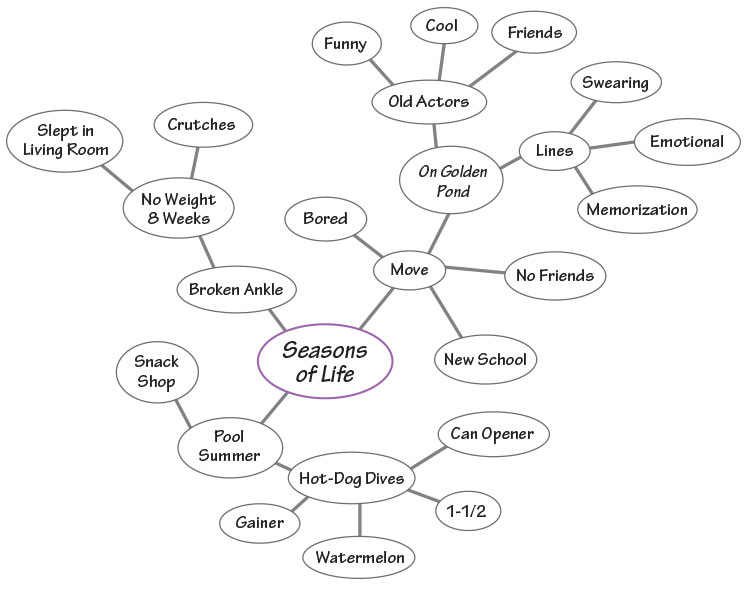
Cluster Diagram
By Anonymous (not verified), 12 March, 2026

Revising Personal Narratives

After you've completed a first draft of your personal narrative, take a break before you begin revising. You need to see your work with a fresh perspective because when you revise, you make big improvements to your ideas, organization, and voice.

Revising to Show Instead of Tell

Study the two passages that follow. The “before” passage only explains the action, telling about it. The “after” passage uses action, dialogue, personal feelings, and details to develop the action, showing it. The second passage is much more interesting to read.

BEFORE (only explains the action)

Once when I was little, I got ready to ride on my dad’s motorcycle. Just as I was getting on the seat, I burnt myself on the cycle! It really hurt and I started to cry. My mom checked the burn. I didn’t want to go back on the motorcycle, but my dad took me anyway.

AFTER (develops the action with dialogue and personal feelings)

When I was little, one of my favorite things to do was riding on my dad’s motorcycle. It was always fun for me.

“Come on. Get up,” said my dad cheerfully.

“Okay,” I answered. But just as I was getting onto the seat, I burnt myself on one of the accelerator pipes!

“Ow!” I yelled as I started to cry.

“Are you all right?” asked my mom.

“No,” I answered.

“Come here,” said my mom. “Let’s take a look at that burn. It’s pretty red. I don’t think she should go for a ride on the motorcycle.”

I felt really glad that she had said that.

“Aw, come on. It won’t hurt her any more than she’s already hurtin’,” said my dad. I started to get really angry. I mean, I was only five years old. I hurt! Why should I have to ride a motorcycle?

By Anonymous (not verified), 12 March, 2026

Writing a Personal Narrative

Once you finish prewriting, you are ready to tell your story in writing. These activities will help you hook the reader's attention at the beginning, build interest through a sequence of events, and lead to a strong ending for your personal narrative. You'll also read another student's narrative to see how all of the parts came together.

Writing the Beginning Paragraph

The first few sentences in your narrative should grab the reader’s attention. They are called the lead. The following activity will help you write an effective lead.

Write a lead.

For each strategy that follows, write a lead that could work for your personal narrative.

  • Start in the middle of the action.

    Suddenly, I heard a crash downstairs and the sound of breaking glass. “Hey, who’s down there?” I yelled.

  • Have the characters talk.

    My brother’s lips were so swollen, it sounded like he said, “Mine guess who fur hiss!”

    “What?” I said.

    He glared at me and said louder, “I’ll get you for this!”

  • Begin with a surprising statement or fact.

    When I was nine, I started my dad’s car and drove onto the street. I thought I was going to New Jersey.

  • Give some important background information.

    It was a beautiful August morning. The sun was brightly shining on my sunglasses while my mother drove the U-haul truck to a warehouse in Santa Ana, California. As my mother drove down the streets of Santa Ana, I looked out the window and began to realize that the mixture of people was no longer a mixture; there was only white.

By Anonymous (not verified), 12 March, 2026

Prewriting for Personal Narratives

Prewriting is your first step in writing a personal narrative. These prewriting activities will help you select a topic to write about, gather important details about the topic, and organize your thoughts before you begin a first draft.

Prewriting to Select a Topic

Explore topic ideas.

The goal for your narrative is to share a personal experience that taught you something or left a lasting impression. To help you think of topic ideas, complete as many of the sentence starters that follow as you can. Each complete sentence could become a topic for your narrative.

  • My friendship was tested one time when . . .
  • My worst day in school was . . .
  • I had to stand up for myself once when . . .
  • I remember the time I won . . .
  • I told a secret, and . . .
  • My most embarrassing moment in school happened when . . .
  • I wanted to be part of a certain group, but . . .
  • A neighbor helped me (scared me, surprised me), and . . .

Choose your topic.

Choose a topic for your narrative. Pick from the topics suggested by the sentence starters above, or choose another topic you have in mind.

Prewriting to Gather Details

Before you can share a story, you need to remember all the important things that happened. Asking and answering the 5 W’s and H questions can activate your memory and help you record important details about your experience.

  • Who was involved in the experience?
  • What exactly happened? (the actions or events)
  • Where did it happen?
  • When did it happen?
  • Why did it happen? (the background)
  • How did you change because of the experience?
By Anonymous (not verified), 12 March, 2026

Reading Personal Narratives

Before you share a story about a time when you learned a valuable lesson, you'll want to see how other students explored their topics. Read the sample paragraph and narrative essay in this lesson and answer the questions about them. Think about how the writer puts ideas together and how you might do so in your own narrative.

Reading a Narrative Paragraph

A narrative paragraph briefly shares a story about something that happened in the writer's life. It includes three parts: The topic sentence introduces the story. The body sentences describe what happened in time order. The ending sentence tells why the experience was important, possibly by stating a lesson learned.

Sample Narrative Paragraph

Listen to "Saying Good-Bye"

Your browser does not support the audio tag.

Hide audio

Saying Good-Bye

Topic Sentence The news broke during a family meeting, the first I can ever remember my parents calling. Mom and Dad sat my brother Patrick and me down in the living room. “We have some big news,” said my Dad, his voice cracking. He paused. My mom continued, “Your dad’s company is transferring him to the United States, and we’re going with him.” Body Sentences My mind went blank. The United States? I had never even visited anywhere outside of my home country, the Philippines. My eyes welled with tears. “What!” I stood and exclaimed. But my protests were no use. In ten days, we would be leaving the only home I’d known. Those last days were filled with last-minute packing, final meals, and final good-byes. I met my best friend Nicole for one last cheese ensaymada at our favorite bakery. Ending Sentence The flaky sugar-coated pastry never tasted so bittersweet.

Respond to the narrative paragraph.

Answer these questions about the reading.

By Anonymous (not verified), 12 March, 2026

Warm-Up for Personal Narratives

When we tell stories about things that happen to us, we share what makes us unique. You can connect with others by writing a personal narrative.

What Is a Personal Narrative?

Listen to "What Is a Personal Narrative?"

By Anonymous (not verified), 12 March, 2026

Editing Personal Narratives

After making big changes to improve your personal narrative, you need to make little changes (editing) to correct any remaining errors. You'll look for problems with sentences, punctuation, capitalization, grammar, usage, and spelling. The following activities will help you edit your narrative.

Editing Dialogue for Quotation Marks

Dialogue uses quotation marks. These special marks go before and after the exact words of the speaker.

“Yum,” I said.

Manny’s dad said, “Welcome to the fiesta.”

Periods and commas that follow the speaker’s words always go inside the quotation marks.

“It’s time to change into our costumes,” said Manny. “Follow me.”

Question marks and exclamation marks go inside the quotation marks when they punctuation the dialogue.

“Are you ready for this?” asked Manny.

“Wow!” I said.

Watch the video "Punctuating Dialogue."

Hide video

Insert quotation marks.

Insert quotation marks before and after the speaker’s words. Use the examples on this page for help. The first one has been done for you.

By Anonymous (not verified), 12 March, 2026

Revising Personal Narratives

Once you draft your personal narrative, take a break and come back to it to see it freshly. When you revise, you make sure the people, places, and events are clearly described and the writing captures the experience in a vivid way. These activities will help you revise.

Revising to Add Sensory Details

To help your story come alive, you can add details about what you saw, heard, smelled, tasted, and touched. These are called sensory details.

Sensory details help you show readers what is happening, rather than just telling them. You can collect these details in a sensory chart.

See

Hear

Smell

Taste

Touch

bright pink, yellow, and red dresses

sparkly suits

big green chilis in white sauce

beat of guitar and trumpets

laughter and fast conversations

yummy smells coming from the kitchen

soupy and spicy green pepper

delicious tacos

flaky pastries

high fives

Watch the video "Sensory Details."

Hide video

See

bright pink, yellow, and red dresses

sparkly suits

big green chilis in white sauce

Hear

beat of guitar and trumpets

laughter and fast conversations

Smell

yummy smells coming from the kitchen

Taste

soupy and spicy green pepper

delicious tacos

Touch

flaky pastries

high fives

Add sensory details.

Read the first draft of your personal narrative. Think of sensory details that you could add to make the writing come alive. Record the details in a sensory chart. Then add them to your personal narrative.