Revising Personal Narratives
Once you draft your personal narrative, take a break and come back to it to see it freshly. When you revise, you make sure the people, places, and events are clearly described and the writing captures the experience in a vivid way. These activities will help you revise.
Revising to Add Sensory Details
To help your story come alive, you can add details about what you saw, heard, smelled, tasted, and touched. These are called sensory details.
Sensory details help you show readers what is happening, rather than just telling them. You can collect these details in a sensory chart.
|
See |
Hear |
Smell |
Taste |
Touch |
|
bright pink, yellow, and red dresses sparkly suits big green chilis in white sauce |
beat of guitar and trumpets laughter and fast conversations |
yummy smells coming from the kitchen |
soupy and spicy green pepper delicious tacos |
flaky pastries high fives |
Watch the video "Sensory Details."
Hide video
|
See |
bright pink, yellow, and red dresses sparkly suits big green chilis in white sauce |
|
Hear |
beat of guitar and trumpets laughter and fast conversations |
|
Smell |
yummy smells coming from the kitchen |
|
Taste |
soupy and spicy green pepper delicious tacos |
|
Touch |
flaky pastries high fives |
Add sensory details.
Read the first draft of your personal narrative. Think of sensory details that you could add to make the writing come alive. Record the details in a sensory chart. Then add them to your personal narrative.
|
See |
Hear |
Smell |
Taste |
Touch |
|
See |
|
|
Hear |
|
|
Smell |
|
|
Taste |
|
|
Touch |
Teaching Tip
Sometimes not all of the senses will fit naturally into a personal narrative. Have students collect as many sensory details as they can, but let them know they don’t need to force details about each sense into their stories.
Revising Dialogue to Sound Natural
The dialogue in your narrative should sound real, the way people naturally speak. You can review your dialogue to make sure it sounds natural.
Make dialogue sound natural.
Read the tips for creating natural dialogue. Then try them out by revising some of the dialogue from your first draft. If your draft needs more dialogue, add some.
- Pretend you are having a conversation in real life.
“You didn’t tell me I had to wear a costume,” I said. “I didn’t tell you about the dancing either,” said Manny.
- Use casual language, unless the character needs to sound serious.
“Are you going to eat that or what?” asked Manny.
- Match the dialogue with the character’s personality.
“Just follow my lead,” said Manny.
- Use the dialogue to help tell your story.
Just when I was feeling relaxed, Manny said, “It’s time to change into our costumes.”
Revising with a Peer Response
Share your writing.
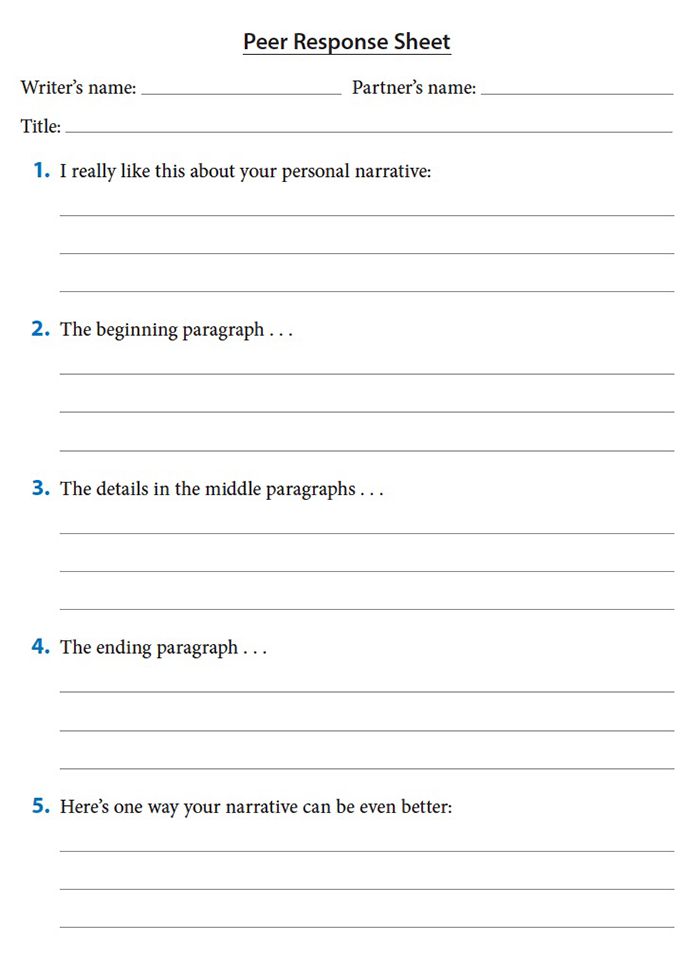
Have a trusted classmate read your essay and complete the form.
Revising in Action
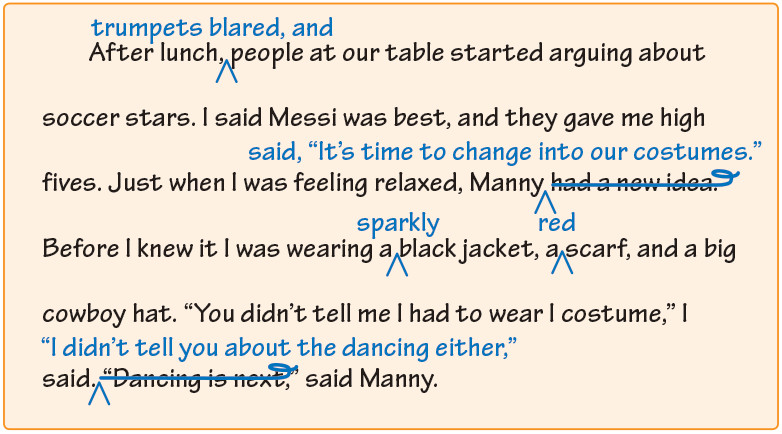
When you revise, you add, delete, rewrite, and rearrange your writing to make it clearer. Here are some revisions to the "Something New" essay.
-
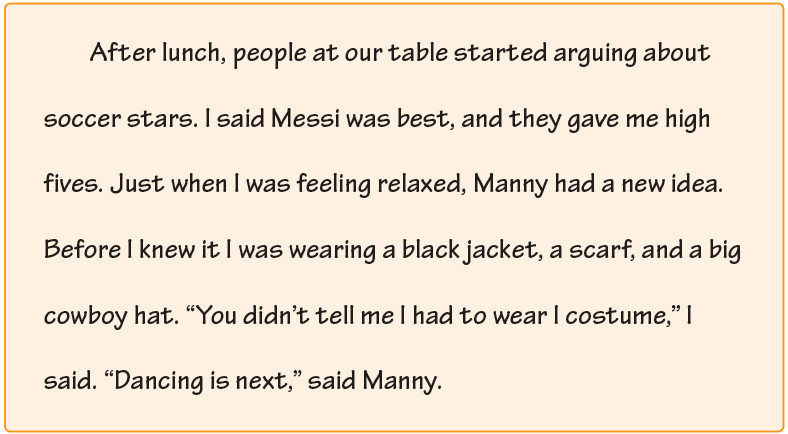
Paragraph Before Revisions
-
Sounds, Dialogue, and Sights are added. Dialogue is improved.
-
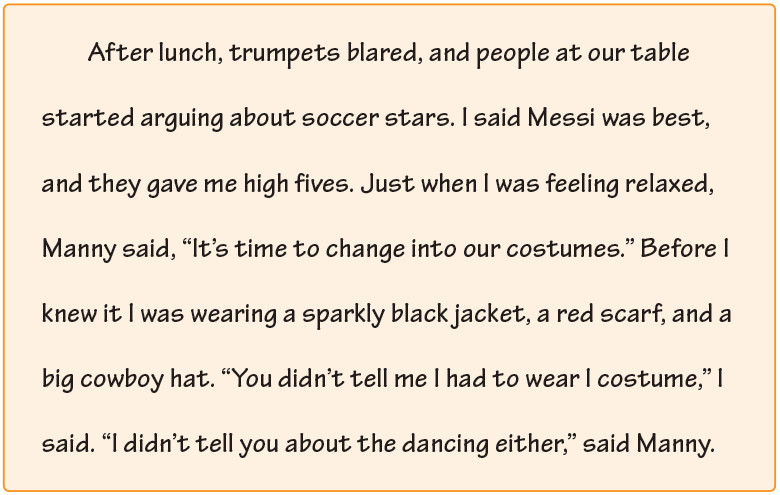
Paragraph After Revisions
Revise with a checklist.
Read each line. When you can answer each question with a yes, check it off.
Developing Your Ideas
- Does the narrative tell an interesting story?
- Does it include actions, dialogue, thought details, and sensory details?
- Does the voice sound natural and interesting?
Structuring Your Ideas
- Does my lead sentence hook the reader at the beginning?
- Does the beginning paragraph introduce the experience?
- Do middle paragraphs include actions and details in time order?
- Do time-order transition words help move the action along?