CCSS.ELA-LITERACY.RI.11-12.4

By Anonymous (not verified), 12 March, 2026

Finding Supporting Details

Each controlling sentence in a text is supported with different types of details. Note how the following thesis statement is supported by different details.

Thesis statement: Music speaks directly to us, saying things that words cannot say, and the reason is in part because music is older than language.

Supporting Details

Example

Facts are ideas that can be proven true or false.

Prior to the development of speech, humans communicated orally through sighs, calls, moans, and other sounds with pitch and rhythm.

Statistics are ideas expressed in numbers.

For 1 million years, Homo habilis communicated, coordinating the efforts of over a dozen individuals to create elaborate home sites, but Homo sapiens did not develop the full apparatus for modern speech until about 50,000 years ago.

Definitions tell what a word means.

The larynx, the structure that holds the vocal folds, migrated downward in the human throat to make speech possible, though humans could produce other sounds before.

Examples show how an idea works in specific situations.

Other animals that communicate aurally do so with song, including all manner of birds, whales, and insects.

Descriptions tell what something looks, feels, smells, tastes, or sounds like.

The human vocal apparatus is a Rube-Goldberg-like machine including flexible lips, an acrobatic tongue, a reedlike set of vocal folds, and a diaphragm that can control breath like the ever-pressing arm of a bagpiper.

Anecdotes are stories that illustrate a point.

Vicki the chimpanzee learned to verbally speak four words—"mama," "papa," "cup," and "up"—but Koko the gorilla learned to nonverbally speak using 250 words in American Sign Language.

Quotations provide the exact words of someone.

The great American composer Leonard Bernstein speculated that the origin of the word "mama" was the musical hum of hunger, "mmmmm," combined with the sung "aaaaa" of longing: "What we seem to be getting to is a hypothesis that would confirm a cliche—namely, Music is Heightened Speech." Indeed, music is the mother of speech.

Different types of details provide different types of support. Using a variety of details lets you fully elaborate an idea, answering the reader's many questions about it.

  • Facts ground a point in reality by providing verifiable evidence.
  • Statistics quantify a claim, telling how much, how often, or to what extent.
  • Definitions clarify terms, helping readers gain the vocabulary they need to fully grasp the concept.
  • Examples provide specific instances of a general concept, showing how an idea works in reality.
  • Descriptions allow readers to experience an idea through sensory details—sights, sounds, scents, pressure, temperature, texture, and so on.
  • Anecdotes illustrate a point using one of the most potent strategies for making meaning—stories.
  • Quotations allow readers to hear directly from experts and others involved in the topic.

Find supporting details.

Read the following excerpt. Write down one supporting detail for each type listed below the excerpt.
By Anonymous (not verified), 12 March, 2026

Understanding Controlling Sentences

As you read, watch for two types of controlling sentences.

A thesis statement tells what an essay or article is about. It usually appears in the first paragraph, often at the end.

       Why did writing get invented? To recount the exploits of great heroes like Gilgamesh and Odysseus? No, those epics are only 3,000 to 4,000 years old. To inscribe the laws of the land, as in the Code of Hammurabi? That's another good guess, but it wasn't the first reason. Writing began 5,000 years ago because of goats.

A topic sentence tells what a paragraph is about. It usually appears at the start of a middle paragraph.

       That practical business tool transformed human civilization. It marked the shift from prehistoric times (before written records) to modern times. Writing has come a long way since the days of clay tablets. Now we have emails, Facebook statuses, tweets, and texts, not to mention stock exchange tickers that robots can read faster than we can. . . .

Find controlling sentences.

In the following speech by Eleanor Roosevelt, underline each controlling sentence.

By Anonymous (not verified), 12 March, 2026

Closely Reading Nonfiction

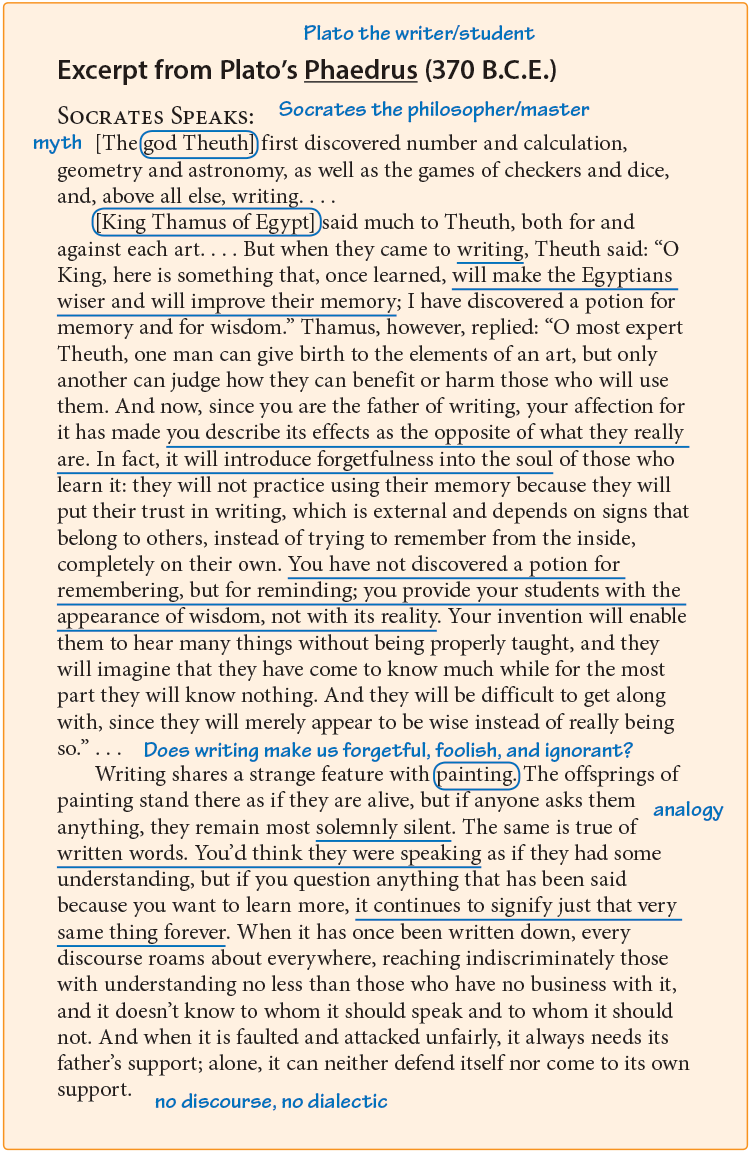
Close reading is active reading. Instead of simply skimming over a text, you engage it, question it, and think about it. Yes, you might start by looking at the heading, noting the source, and trying to get a sense of what you are about to read. But then you should read carefully, annotating the text as you go: underline important concepts, jot notes in the margin, and write questions that occur to you. After you finish reading, you should ask and answer the 5 W's and H about the topic, making sure you fully understand the reading.

You can practice this process by closely reading the following passage and answering questions about it.

Closely read an excerpt.

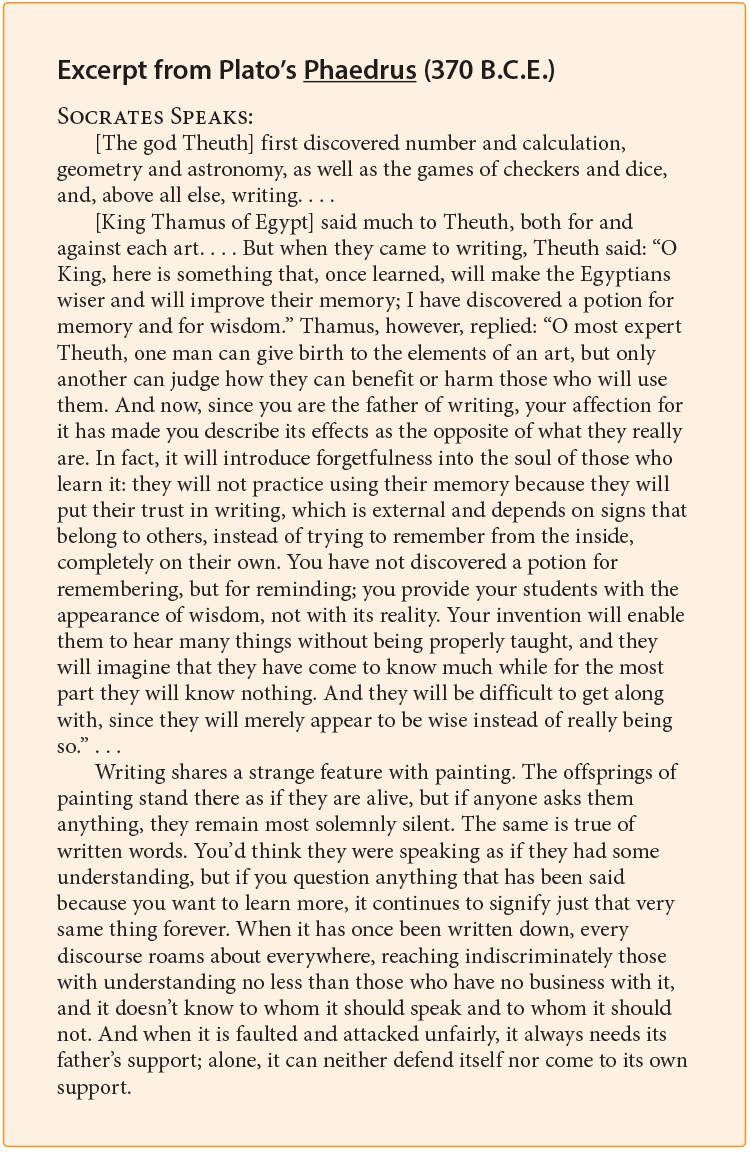
Read the following excerpt from Plato's Phaedrus, a dialogue in which the ancient Greek philosopher Socrates reflects on how writing changes people's thinking. First survey the piece, reading the heading and first sentences and getting a sense of what it is about. As you read, annotate the text, underlining key ideas and jotting down notes and questions. Afterward, answer the 5 W's and H about the reading.

Listen to "Excerpt from Plato's Phaedrus"

Your browser does not support the audio tag.

Hide audio

  • Editing
  • Editing
  1. Who wrote this piece, and who is featured as the narrator of the piece?
  2. What is the excerpt about?
  3. Where and when was this text originally written and read?
  4. Why did the writer create this text? (What was he trying to do?)
  5. How does the writer make his point? What literary devices does he use?
  6. Do you agree or disagree with the excerpt? Why?
By Anonymous (not verified), 12 March, 2026

Prewriting for Research Papers

When something fascinates you, studying it is simple. You naturally train all your attention on it and try to figure it out. Learning is easy because all the doors and windows of your mind are flung wide open. When something bores you, studying it is a chore. You can't stay focused. No one could pay you enough to care.

Since you need to closely study whatever topic you choose for your research paper, you should strive up front to find a topic that fascinates you. The next activity will help you find a strong topic, and the activities afterward will help you launch your research.

Prewriting to Select a Topic

The following "Basics of Life" list includes broad subject areas that are critical to life. You can click on any entry to find more resources about it. You can also apply these general subjects to a specific class in order to find a unique topic. For example, applying "Personality" to the Spanish-American War unit in AP U.S. History would suggest studying the irrepressible Teddy Roosevelt and his Rough Riders.

By Anonymous (not verified), 12 March, 2026

Reading a Research Paper

Before you start work on your own research paper, you should read a paper created by another student. As you read, note how the writer gathers interesting details from a variety of sources, both online and in print. Click on the side notes to study the different parts of the research paper.

Reading a Student Model

This research paper details what scientists know about Sagittarius A*, the supermassive black hole at the center of our galaxy. The overall structure of the paper includes a beginning paragraph, multiple body paragraphs, an ending paragraph, and a works-cited page. The writer uses in-text citations to credit sources.

By Anonymous (not verified), 12 March, 2026

Reading a Problem-Solution Essay

You notice a problem and analyze it. You brainstorm solutions and try one. That's the problem-solving process in a nutshell. It's also the outline of a problem-solution essay: introduce and analyze a problem, propose and explain a solution, and argue why it is the best course of action. Below, you'll see how one student built such an essay.

Reading a Student Model

Read the following problem-solution essay and respond to the reading afterward. In the beginning paragraph, the student grabs the reader's attention and delivers the opinion statement. The first middle paragraphs analyze the problem, and the later middle paragraphs propose, explain, and argue for a specific solution. The ending paragraph sums up the proposed solution and encourages the reader to help enact it. Click on the side notes to study the features of this essay.

By Anonymous (not verified), 12 March, 2026

Reading a College-Entrance Essay

Before you try your hand at writing a college-entrance essay, you should review a sample writing prompt and the essay that one student wrote in response. Note how the student uses the PAST strategy to analyze the prompt and develop an on-target response.

Reading a Student Model

Read the following prompt and the student's PAST analysis.

College-Entrance Writing Prompt

Our school motto is "Preparing the students of today to be the leaders of tomorrow." Leaders come in many forms, large and small. Write an essay that tells what leadership means to you and describes how you have shown leadership in your school and community. Provide specific examples and write about how you will show leadership when you join our campus community.

By Anonymous (not verified), 12 March, 2026

Reading a Definition Essay

Before you write your own definition essay, you should read and review an essay written by another student. You'll see how the student defines and explores a term using a variety of details. You'll also note how the writer's explanatory voice shows interest in the topic.

Reading a Student Model

Read the following definition essay, in which Julie explores the meaning of the word courage. Note how she catches the reader's attention and introduces the term and then develops paragraphs that explore the meaning and history of the word. Click on the side notes to see the different features of this definition essay.

By Anonymous (not verified), 12 March, 2026

Warm-Up for Definition Essays

Words let you think. When you don't have a word for something, you can't think very effectively about it. For example, you might think very little about the pencils you use, but having terms for different kinds of pencils can awaken your thinking:

  • Hexie: a pencil with six flat sides
  • Rounder: a pencil with a round bore
  • Flatty: a carpenter's pencil, made not to break in a pocket and sharpened by whittling
  • Dentcil: a pencil that has been chewed
  • Penstub: a pencil that has been sharpened too many times; a golf pencil
  • One-shot: a pencil with no eraser
  • Mulligan: a pencil with a large eraser
  • Fakecil: a pencil that won't sharpen correctly, with a tip of wood that doesn't write
  • Lightsee: a #3 pencil that doesn't write darkly enough to be easily read
  • Smudgie: a #1 pencil that writes like a crayon and smears
  • Spock: a mechanical pencil
  • Horseleg: an oversized pencil that doesn't fit in a sharpener

Check your pencils.

Check your backpack or locker to see how many of each type of pencil you can find. How many pencils fit more than one term? (For example, a chewed pencil with no eraser would be a dentcil one-shot.) What other words could you invent for different types of pencils? Which of these made-up terms interests you most and why?

What Is a Definition Essay?

Listen to "What Is a Definition Essay?"

Your browser does not support the audio tag.

Hide audio

Writing Definition Essays
© Thoughtful Learning 2018

A definition essay deeply explores the meaning of a term. It includes dictionary definitions (denotations), but goes far beyond, providing examples, etymology, synonyms, antonyms, and other details. Instead of defining the term narrowly, a definition essay seeks many connections and applies the term in many contexts.

The poet William Blake once noted that one could "see a world in a grain of sand," which is what you'll be doing when you write your definition essay. One interesting word, like a grain of sand, can lead you to many connections with the much wider world. To warm up your thinking, you can start by explaining a school-appropriate slang term to an older person.

Thinking About a Slang Term

Every generation has its own slang—words used in special ways that are generally not understood by people in the older generation. If you use a slang term in the presence of an older person, you may be asked what the term means. For example, the term "woke" in its modern slang usage has a very specific meaning: