Grade 5

By Anonymous (not verified), 12 March, 2026

Prewriting for Narrative Paragraphs

Prewriting is your first step in writing a narrative paragraph. These prewriting activities will help you select a memory to write about, create a focus statement, and gather and organize your details before you begin a first draft.

Prewriting to Choose Your Topic

Your narrative paragraph will share a special memory from your life. Here’s how you can get started.

Gather writing topics.

Finish the sentence starters below to collect writing ideas for your narrative. Draw a star next to the topic you like best.

  1. One of my favorite times with my best friend was . . .
  2. I’ll never forget the holiday when . . .
  3. I’ll never forget my family vacation to . . .
  4. One crazy thing my family did was . . .
  5. I’ll always remember the first time I . . .
  6. An exciting time in my neighborhood was when . . .

Teaching Tip

Students may also decide to use a writing topic from the “My Memory Wishes” activity.
By Anonymous (not verified), 12 March, 2026

Reading a Narrative Paragraph

Before you capture your own memory wish in a narrative paragraph, you should read a similar paragraph created by a different student. As you read and respond to the paragraph, think about how the writer made the memory come to life for the reader.

Reading a Narrative Paragraph

A narrative paragraph tells a true story from the writer’s life. It has three main parts. The topic sentence introduces the topic of the story. The body sentences tell what happened in the story. And the ending sentence wraps up the story. The sample paragraph tells about a special trip to the zoo.

Listen to "Polar Bear Games"

Your browser does not support the audio tag.

Hide audio

Sample Paragraph

Polar Bear Games

Topic SentenceI’ll never forget the time I saw the playful polar bear. My family and I were at the polar bear pen at the zoo. Inside the pen, a white polar bear named Amelia was wrestling with a log. Body SentencesThe bear rolled around and tossed the log into the air. Then she batted it into a giant swimming pool. But the polar bear wasn’t done with the log just yet. She leaped into the water and disappeared. “Let’s go down to the water-window!” I said, so my sister and I raced down to find her. Next, we pressed our faces against the glass, and the playful polar bear swam right in front us.Ending Sentences And guess what? She had the log tucked under her arm!

By Anonymous (not verified), 12 March, 2026

Editing Essays

After making big changes to improve your essay, you need to make little changes (editing) to correct any remaining errors. You'll look for problems with sentences, punctuation, capitalization, grammar, usage, and spelling. The following activities will help you edit and publish your writing.

Editing End Punctuation

Sentences end in a period, question mark, or exclamation point. These punctuation marks are like traffic signs because they signal that a sentence has come to a stop. Here are the rules for using these marks.

  • Use a period at the end of a statement.

    Thirty-five third graders in the school answered two questions.

  • Use a question mark at the end of a question.

    What is your favorite ocean mammal?

  • Use an exclamation point to show strong emotion.

    They crack oysters open on rocks on their bellies!

Watch the video "Using End Punctuation"

Hide video

Punctuate sentences.

Add the correct end punctuation to each one of these sentences.

By Anonymous (not verified), 12 March, 2026

Revising Essays

Once you draft your essay, take a break and come back to it to see it freshly. When you revise, you make sure your big ideas are separated into different paragraphs and enough details explain each idea. These activities will help you revise.

Revising to Find Paragraphs

If your writing goes on and on without paragraphs, it can be hard to read. When this happens, you need to separate the writing into paragraphs. Use this three-step process:

  1. Label the first word with a paragraph sign (¶).
  2. Name the main idea in the first paragraph.
  3. Find the first sentence not about this idea and label it. Start a new paragraph.
  4. Repeat steps 1-3 as you move through your essay.

Watch the video "Finding Paragraphs"

Hide video

Mark the paragraphs.

Carefully read this part of an essay. The first new paragraph is marked for you. Mark the next new paragraphs and repeat the three-step process.

We have had many great presidents. They have led our country when we were in wars or when people really needed help. Many third graders in Waller School picked Abraham Lincoln as the best president. ¶Twenty-four third graders in our school answered two questions. Who is the best president? Why? Mr. Hayes collected and posted the results. Fifteen students picked Abraham Lincoln as our best president. Twelve of these students picked him because he freed the slaves. Three students said he was a great leader during the Civil War. Six students picked George Washington as our best president. Five of these students picked Washington because he was our first president. One student thought he was great because he fought for our freedom. Three students picked President Obama. Two students said he is our first African-American president. One student said he helped our country get a better economy.

We have had many great presidents. They have led our country when we were in wars or when people really needed help. Many third graders in Waller School picked Abraham Lincoln as the best president. ¶Twenty-four third graders in our school answered two questions. Who is the best president? Why? Mr. Hayes collected and posted the results. ¶Fifteen students picked Abraham Lincoln as our best president. Twelve of these students picked him because he freed the slaves. Three students said he was a great leader during the Civil War. ¶Six students picked George Washington as our best president. Five of these students picked Washington because he was our first president. One student thought he was great because he fought for our freedom. ¶Three students picked President Obama. Two students said he is our first African-American president. One student said he helped our country get a better economy.

By Anonymous (not verified), 12 March, 2026

Writing Essays

Once you finish prewriting, you are ready to present your poll results in writing. These activities will help you hook the reader's interest at the beginning, explain important information in the middle, and end with a strong final point. You'll also read another student's essay to see how all of the parts came together.

Writing the Beginning Paragraph

In the beginning paragraph, the first sentence is called the lead sentence. The lead should get the reader’s interest about the topic of the essay. The last sentence is the focus statement, which names the main idea of the essay. Any sentences in between give details about the topic.

Write a lead sentence.

Follow the directions below to write two different lead sentences. Then choose the one you like best for your essay.

  1. Say something interesting about the topic.

    Ocean mammals are big and small.

  2. Ask a question about the topic.

    What ocean mammal is your favorite?

By Anonymous (not verified), 12 March, 2026

Prewriting for Essays

Prewriting is your first step in writing an essay. This prewriting activity will help you select a topic to write about and gather important details about the topic before you begin a first draft.

Prewriting to Plan Your Own Essay

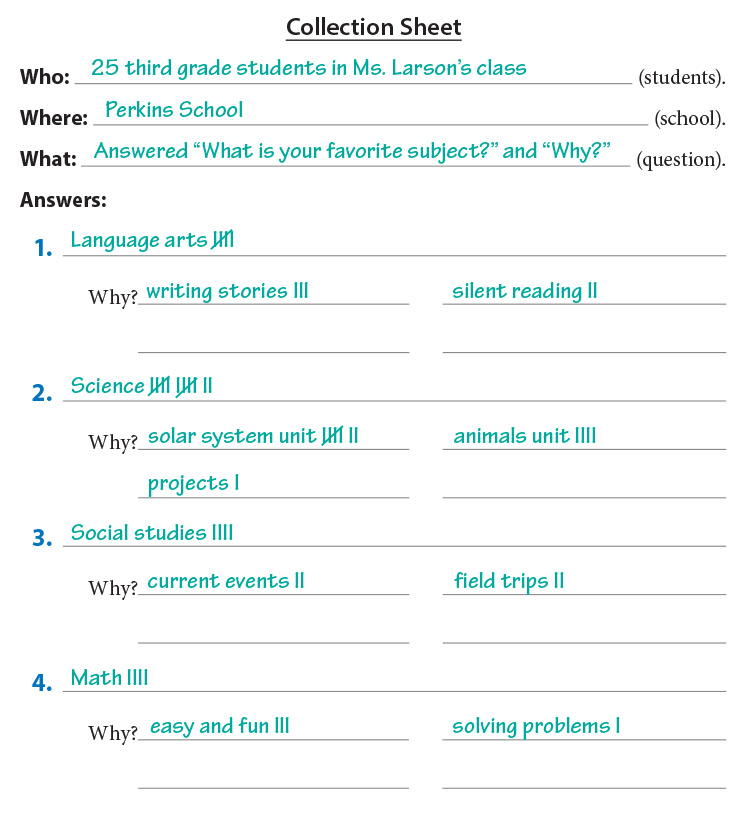
Review the results.

Study the answers to another question. This will be the topic for your own essay.

Peer Response Sheet

Teaching Tip

You can also have students write an essay about the answers to another question from the "Thinking About Polls" warm-up activity.

By Anonymous (not verified), 12 March, 2026

Reading an Informational Paragraph and Essay

Before you write your essay, you'll want to see how others did so. This lesson shows you an informational paragraph and an informational essay, explaining each part. As you read them, think about how the writers put ideas together and how you could describe the results of a classroom poll in your own essay.

Reading an Informational Paragraph

An informational paragraph has three main parts. The topic sentence names the topic. The body sentences explain the topic. The ending sentence gives a final idea about the topic. This paragraph explains the results of the poll about students’ favorite seasons.

Sample Paragraph

Listen to “Summer Wins”

Your browser does not support the audio tag.

Hide audio

Summer Wins

Topic Sentence Most third graders at Parkview Elementary picked summer as the best season. There are 32 third graders at Parkview, and 20 of them picked summer. Most of these students liked it because of the warm weather and no school. Body Sentences Winter came next with eight third graders voting for it. Playing in the snow and Christmas were the main reasons. Three students picked fall because of Halloween and fall colors. Only one third grader picked spring because of the flowers. Ending Sentence The seasons are all fun, but every third grader has a favorite.

By Anonymous (not verified), 12 March, 2026

Warm-Up for Writing Essays

Writing a Personal Narrative
(c) Thoughtful Learning 2016

An essay explores a topic in great detail using multiple paragraphs. This lesson will show you one special way to gather information for your own essay.

What Is an Essay?

You first learn how to write sentences. Then you learn how to write paragraphs. Next, you learn how to write essays. Each new form builds on what you learned before: A group of related sentences forms a paragraph. A group of related paragraphs forms an essay.

An essay gives information about a single topic. The beginning paragraph introduces the topic, the middle paragraphs explain the topic, and the ending paragraph summarizes the main points. Essays explain, describe, or persuade.

In this unit, you will write an essay that explains how a group of third graders answered an interesting question.

Watch the video "Building Essays"

Hide video

Thinking About Polls

Big companies and organizations take polls to find out what people are thinking. For example, when there is an election, voters will be asked who they are going to vote for and why. Asking these questions helps candidates know how they are doing during their campaign.

Consumers are asked what they like such as thin or thick crust on their pizza. Young TV viewers like you may be asked about their favorite shows. Even principals and teachers use polls to ask their students different questions.

By Anonymous (not verified), 12 March, 2026

Editing Paragraphs

After making big changes to improve a paragraph, you need to make little changes (editing) to correct any remaining errors. You'll look for problems with sentences, punctuation, capitalization, grammar, usage, and spelling. The following activities will help you edit your writing.

Editing for Sentences

Every sentence needs a subject and a verb. The subject is the person, place, thing, or idea that the sentence is about. The verb tells something about the subject.

Editing Sentences

If a group of words does not have a subject or a verb, it is a fragment.

Editing Sentences

To fix a fragment, add the part that is missing—subject, verb, or both.

Editing Sentences
By Anonymous (not verified), 12 March, 2026

Revising Paragraphs

Once you draft a paragraph, take a break and come back to it to see it freshly. When you revise, you check your writing for its ideas and structure. These activities will help you revise.

Revising for Structure

Your first job in revising is to check the overall structure of your paragraph. Choose one of the paragraphs you have written and check each part below.

Check your topic sentence or opinion statement.

Answer these questions about your first sentence. Apply any changes that will improve your first sentence.

  1. How could my first sentence more clearly identify my topic?
  2. How could I capture my reader’s attention in the first sentence?

Check your body sentences.

Answer these questions about your body sentences. Apply any changes that will improve them.