Revising Paragraphs
Once you draft a paragraph, take a break and come back to it to see it freshly. When you revise, you check your writing for its ideas and structure. These activities will help you revise.
Revising for Structure
Your first job in revising is to check the overall structure of your paragraph. Choose one of the paragraphs you have written and check each part below.
Check your topic sentence or opinion statement.
Answer these questions about your first sentence. Apply any changes that will improve your first sentence.
- How could my first sentence more clearly identify my topic?
- How could I capture my reader’s attention in the first sentence?
Check your body sentences.
Answer these questions about your body sentences. Apply any changes that will improve them.
- What new idea would strengthen my support?
- What idea could be deleted to create better focus?
- What idea could I rewrite to make clearer?
Check your ending sentence.
Answer this question and apply any changes.
- How could I make my ending sentence more interesting?
Teaching Tip
This activity requires students to suggest ways that they might revise their paragraphs. Help students realize they do not have to make every change, but that they should consider changes that will improve their writing.
Revising to Elaborate Details
Your body sentences need to include a variety of details that elaborate on the first sentence. Choose a paragraph you have written and use this activity to think of a variety of new details for it.
Elaborate details.
For each type of detail, think of an example that works with your paragraph. Consider adding new details to your paragraph.
- Facts are ideas that can be proven to be true.
Pete Nelson has made a living building tree houses for adults.
- Definitions tell what a word means.
A suspension bridge is held up by ropes or cables.
- Examples show a specific type of something.
A bridge can connect one tree house to another.
- Sensory details focus on seeing, hearing, smelling, tasting, and touching.
During hot summer days, tree houses get shady breezes.
- Quotations let people involved speak about the process.
Dad said, "The tree house will be your own little home."
Teaching Tip
This activity helps students brainstorm additional details that can enrich their writing. They should not include all of the new details, but only those that make their ideas stronger.
Revising for Organization
When you revise your paragraph, make sure you have placed details in the best order. Use transition words and phrases to help connect your ideas.
Time Order
Time order places details in the order in which they happened. Time order works well in narratives or paragraphs about a process.
. . . The first thing we had to do was build a frame for the floor of the house. Then we used a rope to raise all the wood up into the tree. Afterward, we nailed the boards to the frame, and soon we had a floor. . .
Transitions that show time
about
after
at
before
during
first
second
third
until
meanwhile
today
tomorrow
yesterday
next
soon
later
finally
then
as soon as
when
Check time order.
Organize details in time order in your narrative or explanatory (process) paragraph. Use transitions to connect your ideas.
Order of Location
Order of location usually goes from left to right, from top to bottom, or from near to far. Descriptive paragraphs often use this pattern.
. . . The tree’s trunk is so wide I can’t reach my arms around it! Its bark forms funny patterns as it crawls up toward the sky. . . .
Transitions that show location
above
across
against
along
among
around
behind
below
beneath
beside
between
by
down
in back of
in front of
inside
into
near
off
on top of
outside
over
throughout
toward
up
Teaching Tip
In this unit, students have developed paragraphs that use time order and order of importance, so those transitions will probably be most helpful.
Order of Importance
Order of importance moves from most important to least or the other way around. Persuasive paragraphs often use this pattern.
. . . Kids need a place to call their own, and a tree house is perfect. For instance, a tree house gives my friends and me a chance to get away from the pressures of school, homework, and little brothers or sisters. . . . .
Transitions that show importance:
obviously
therefore
because
as a result
for instance
for example
for that reason
clearly
again
and
next
finally
as well
along with
in addition
in conclusion
Check order of importance.
Organize details in order of importance in your persuasive paragraph. Use transitions to connect your ideas.
Comparison-Contrast Order
When writing focuses on the similarities and differences between two topics, it uses comparison-contrast order. Sometimes writing will focus on similarities first and differences after. Sometimes it will focus on one subject completely and then the other. Sometimes it will compare and contrast them point by point.
. . . Most pine trees have a straight central trunk, while most deciduous trees have branches that spread outward from the center. It’s easier to find space for a tree house in a broad-leaf tree. Also, pines have soft wood and sticky sap, whereas deciduous have hard wood and watery sap. . . . .
Transitions that compare
in the same way
similarly
likewise
like
as
also
too
and
Transitions that contrast
on the other hand
even though
otherwise
however
but
while
although
whereas
Revising in Action
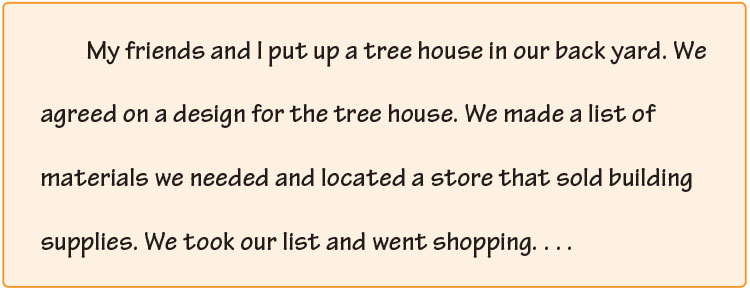
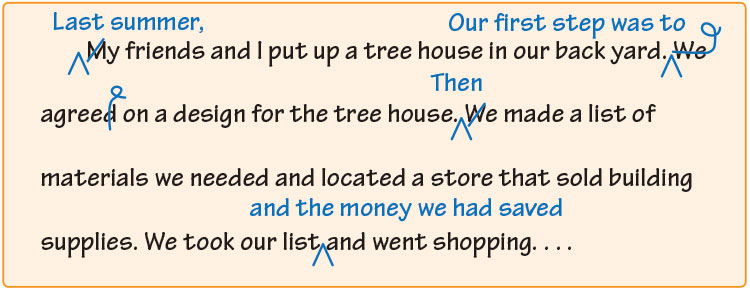
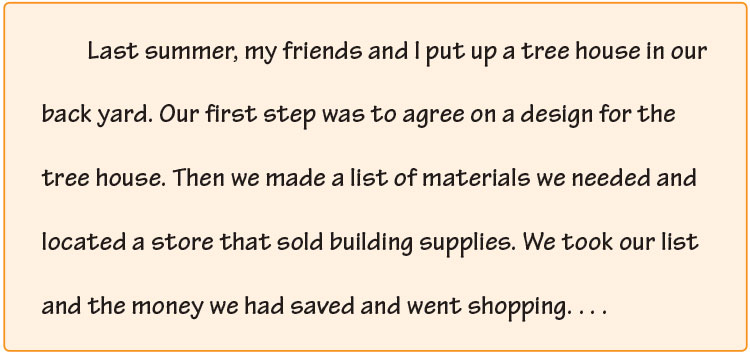
When you revise, you add, delete, rewrite, and rearrange your writing to make it clearer. Here are revisions to the tree-house explanatory paragraph.
-
Paragraph Before Edits
-
Transitions and a detail were added.
-
Paragraph After Edits
Teaching Tip
The revision shown here uses standard symbols for inserts and deletions. Students can use these symbols or their own notation system. The key is that changes are clearly marked.
Revise with a checklist.
Read each line in the checklist. When you can answer each question with a yes, check it off. Make a copy of this Google doc or download a Word template.
Developing Your Ideas
- Do I clearly name my topic?
- Do I develop my topic with facts, definitions, details, and examples?
- Does the voice show my interest in the topic?
Structuring Your Ideas
- Does a topic sentence begin my paragraph?
- Do body sentences support my topic sentence?
- Does an ending sentence sum up the paragraph and leave the reader with an interesting final thought?
- Do transition words connect my ideas effectively?