Grade 6

By Anonymous (not verified), 12 March, 2026

Analyzing the Meaning of Poetry

Poetry uses different techniques to create different meanings. When you read a poem, watch for these kinds of techniques.

Connotation is the feeling that words create.

Grandma wore denim; mother wore silk.

(Denim has the connotation of being inexpensive, durable, and practical; silk has the connotation of being expensive, delicate, and dressy.)

Denotation refers to the literal meaning of words.

Grandma wore denim; mother wore silk.

(Denim is a cotton fabric; silk is a fabric made from the cocoons of silkworms.)

Imagery refers to what you see, hear, smell, taste, and touch.

In the trees, green leaves murmur.

In the grass dance sunlight stars.

(Imagery includes trees, green, murmur, grass, dance, sunlight stars.)

Metaphor is saying that one thing is another thing, without using like or as.

The speech was a lighthouse beacon,

Guiding me to shore.

(The speech is a beacon.)

Personification is giving human qualities to nonhuman things.

I wrestled the math problem all afternoon.

It pinned me to the mat.

(The math problem acts like a wrestler.)

Simile is comparing two things using like or as.

My dog is like Saturday,

Brimming with adventure and excitement.

(The dog is compared to Saturday, using like.)

Symbol is using one thing to stand for another.

She kept her heart in a safe

Where no one could ever break it.

(Her heart is a symbol of her inner self and her relationships.)

By Anonymous (not verified), 12 March, 2026

Analyzing the Sound of Poetry

As you know, a poem is not the same as a short story or a novel. One big difference is that poetry plays with the sounds of words. Different techniques create different sounds. When you read a poem, listen for these kinds of sounds.

Alliteration is using the same beginning consonant sound.

The burrow delves down dark and deep

Where slinking creatures go to sleep.

Assonance is repeating vowel sounds within words.

In a yellow casserole

A green bean makes a scene.

Onomatopoeia occurs when a word sounds like what it describes.

The ladle dripped atop my roll

And splashed the soup inside my bowl.

Repetition is using a word or phrase again to draw attention to it or to create rhythm.

The white dove in the white snow

Waits for the white-out winds to go.

Rhyme refers to repeating the end sounds of words, often at the end of lines.

If you would show some gratitude

Instead of so much attitude,

You wouldn’t hear a platitude

About your lack of manners, dude.

Rhythm refers to creating a pattern of stressed and unstressed sounds in a line of poetry.

If you would show some gratitude

Instead of so much attitude,

You wouldn’t hear a platitude

About your lack of manners, dude.

Closely read a poem.

Read the following wintry poem, focusing on the sounds it creates.

By Anonymous (not verified), 12 March, 2026

Analyzing Theme

The theme of a story is a lesson it teaches about life. The theme usually will not be stated outright. You have to infer it from the characters’ actions and words. Ask yourself questions like these.

  • What does the main character learn?

    Glenda learns that she should focus on what she can control (how high she climbs) rather than what she can’t (how tall she is).

  • How does the main character change?

    Glenda stops being a hanger and becomes a climber. She accepts her height and focuses on things she can do instead.

  • How are you changed by reading this story?

    I realize I should accept things I can’t change about myself and focus on what I can do.

  • What is the writer trying to say about life? (theme)

    Don’t focus on what you are given, but on what you do with it.

Read for theme.

Read the following story, watching for theme.

By Anonymous (not verified), 12 March, 2026

Analyzing Plot

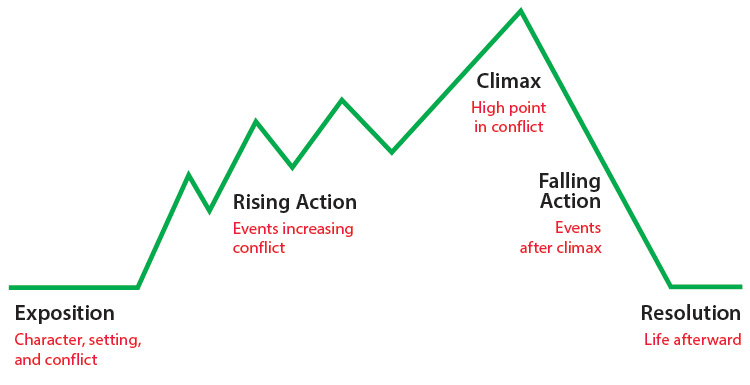
The plot of a story takes a standard shape. The beginning (exposition) introduces character, setting, and conflict. The middle (rising action) raises the level of conflict to a high point (climax). The ending tells what happens afterward (falling action and resolution).

Plot Diagram
By Anonymous (not verified), 12 March, 2026

Analyzing Conflict

Once you know what a character wants, you can think about the obstacles in the way—what the person has to overcome. Obstacles create conflict. You’ll find six basic types of conflict:

  1. Person versus self means the character is his or her own worst enemy or is struggling to make up his or her mind.
  2. Person versus person pits the character against another character.
  3. Person versus society brings the character into conflict with what other people want or think is okay.
  4. Person versus nature has the person fight weather, animals, wilderness, natural disaster, or forces like aging or gravity.
  5. Person versus supernatural sets the character against fate or magic.
  6. Person versus machine pits the character against computers or technology.
By Anonymous (not verified), 12 March, 2026

Analyzing Characters

Stories focus on people, animals, or humanlike objects called characters. You can analyze a character by describing the person physically and mentally.

  • Name

    Coup, the most sensible car at the dealership

  • Physical description (gender, age, appearance, health, strength, speed)

    He is a new car, “blue, midsized, economical, with a ten-year warranty;” he’s not the fastest, the largest, or the most stylish.

  • Mental description (intelligence, personality, confidence, attitude)

    He is practical and shy. He knows the kind of owner he wants but rarely sees one. He’s picky. He also seems discouraged and closed off.

  • Motivation (what the character wants)

    Coup wants to find a practical owner. He wants to be driven away from the dealership, but he seems afraid to let people try him out.

Read for character.

Pay close attention to the main character and what she wants.

By Anonymous (not verified), 12 March, 2026

Closely Reading Stories

To closely read stories, you should read once to get an overall sense of what is happening. Then return to read a second time and focus on character, setting, conflict, and theme.

Read a short story.

Pay close attention to the main character and what he wants.

By Anonymous (not verified), 12 March, 2026

Warm-Up for Reading and Writing Literature Assessments

Reading lets you experience great stories, and writing helps you tell your own great stories. That's why some major assessments test your ability to read literature, write about it, and maybe even write your own stories.

What Is Literature Assessment?

Reading and Writing Literature Assessments
© Thoughtful Learning 2016

Literature assessments test how well you read stories and poems and whether you can write clearly about them. On some literature assessments, you will create your own stories. This unit will help you prepare for these kinds of assessments.

In the following activities, you’ll learn about close reading—reading to understand how a story or poem works. You’ll discover how writers use character, setting, plot, conflict, and theme to develop stories. You’ll also learn how poets use rhythm, rhyme, imagery, and figures of speech. Then you’ll discover strategies for on-demand writing—strategies for developing your own ideas during an assessment.

Thinking About Close Reading

To read closely, you need to think about the parts of a story: character, setting, conflict, and theme. Even flash fiction has these elements.

Read closely.

Read the following flash-fiction story and answer the questions.

Worm with a Backbone

By Kerry Jackson

Flippy the Fish had never seen such a fat worm. It just hung there, wriggling under the water. Its pink skin gleamed with morning sunlight, and the flesh puffed up in the most delicious way. What a perfect breakfast! Flippy was just a little blue gill in a big pond, but if he ate enough worms like this, he’d be a big fish in no time. Except there was something weird about this worm. It was curved. It wriggled, yes, but it never unbent. Flippy moved closer and blinked. The worm looked like it had a backbone—a metal backbone curved in a hook shape. Hmm. Who wants to eat metal? Not so delicious after all, Flippy thought. He finned away across the pond, looking for a better breakfast.

By Anonymous (not verified), 12 March, 2026

Editing Application Letters

To make a great impression, your letter needs to be free of careless errors. Misspelled names, missing end punctuation, or sloppy design could derail an otherwise great letter. The following editing activities will help you create a neat and clean final version of your letter.

Editing Special Parts of a Letter

When checking a business letter for punctuation, pay special attention to addresses, dates, the salutation, and the closing.

Use a comma . . .

  • between a city and a state in an address: Phoenix, Arizona
  • between the day of the month and the year in a date: May 7, 2016
  • after the closing: Sincerely, Yours truly,

Use a colon . . .

  • after the salutation: Dear Mr. Abrams: Dear Ms. Rodriguez:

When checking for capitalization, pay special attention to the salutation and closing.

Capitalize . . .

  • the word “Dear” in the salutation: Dear Senator Ainsley:
  • the first word in the closing: Yours truly, Sincerely,
  • first and last names, titles, months, and addresses: Mrs. Daly

Edit for punctuation and capitalization.

Edit the following parts of business letters for punctuation and capitalization. The first one has been done for you.

By Anonymous (not verified), 12 March, 2026

Revising Application Letters

Once you finish a first draft of your application letter, set it aside for awhile. When you return to it, you can see it with a fresh perspective. When you revise, you look at your essay from your reader's point of view to make sure your writing includes a proper tone and effective details. These activities will help you revise.