CCSS.ELA-LITERACY.W.6.2

By Anonymous (not verified), 12 March, 2026

Prewriting for Comparison-Contrast Essays

Instead of just leaping into writing, you should spend some time choosing a topic, gathering information, and organizing your thoughts. That's prewriting. This lesson will help you select a topic and gather details for a comparison-contrast essay.

Prewriting to Select a Topic

Explore writing topics.

Write two different people, places, things, and ideas that interest you and that you think would be interesting to compare and contrast. Circle the two subjects you like best.

People

Places

Things

Ideas

People

Places

Things

Ideas

By Anonymous (not verified), 12 March, 2026

Editing Classification Essays

After you revise your classification essay, making major improvements, you need to edit it to correct any remaining errors. You'll look for problems with sentences, punctuation, capitalization, grammar, usage, and spelling. The following activities will help you edit your writing.

By Anonymous (not verified), 12 March, 2026

Revising Classification Essays

Finishing the first draft of an essay is an important milestone, but a first draft isn't a final draft. Next, you need to revise, making improvements to the ideas, organization, and voice of your work. These activities will help you improve the unity and coherence of your paragraphs.

Revising for Paragraph Unity

Focusing on one idea in a paragraph is called unity. For example, the sentences in each paragraph in your essay should focus on the category mentioned in the paragraph’s topic sentence. A paragraph lacks unity when it includes ideas that do not relate to its topic sentence. In the example paragraph below, the topic sentence is in bold type, and an unrelated idea is deleted.

Percussion instruments provide rhythm and many of the interesting sounds you hear during musical performances. Percussionists make sounds by striking, shaking, or scraping their instruments. Drums, cymbals, xylophones, and maracas are examples of percussion instruments. Surprisingly, the piano is a percussion instrument, too. Another keyboard instrument is the pipe organ, but sound on a pipe organ is made when air goes through pipes. The percussion section in an orchestra varies in size depending on the requirements of the music that is being performed.

Create paragraph unity.

Read the passages below. If every sentence belongs, write “U” for unity on the line provided. If a passage lacks unity, cross out the sentence that does not belong.

  1. Poison ivy is an enemy of campers and other nature lovers. It contains an oil that irritates the skin. The oil gets onto the skin when the plant’s leaf is crushed. Walking through or on top of poison ivy can release the oil. You can easily recognize poison ivy because it usually grows as a vine and has compound leaves made up of three leaflets each. Poison sumac is also a problem for campers. Poison ivy is an enemy of campers and other nature lovers. It contains an oil that irritates the skin. The oil gets onto the skin when the plant’s leaf is crushed. Walking through or on top of poison ivy can release the oil. You can easily recognize poison ivy because it usually grows as a vine and has compound leaves made up of three leaflets each. Poison sumac is also a problem for campers.
By Anonymous (not verified), 12 March, 2026

Writing a Classification Essay

Once you finish prewriting, you are ready to create the first draft of your ideas. These writing activities will help you create a strong beginning, middle, and ending for your classification essay. You'll also read another student's essay to see how all of the parts came together.

Writing the Beginning Paragraph

The beginning of your classification essay should introduce your topic with some interesting background information and then give your focus statement.

Write your beginning paragraph.

Create your first paragraph, starting with interesting background information and moving toward your focus statement.

Lead Sentence

We humans have created devices, such as camouflage-patterned military fatigues and pepper spray, to protect ourselves in dangerous situations.

Detail Sentences

Have you ever wondered where we got the ideas for these tools? They may have come from examples set by other members of the animal kingdom. Animals face many dangers in their environments, and they have some unusual and inspired methods of defense.

Focus Statement

Three ways in which animals protect themselves are by changing colors, releasing chemicals, and giving up a body part.

Writing the Middle Paragraphs

By Anonymous (not verified), 12 March, 2026

Prewriting for Classification Essays

Prewriting is your first step in writing a process essay. You can start by brainstorming topic ideas. When you brainstorm, you don’t hold back or judge your ideas. You just write down whatever comes to mind as quickly as you can.

Prewriting to Focus Your Ideas

List topic ideas.

Think of specific things that interest you. Some examples might include a hobby, a sport, a career or profession, a skill, an art form, a place, or an idea or concept, such as authority. Brainstorm as many ideas as you can (at least 20), rapidly jotting them down without judging.

What Interests Me


Narrow your subject list.

Circle topics you already know something about. If a circled topic can be broken into categories, put a star by it. Rank the starred topics, writing a 1 next to the one that interests you most.

Prewriting to Select a Topic

You should be able to break down the subject of your essay into three or four parts or categories that can be explained in separate paragraphs. A subject that is too broad may include too many categories or categories that are difficult to explain. A subject that is too narrow will not have enough categories.

Too Broad: Mammals—This topic is too general because there are so many kinds of mammals and each kind is a complex subject of its own.

By Anonymous (not verified), 12 March, 2026

Warm-Up for Classification Essays

Explanatory essays share information about a topic. One way to explain a topic that interests you is to write a classification essay.

What Is a Classification Essay?
Classification Essays
© Thoughtful Learning 2016

In a classification essay, you break information down into smaller parts, or categories, and then explain each part. By learning about the topic’s parts, a reader gains a better understanding of the topic as a whole.

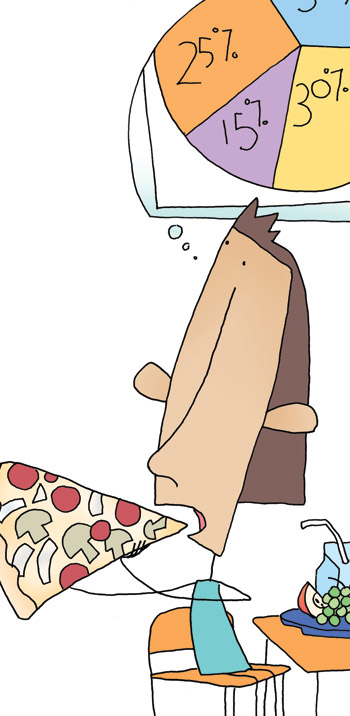
For example, what if someone asked you what makes up a perfect pizza slice? You might start by discussing a crust with a crisp base and bread-like center. On top of that, you want pizza sauce with oregano and a touch of sweetness. Then comes the mozzarella cheese, the mushroom slices, the onion, the pepperoni. Each component needs to be in the right proportion and baked to perfection for a great slice.

In this unit, you will be asked to write an essay that breaks down a topic (such as a hobby, sport, career, or skill) into its important parts and then explains each part. For example, if you’re interested in guitars, you could write an essay explaining the role of the lead guitar, rhythm guitar, and bass guitar in a band. Or, if you know a lot about robotics, you could write an essay telling how robots move, sense objects, and perform tasks. The key to your writing is to select a topic that truly interests you and that you know a lot about.

Thinking About Categories

What if you went to the library to choose a book, but the books weren’t arranged in categories? You’d face a tough search! Books is a broad topic, after all. Here's one (of many) ways to break it down:
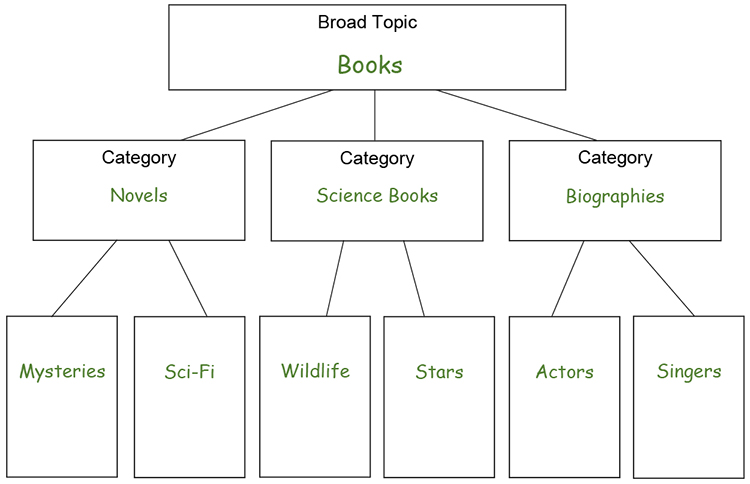
Line Diagram
By Anonymous (not verified), 12 March, 2026

Editing Cause-Effect Essays

Revising makes big improvements to your writing while editing focuses on little (but important) corrections. You'll look for problems with sentences, punctuation, capitalization, grammar, usage, and spelling. The following activities will help you edit your cause-effect essay.

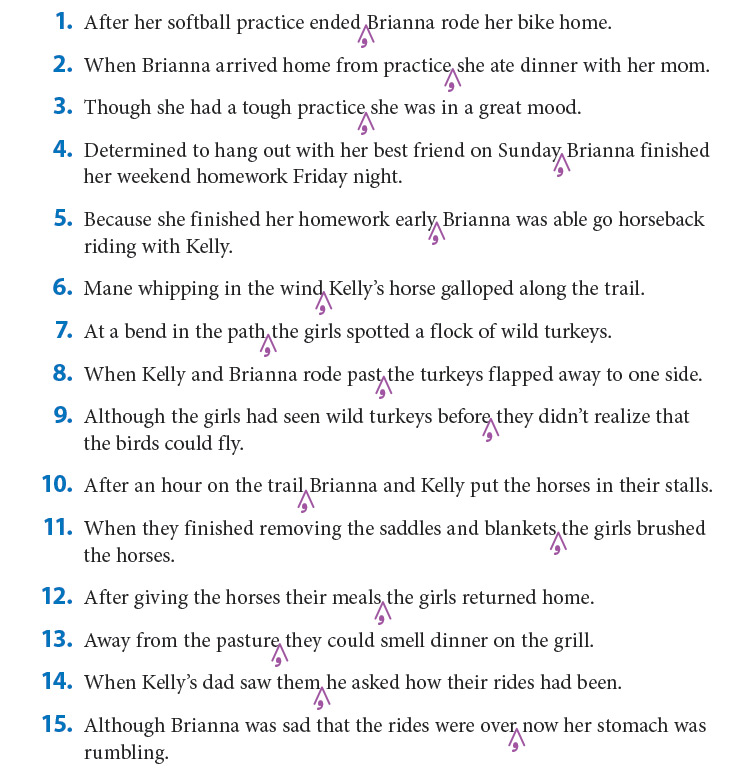
Editing for Commas with Intro Words

When a sentence starts with four or more introductory words, insert a comma after them, before the main part of the sentence.

Responding to a national initiative, our school changed its lunch program.

Even though Sam prefers white bread, he is giving wheat bread a chance.

Insert commas after introductory words.

Insert a comma after four or more introductory words.

Commas
  • Commas
  • Commas

Editing for the Right Word

“Affect” and “effect” sound the same but have different meanings and spellings.

  • Affect is a verb that means “influence.”
  • Effect is most often used as a noun to mean “result.” Effect can also be used as a verb to mean “bring about” or “accomplish.”

Weather affects (“influences”) clothing choices.

Weather has a strange effect (“result”) on my mood.

Sunny weather has positive effects (“results”).

Jill hopes to effect (“bring about”) change with her persuasive speech.

By Anonymous (not verified), 12 March, 2026

Revising Cause-Effect Essays

After you've completed a first draft of your cause-effect essay, take a break before you begin revising. You need to see your work objectively, because when you revise, you make big improvements to your ideas, organization, and voice. These activities will help you revise.

Revising for Depth of Detail

Each middle paragraph should fully explain the specific cause or effect identified in the topic sentence. If a paragraph lacks support, you need to add details to the paragraph.

Check depth of detail.

Briefly list the supporting details in each of your middle paragraphs. Do any paragraphs lack the level of detail of the others? If so, add supporting details, such as facts, reasons, and examples.

Middle Paragraph 1

Middle Paragraph 2

Middle Paragraph 3

Middle Paragraph 4

Teaching Tip

Use this lesson to help students deepen their explanations. Additional research may be needed to discover new details.

Revising for Focus

You can revise paragraphs for focus by developing one main idea and cutting unrelated details.

Unfocused paragraph (includes too many ideas and unrelated details)

One major cause of erosion is water. Over time, rainfall splashes against rock, causing it to wear away. Strong wind is another major cause of erosion. Crashing waves produce a similar impact. Huge waves can be dangerous for swimming. Lastly, powerful floods lead to rapid erosion.

Revised paragraph (one main idea developed in detail)

One major cause of erosion is water. Over time, rainfall splashes against rock, causing it to wear away. Crashing waves produce a similar impact. Lastly, powerful floods lead to rapid erosion.

By Anonymous (not verified), 12 March, 2026

Writing a Cause-Effect Essay

You've selected a topic, done your research, and formed a focus. Now it's time to write your first draft. Relax. You have all the material you need. Now you just need to put it down in a first form. Your draft doesn't have to be perfect: That's what revising and editing are for.

Writing the Beginning Paragraph

Your beginning paragraph starts with a lead that gets your reader's attention, includes detail sentences that explain the cause-effect relationship, and ends with a focus statement that tells readers just what your essay will be about.

Write a lead.

Read each lead-writing strategy and example, and write your own leads related to your topic.

  1. Ask a question.

    What did you eat for lunch today?

  2. Relate the topic to your own experience.

    Last year, school lunches changed in a big way.

  3. Start with a thought-provoking fact or statement.

    School districts are taking a closer look at school lunches.

Write your beginning paragraph.

Write your best lead sentence, add detail sentences, and provide your focus statement.

Lead Sentence

Detail Sentences

Focus Statement

By Anonymous (not verified), 12 March, 2026

Prewriting for Cause-Effect Essays

Instead of just leaping into writing, you should spend some time gathering information and organizing your thoughts. That's prewriting. This lesson will help you select a topic and gather details.

Prewriting for Topics

Cause-effect essays explain how one thing leads to another. To brainstorm cause-effect essay topics, think about changes to your school, community, or environment. Also consider important events in history.

Explore writing topics.

Answer the following questions to consider possible topics for your cause-effect essay.

  1. What changed or is changing in my school or community?
  2. What changed or is changing in the world?
  3. What changed or is changing in the environment?
  4. What is one event or invention that changed history?

Choose a writing topic.

Review your answers to the previous activity. Consider the causes and effects of each topic. Choose the topic you find most interesting and that has the clearest relationship between causes and effects. Write your topic below.