CCSS.ELA-LITERACY.W.6.6

By Anonymous (not verified), 12 March, 2026

Editing Literary Analyses

After revising your literary analysis, it is time to work on the finishing touches. Editing involves polishing your writing so that it has correct sentences, punctuation, capitalization, spelling, usage, and grammar. The following activities will help you edit your analysis.

Editing for Comma Usage

A comma creates a slight pause, gently separating the idea that comes before from the idea that comes after. This little separation help readers understand how words relate to each other. For example, a comma can show a reader how two or more adjectives work in front of a noun.

To Separate Equal Adjectives

Use a comma to separate two or more adjectives if they modify a noun in an equal way. Do not use a comma if the adjectives modify the noun in an unequal way.

I have a difficult, challenging job.

("Difficult" and "challenging" modify "job" in an equal way, so a comma is needed.)

Seasonal construction jobs are physically demanding.

("Seasonal" and "construction" do not modify "jobs" in an equal way. They need to be written in that exact order without a comma to make sense.)

How can you determine if adjectives are equal or unequal? Use one or both of these simple tests:

  • If you can switch the order of the adjectives and they still sound right, they modify equally and need a comma.

    I have a challenging, difficult job.

  • If the word and works between the adjectives, they modify equally and need a comma.

    I have a difficult and challenging job. I have a difficult, challenging job.

To Set Off Introductory Clauses and Phrases

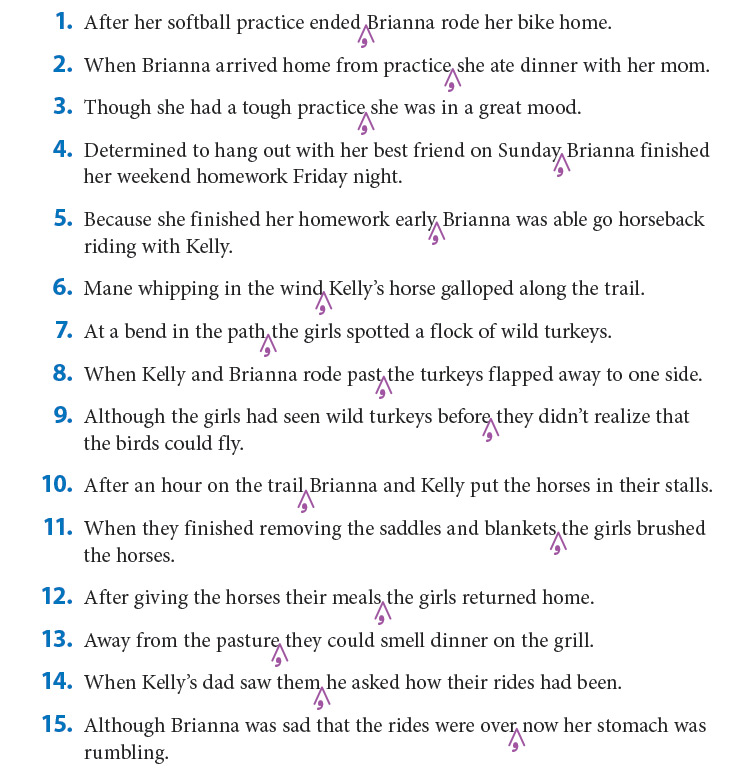
Use a comma after an introductory clause or a long introductory phrase. The comma helps the reader know when the introduction is over and the main part of the sentence is beginning. If an introductory phrase is very short (three words or fewer), the comma is optional.

Because weather changes quickly in the mountains, we carried rain gear.

(an introductory clause)

Sore and tired from the climb, we stopped for a rest near a waterfall.

(an introductory phrase)

After lunch we continued our hike.

(a short introductory phrase)
By Anonymous (not verified), 12 March, 2026

Editing Character Analyses

After revising your character analysis, you should next carefully edit it for correctness. Editing involves reviewing your punctuation, capitalization, spelling, and grammar. The following activities will help you work through important editing issues.

Editing Common Comma Errors

In the last lesson, you learned how to combine sentences to improve the flow of your writing. In this lesson, you'll review how to avoid three common comma errors that can occur when you combine sentences.

  1. Missing Comma in a Compound Sentence: When you combine two sentences (independent clauses) using a coordinating conjunction (and, but, or, nor, for, so, yet), always place a comma before the conjunction.

    Manuel gave swimming lessons to Sam, and Lupita coaxed him into the wave pool.

    Note: Without the comma, this compound sentence could be misread as "Manuel gave swimming lessons to Sam and Lupita . . .

  2. Missing Comma in a Series: Use commas to separate three or more words, phrases, or clauses, in a series.

    I want to thank my parents, Spock, and Serena Williams.

    Note: Without the final comma, this sentence could be misread as "I want to thank my parents, Spock and Serena Williams (the parents are Spock and Serena Williams?).

  3. Missing Comma After Long Introductory Phrases or Clauses: Place a comma after a long introductory phrases or clauses before the main part of sentence.

    In the middle of the night, the neighborhood was usually very quiet.

    When I heard a thump and shout, the pounding of my heart filled the room.

    Note: Without the comma, the opening clause gets confused with the subject: "a thump and shout the pounding of my heart . .&nbsp."

By Anonymous (not verified), 12 March, 2026

Assessing with an Explanatory Rubric

A test grader will use a rubric to score your on-demand writing. A rubric lists the features the grader is looking for at different levels of performance. If you understand the kinds of rubrics that graders use, you will better understand how to write responses that score well.

By Anonymous (not verified), 12 March, 2026

Editing Cause-Effect Essays

Revising makes big improvements to your writing while editing focuses on little (but important) corrections. You'll look for problems with sentences, punctuation, capitalization, grammar, usage, and spelling. The following activities will help you edit your cause-effect essay.

Editing for Commas with Intro Words

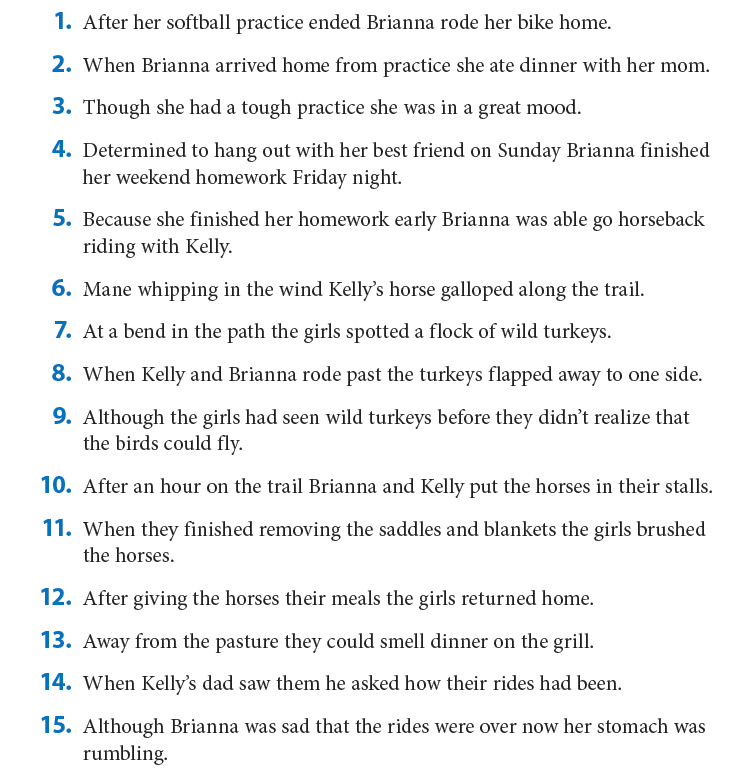
When a sentence starts with four or more introductory words, insert a comma after them, before the main part of the sentence.

Responding to a national initiative, our school changed its lunch program.

Even though Sam prefers white bread, he is giving wheat bread a chance.

Insert commas after introductory words.

Insert a comma after four or more introductory words.

Commas
  • Commas
  • Commas

Editing for the Right Word

“Affect” and “effect” sound the same but have different meanings and spellings.

  • Affect is a verb that means “influence.”
  • Effect is most often used as a noun to mean “result.” Effect can also be used as a verb to mean “bring about” or “accomplish.”

Weather affects (“influences”) clothing choices.

Weather has a strange effect (“result”) on my mood.

Sunny weather has positive effects (“results”).

Jill hopes to effect (“bring about”) change with her persuasive speech.

By Anonymous (not verified), 12 March, 2026

Editing Phase Autobiographies

After making big changes to improve your phase autobiography, you need to make little changes (editing) to correct any remaining errors. You'll look for problems with sentences, punctuation, capitalization, grammar, usage, and spelling. The following activities will help you edit your writing.

Editing Possessives

In writing, possessives are used to show ownership. Read the following rules and examples about forming possessives.

  • To form the possessive of a singular noun or an indefinite pronoun, add ’s. (Indefinite pronouns include one, anybody, nobody, somebody, anyone, no one, someone.)

the dog’s ball, Jess’s book, someone’s backpack

  • To form the possessive of most plural nouns (those that end in s), add only the apostrophe.

the boys’ locker room, the teachers’ lounge, the Smiths’ party

  • To form the possessive of irregular plural nouns (those that do not end in s), add ’s.

the children’s toys, women’s basketball

Form possessives.

If the possessive form in any of the following sentences is incorrect or missing, replace it with the correct form. Use the rules and examples above as a guide.

  1. Joes train has been delayed. Joe’s train has been delayed.
  2. My books pages are stuck together. My book’s pages are stuck together.
  3. The mens’ locker room is down the hall. The men’s locker room is down the hall.
  4. The women basketball game lasted two hours. The women's basketball game lasted two hours.
  5. I poured the cat food into Henry’s bowl. I poured the cat food into Henry’s bowl. (correct)
  6. The party is at the Green’s house. The party is at the Greens’ house.
  7. The outcome of the election is anybodys’ guess. The outcome of the election is anybody’s guess.
  8. The closet was full of children’s toys. The closet was full of children’s toys. (correct)
  9. The first baseman missed the coachs’ sign. The first baseman missed the coach’s sign.
  10. Alisha met her friends at Janets’ house. Alisha met her friends at Janet’s house.