CCSS.ELA-LITERACY.W.7.2

By Anonymous (not verified), 12 March, 2026

Prewriting for Literary Analysis

Sometimes, the hardest part of writing is getting started. The prewriting ideas in this lesson will get you moving. These prewriting lessons will help you draw ideas and details from your reading and focus and plan your analysis.

Prewriting to Select a Work

Your teacher may assign a certain work of literature for you to analyze, or you may get to choose your own. If you need to choose between multiple works, create a chart to gather topic ideas. Then select the topic for your analysis.

Story and author

What is the story about?

What is the main character like?

"Thank You, Ma'm" by Langston Hughes

A boy tries to rob an old lady, but she drags him home.

Roger is a tough kid until he gets caught.

"Helen on Eighty-Sixth Street" by Wendi Kaufman

A girl tries to understand why her dad went away.

Vita is very smart.

Roll of Thunder, Hear My Cry by Mildred D. Taylor

A young girl learns important lessons about discrimination.

Cassie is bold and daring.

Fill in a topic-ideas chart.

Fill in the chart with topic ideas for your literary analysis. Review your answers, and choose one work to analyze.

Prewriting to Focus on Literary Elements

All fiction has a number of common elements: characters, plot, setting, and theme. You can ask questions about each element to gather details about the work you chose. You may need to reread portions of the work in order to fully answer qustions.
By Anonymous (not verified), 12 March, 2026

Editing Character Analyses

After revising your character analysis, you should next carefully edit it for correctness. Editing involves reviewing your punctuation, capitalization, spelling, and grammar. The following activities will help you work through important editing issues.

Editing Common Comma Errors

In the last lesson, you learned how to combine sentences to improve the flow of your writing. In this lesson, you'll review how to avoid three common comma errors that can occur when you combine sentences.

  1. Missing Comma in a Compound Sentence: When you combine two sentences (independent clauses) using a coordinating conjunction (and, but, or, nor, for, so, yet), always place a comma before the conjunction.

    Manuel gave swimming lessons to Sam, and Lupita coaxed him into the wave pool.

    Note: Without the comma, this compound sentence could be misread as "Manuel gave swimming lessons to Sam and Lupita . . .

  2. Missing Comma in a Series: Use commas to separate three or more words, phrases, or clauses, in a series.

    I want to thank my parents, Spock, and Serena Williams.

    Note: Without the final comma, this sentence could be misread as "I want to thank my parents, Spock and Serena Williams (the parents are Spock and Serena Williams?).

  3. Missing Comma After Long Introductory Phrases or Clauses: Place a comma after a long introductory phrases or clauses before the main part of sentence.

    In the middle of the night, the neighborhood was usually very quiet.

    When I heard a thump and shout, the pounding of my heart filled the room.

    Note: Without the comma, the opening clause gets confused with the subject: "a thump and shout the pounding of my heart . .&nbsp."

By Anonymous (not verified), 12 March, 2026

Revising Character Analyses

After you have completed a first draft of your analysis, set it aside awhile before you begin revising. Once you get some distance from it, you'll be able to see it with fresh eyes. Then look for opportunities to improve your draft. The following activities will assist you.

Revising to Connect Characters to Themes

An effective character analysis should show how the words and actions of the characters demonstrate larger themes. Often themes express life lessons, social or cultural realities, or moral dilemmas. Answering critical questions about the character can help you identify themes:

  1. Why is this character so interesting?

    Ghost is interesting because he tries to outrun his past, but doing so leads to bad decisions in his present.

  2. What is the most critical moment for this character?

    On the day he's supposed to get his uniform, his coach finds out he stole the track shoes.

  3. If this character could do one thing over, what would it be?

    He would have asked his mom or coach to help him get a pair of track shoes for the season.

  4. What emotion best defines this character?

    Ghost experiences many emotions, but the two that pop up the most are anger and resentment. He doesn't feel comfortable with himself until he lets others into his life.

  5. What can you learn from the character?
By Anonymous (not verified), 12 March, 2026

Writing a Character Analysis

After you've gathered evidence and written a working thesis statement about your character, you are ready to write an initial draft of your analysis. Start by writing an interesting lead sentence and using it to introduce a beginning paragraph. Or you can develop the middle paragraphs first and return to write the beginning and ending. If you need inspiration along the way, look at the end of this lesson to find an analysis of another character from Jason Reynolds's Track Series.

Writing the Beginning Paragraph

Start your essay with a lead that gets readers' attention and orients them to the piece of literature you will analyze. Then provide background information that leads to your thesis statement.

Write a lead sentence.

Try out each lead strategy below. Let the examples inspire you as you write similar leads for your own topic.

  1. Name the work and author and summarize its importance.

    Ghost by Jason Reynolds tells the story of a middle-schooler running toward a better future.

  2. Ask a compelling question about the character or theme.

    Have you ever tried running away from a problem?

By Anonymous (not verified), 12 March, 2026

Prewriting for Character Analyses

Some of the most important work of developing a character analysis happens before you begin writing. The prewriting stage helps you choose a topic, gather details about it, and figure out what you want to say about it. By doing the necessary thinking and gathering up front, you'll have an easier time writing your analysis.

By Anonymous (not verified), 12 March, 2026

Writing an Essay for Assessment

Some tests ask you to write an essay response to short stories and poems you have closely read. The following activity will help you practice.

Analyze an essay prompt.

Read the following prompt, answer the PAST questions about it, write a focus statement, and list details.

Read the writing prompt.

The short story “Friend Beneath Your Feet” tells about a day that Jana spends with her shadow. The poem “Chicago Poet” tells about a poet seeing himself in a mirror. Both deal with reflections and shadows, which stay with us our whole lives. What theme is the same in this short story and this poem? How does the short story express this theme? How does the poem express it? Use evidence from the two sources.

Answer the PAST questions.

Purpose?

Audience?

Subject?

Type?

By Anonymous (not verified), 12 March, 2026

Analyzing Writing Prompts

Often tests contain writing prompts that you must respond to. Your first step is to understand the writing prompt. Use the PAST questions.

  • Purpose? Why am I writing? (To analyze? To entertain?)
  • Audience? Who will read my writing? (Tester? Classmates?)
  • Subject? What subject should I write about? (Story? Poem?)
  • Type? What type of writing should I create? (Essay? Story?)

Sample Writing Prompt

In “The Most Sensible Car” by Carolyn Asher, Coup is looking for a practical owner. In the end, Coup says, “Nobody wants a truly sensible car these days.” Is he right? What evidence from the story supports your conclusion. Write an essay explaining Coup’s problem with finding an owner, and show what the story says about life.

Answers to PAST Questions

  • Purpose?

    Explain Coup’s problem with finding an owner and show what the story says about life

  • Audience?

    Any other reader

  • Subject?

    “The Most Sensible Car” by Carolyn Asher

  • Type?

    Essay

Note: Some writing prompts do not answer all of the PAST questions. If an answer is not given, infer one (come up with a reasonable answer based on the rest of the information).

By Anonymous (not verified), 12 March, 2026

Writing an Application Letter

Once you finish prewriting, you are ready to write the body of your letter. These activities will help write strong opening, middle, and ending parts.

Writing the Opening Part

Write your opening part.

Read about opening strategies. Then use them to write the beginning of your letter of application.

In the first part of your letter, you should do two things.

  • Identify the position that you are applying for.

    I am interested in going to SeaScapes Scuba Camp this summer.

  • Tell what you know about the organization, such as where you learned about it.
  • I read about your camp in the most recent issue of Scuba Kidz magazine. I understand that your camp is for kids aged 10 to 16 with all different levels of experience.

Opening Paragraph

Writing the Middle Part

Write your middle part.

Read about middle strategies. Then use them to write the middle part of your letter.

By Anonymous (not verified), 12 March, 2026

Writing a Research Report

Once you finish your planning and research, you are ready to write your first draft. These activities will help you hook the reader's interest at the beginning, explain important information in the middle, and end with a strong final point.

Writing the Beginning Paragraph

Write a lead.

Read each lead-writing strategy and example and write your own.

  1. Ask a question about the topic.
  2. Did you know women couldn’t become astronauts for almost the first three decades of the space program?

  3. Start with a surprising fact or detail about the topic.
  4. Before Sally Ride, space travel was mostly a club for men.

  5. Tell a little story about the person.
  6. Sally Ride didn’t always want to be an astronaut. When she was young, going to space was not a realistic aspiration for girls.

Write your beginning paragraph.

Write your lead and then give details that lead up to your focus statement. End the paragraph with your focus statement.

By Anonymous (not verified), 12 March, 2026

Prewriting for Research Reports

Of all the forms of academic writing, research reports require the most planning. The good news is that the extra attention you give to prewriting will make it easier for you to draft your report.

Prewriting to Select a Topic

For your report, you will research an important person from the past or present. As you consider topic choices, note people who truly interest you, because you will be spending a lot of time learning about them.

Create a cluster.

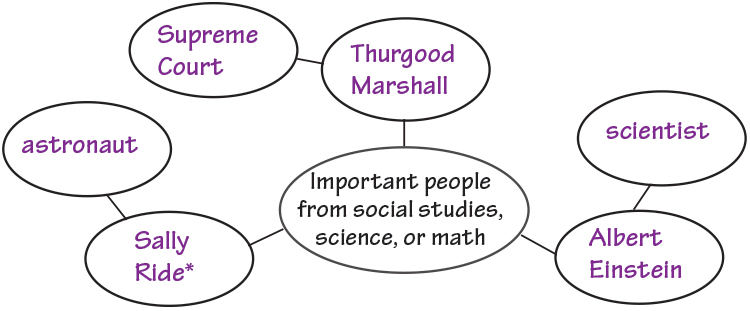
Create a cluster about historical figures from social studies, science, or math. Add names in the first branch of circles. Write a detail about the person in the second branch. Finally, put a star by the person you want to write about.

Cluster
  • Cluster
  • Cluster

Other Ways to Discover Topic Ideas

Search online or scan your school books for influential figures. Also try freewriting for topics.

Prewriting for Research Questions

Now that you have decided on a topic for your report, you need to find out what you already know about the person and what you want to learn.

Record what you know.

List all the things that you definitely know to be true about your topic. Then list any information you are not completely sure of.