Editing Argument Essays
After you complete major revisions to your argument essay, you should edit it to make sure every word and punctuation mark is correct. Among other issues, you'll make sure that you have correctly used pronouns and commas. The activities that follow will help. You'll also use a checklist to finalize your editing.
Editing to Correct Pronoun Usage
A pronoun is a word that stands in the place of a noun or another pronoun (its antecedent). The most familiar pronouns are I, me, my; we, us, our, ours; you, your, yours; he, she, it, they, their, theirs. A pronoun needs to agree with its antecedent. That means both need to have the same person (first, second, or third), the same number (singular or plural), and the same gender (masculine, feminine, neuter, or indeterminate).
Agreement
Carlos brought his guitar. (Carlos and his are both third person, singular, and masculine: they agree.)
I played my bass. (I and my are both first person, singular, and indeterminate.)
The band members practiced their parts before rehearsal. (Members and their are both third-person, plural, and indeterminate.)
Sometimes a singular pronoun replaces a word such as anybody, anyone, everybody, everyone, nobody, no one, somebody, or someone. Notice how these words are third person, singular, and indeterminate, but English has no such personal pronoun to replace it.
Agreement Errors
Someone left their assignment here. (Someone is singular but their is plural.)
Someone left his assignment here. (Someone is indeterminate but his is masculine.)
You can fix the problem by using alternate pronouns (her or his) or rewriting the sentence to avoid the problem.
Corrected Agreement
Someone left her or his assignment here.
I found someone's assignment here.
Students should make sure they didn't leave their assignments behind.
Most pronouns change form to create possessives. A personal pronoun with an apostrophe s is a contraction, not a possessive. Make sure to use the correct form.
Possessive Pronouns
your, its, their, whose
Contractions with Pronouns
you're, it's, they're, who's
Fix pronoun use.
In each sentence below, fix pronoun usage. Afterward, review your essay and correct any pronoun errors that you find.
-
Who likes to hear, "YourYou're options are limited"?
-
They'reTheir limited because of special-interest lobbies.
-
Everyone wants his or hertheir options to remain open.
-
Restaurant owners fear theirthey're customers will go elsewhere.
-
Anyone who can afford a van and food can set up her or histheir own food truck.
-
Food trucks have really expanded theirthey're menus.
-
Who'sWhose the one who gets to decide what's for lunch?
-
Each citizen can make up his or hertheir own mind about lunch selections.
-
An average diner has her or hisyour go-to selections on each menu.
-
It'sIts time to open our city to food trucks!
Editing for Comma Usage
As the most common punctuation mark, commas often get misused. Learning and applying four basic comma rules can help you improve the correctness of most of your writing.
- Use a comma to separate the clauses in a compound sentence. You can join two short sentences together with a comma and a coordinating conjunction (and, but, or, nor, for, so, yet). Using only a comma and no conjunction creates an error called a comma splice. Using neither the comma nor the conjunction creates an error called a run-on. Following this one rule can eliminate three types of errors.
The food truck craze is sweeping the nation, and many foodies are getting onboard.
- Use a comma after four or more introductory words. When an introductory clause or a long introductory phrase starts a sentence, set off the phrase with a comma.
With a new food-truck ordinance, Waterford can expand its culinary horizons.
- Use a comma to separate equal adjectives. If two adjectives come before a noun and equally modify it, put a comma between them. You can tell if they equally modify it because you can switch the order of the adjectives, and they still make sense (or you can put an and between them, and they still make sense).
Have you heard of the exciting, innovative trend in eating out?
- Use a comma before the and or or in a series of three or more. When you list three or more words, phrases, or clauses in a series, use a comma after all but the last item (including a comma after the second-to-last item).
Would you like shawarma, sushi, or shiskabob?
Teaching Tip
Each of these rules helps readers. The first rule helps readers realize where one idea (independent clause) ends and another begins. The second separates a less-important idea (introductory phrase or clause) from the main idea of the sentence. The third helps readers understand how adjectives modify a noun. The final keeps the elements in a list parallel and prevents confusion.Correct comma errors.
Correct comma usage in each of the following sentences. Afterward, review your essay and correct any comma errors you find.
-
People can choose from home cooking, restaurant fare, and food-truck offerings.
-
Food trucks provide a quick, simple solution to employers out of town.
-
Restaurant owners don't want unfair competition, but they should not close the marketplace to fair competition.
-
Sensible license fees, reasonable setbacks from competing restaurants, and other provisions can ensure a fair marketplace.
-
With the advent of food trucks, the foodie scene in Waterford will thrive.
-
Though some people remember just fast-food trucks, today's trucks offer much more.
-
Diners can try Asian, African, and South American cuisine.
-
We should conduct a thorough, diligent review of food-truck ordinances.
-
After a public debate on the issue, the city council will vote on an ordinance.
-
We await the exciting, delicious possibilities!
Editing in Action
After you check your argument essay for pronoun and comma usage, you should also make sure your work has correct punctuation, spelling, usage, and grammar. Keep editing until your essay is error free.
-
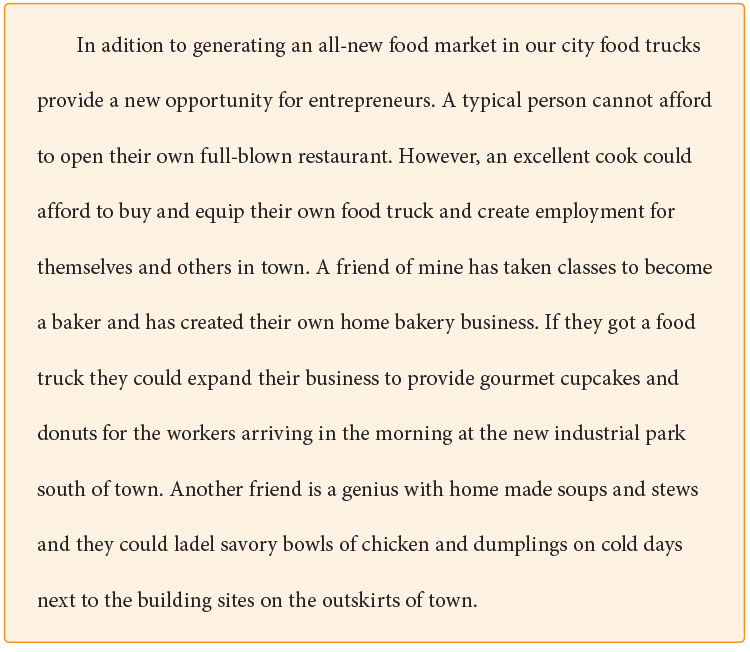
Paragraph Before Edits
-
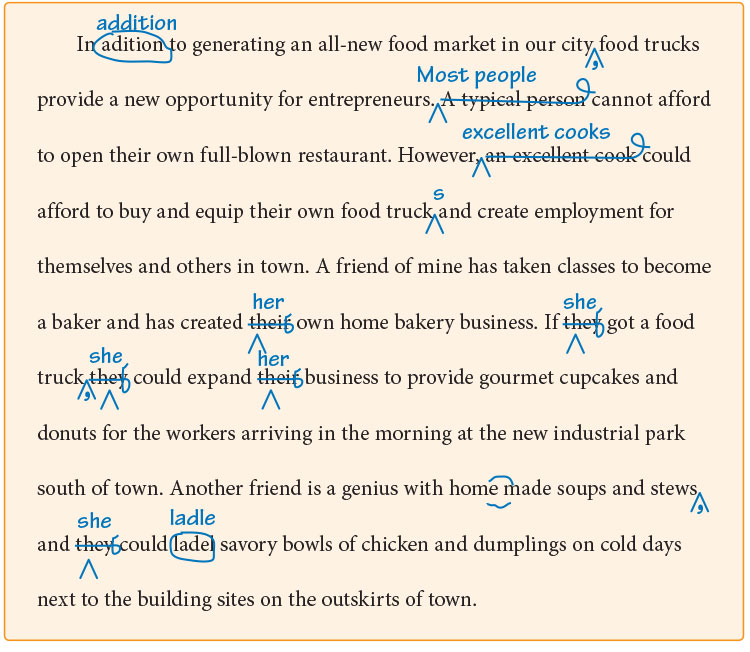
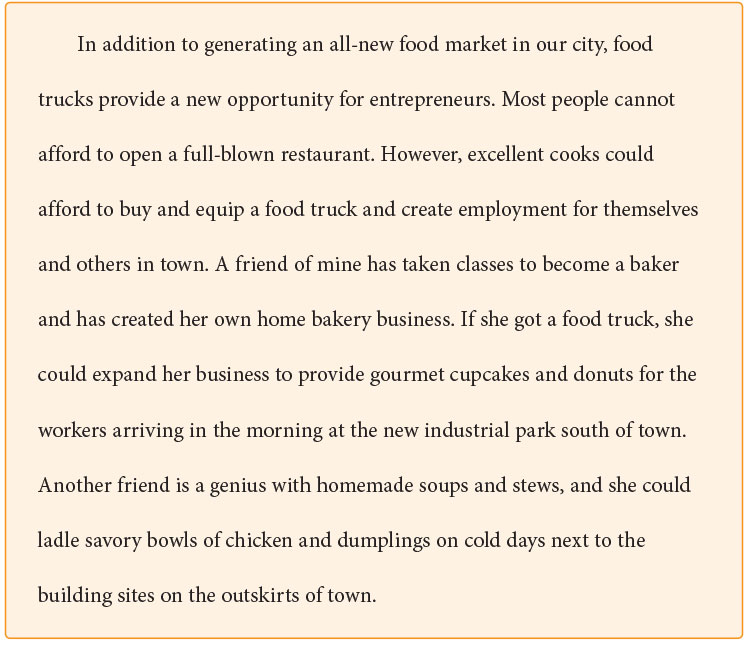
Corrections improve pronoun usage, comma placement, and spelling.
-
Paragraph After Edits
Edit with a checklist.
Use the following checklist to edit your argument essay. When you can answer a question with a yes, check it off. Continue editing until each line is checked.
Sentences
- Do sentences read smoothly?
- Are sentences correct, without run-ons, comma splices, or fragments?
Punctuation
- Do commas appear before coordinating conjunctions (and, but, or, nor, for, so, yet) in compound sentences?
- Do commas follow introductory clauses and longer introductory phrases (four words or more)?
- Do commas appear between equal adjectives?
- Does a comma appear before the coordinating conjunction in a series of three or more items?
Mechanics
- Are the first words in sentences capitalized?
- Are specific names of people, places, and things capitalized?
- Have I checked spellings of the names of all people, places, and things?
- Have I checked spelling using a dictionary or the spell checker on my computer?
Grammar
- Do subjects and verbs agree in number?
- Do pronouns and antecedents agree in number, person, and gender?
Usage
- Have I checked the usage of terms specific to my topic (such as food truck)?
- Have I correctly formed the possessives of personal pronouns (your instead of you’re, their instead of they’re, its instead of it’s)?
Publishing Your Argument Essay
Now that you have drafted, revised, and edited your argument essay, you'll want to create a clean final copy before you submit it for a grade and share it with classmates and family members.
Publishing a Final Copy
Create a clean final copy.
Include your revising and editing changes and read over your work a final time. Spell-check your essay. Then share your work with your instructor and other important people in your life.
Reflecting on Your Writing
Reflect on your writing.
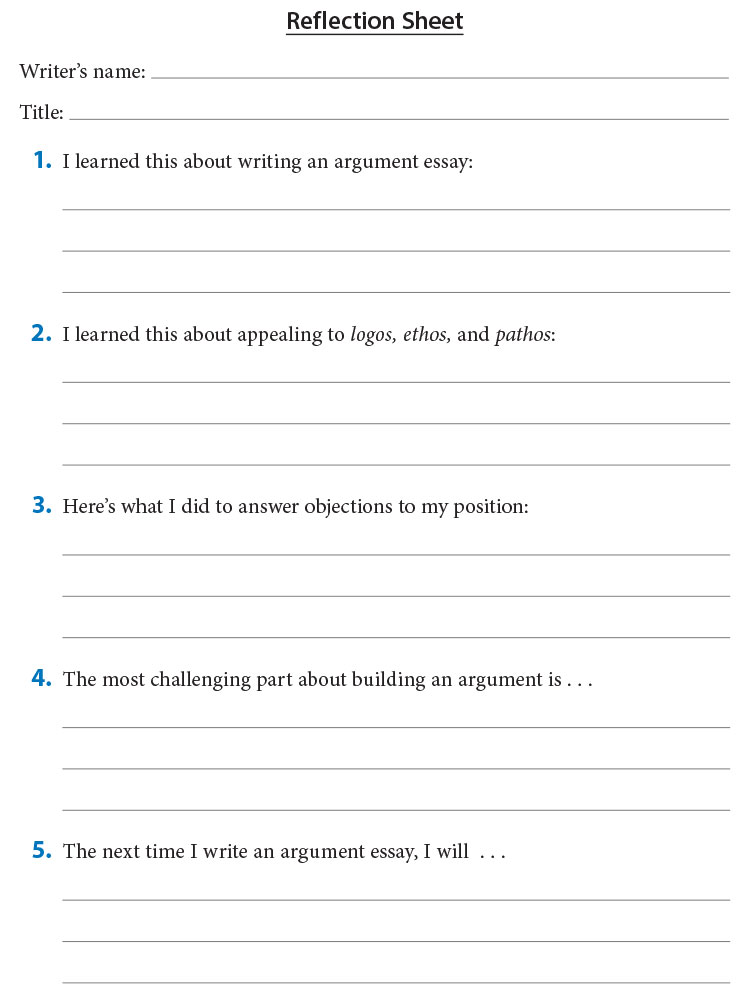
Complete the following sheet to reflect on writing an argument essay.