Revising College-Entrance Essays
Of course, online college applications provide a space for you to write your response to the prompt, so it's tempting to draft an essay and hit "submit." But this essay is really important, impacting your future. You definitely want to take your time revising, making the work as strong as possible. Your essay is your first impression with the school. Make it a good one. These revision strategies can help.
Revising to Target the Prompt
First, you need to make sure you have answered the prompt. A brilliant essay that talks about rock climbing will not score well when the prompt asked for a definition of leadership. You can use your PAST analysis of the prompt to check your response. Turn each answer into a question, and use them to analyze your response.
Write an essay that introduces us to who you are. Tell us about a particular life experience, talent, commitment, or interest you have. Explain how your presence will enrich life on campus.
- Purpose: Why am I writing? (Do I introduce myself and tell how I will enrich life on campus?)
- Audience: Who will read my writing? (Do I address admissions officers, providing the information they need to know about me?)
- Subject: What am I writing about? (Do I focus on a particular life experience, talent, commitment, or interest I have?)
- Type: What form should my writing take? (Do I compose my answer as an essay?)
Target your response.
Review your PAST analysis of the prompt, turning your answers into questions. Then use these new questions to check your response, making sure it is on target. Revise as needed.
Revising to Give Specific Details
If your narrative deals in generalities, it will feel hazy and uninteresting for admissions officers. Replace general actions and descriptions with specific details, focusing on what you see, hear, and feel. These details make your writing vivid and engaging.
Generalities
I climbed higher and then waited for my teammates.
Vivid, Specific Detail
I looked for handholds and footholds in stone, paused to set a carabiner and thread a safety line, grabbed a shoulder of rock, and pulled myself higher. Then I squeezed the brake and sat in the harness, trusting Big Jake with my weight while Karl and Josiah rose beside me.
Provide specific details.
Review your college-entrance essay, looking for generalities. Consider replacing them with sensory details, exact descriptions of actions, names of people or courses, and other specifics.
Teaching Tip
Specific details let readers experience ideas "first-hand," as if they were climbing the cliff face themselves. That's why they make writing vivid and memorable.
Revising to Vary Sentences
Often college-entrance essays become repetitive, "I did this . . . I realized . . . I thought this . . . I plan to . . ." Yes, a narrative essay is about you in the past, present, and future, but starting every sentence with "I" leads to a very choppy essay that sounds self-centered. If you have this issue, you can solve it by varying your sentence beginnings. Try these strategies:
Rewrite some sentences, giving them a subject other than "I."
"I" as Subject
I changed in that moment. I could feel it. I might not need rock climbing in real life, but I realized it basically was real life. I used muscle and grit and courage. I climbed and helped other people who are climbing.
Varied Subjects
That was the moment I changed. I could feel it. Yeah, rock climbing wasn't a skill I'd ever need in real life, except that it basically was real life. It's all about muscle and grit and courage, about climbing and helping other people who are climbing.
Start some sentences with a modifying word or phrase.
"I" at Beginning
I had to learn a hundred different survival skills: orienting, fire building, shelter building, wound setting, snare setting, fish cleaning, and, of course, rock climbing. I thought it was a waste of time to learn all this stuff I'd never use in real life. But not learning it left me cold and hungry and wet. I dug in and learned. I could do it, all of it, and do it well. I gained a new confidence.
Modifying Word or Phrase at Beginning
I had to learn a hundred different survival skills: orienting, fire building, shelter building, wound setting, snare setting, fish cleaning, and, of course, rock climbing. At first, I thought it was a waste of time to learn all this stuff I'd never use in real life. But not learning it left me cold and hungry and wet, so I dug in and learned. Surprisingly, I could do it, all of it, and do it well. I gained a new confidence.
Use a subordinating conjunction (after, although, because, when) to combine two sentences.
"I" at Beginning
I realized I could help others and even teach them. I started to connect.
Modifying Word or Phrase at Beginning
When I realized I could help others and even teach them, I started to connect.
Vary sentence beginnings.
Revise the repetitive sentences in the paragraph below by giving some new subjects, starting some with modifying words or phrases, and combining some with subordinating conjunctions (after, although, as, as if, as long as, as though, because, before, if, in order that, provided that, since, so that, that, though, till, unless, until, when, where, whereas, while).
I am a leader in my school: President of the National Honor Society, Vice-President of Student Government, and Chairman and Founder of the Teacher Appreciation Committee. I founded this committee to address the problem of teacher morale at my school. I have made Burlington High School a better place to teach through my efforts, including a “Teacher of the Month Award” and “Dress as Your Favorite Teacher Day.” I have served on the Danish Exchange Planning Commission. I have organized the exchange of students between Burlington, Wisconsin, and Roskilde, Denmark. I hosted Laura Lund-Knudsen and later represented my school and community when I stayed with her family in Denmark. I soaked in European culture and customs while in Denmark, and I viewed my own country from a new perspective. I hosted Nikolaj Jensen-Holm in our home for a week next year. I learned what it means to be an American and how to participate as a citizen of the world.
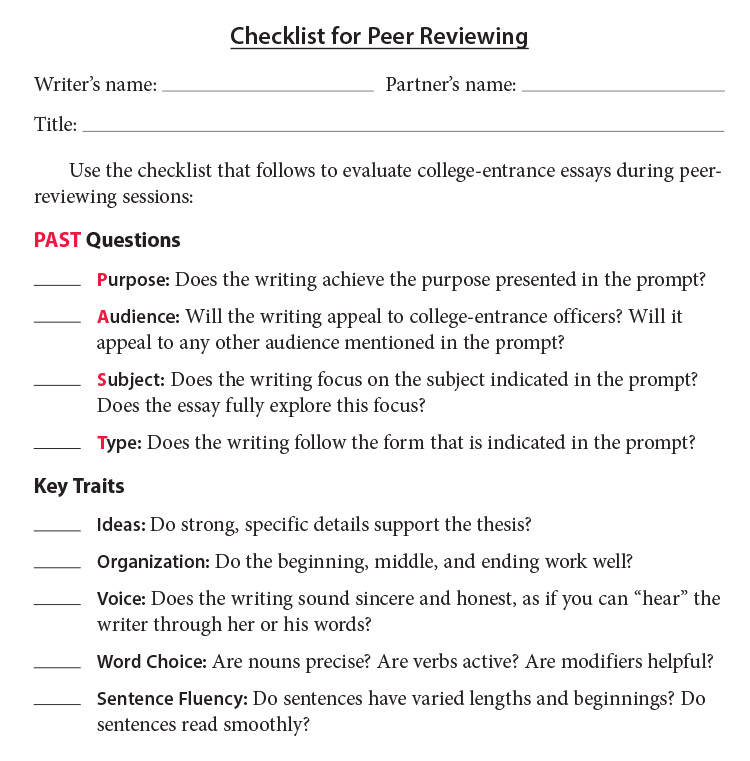
Revising with a Peer Response
Share your writing.
Have a trusted classmate read your college-entrance essay and complete the form.
Revising in Action
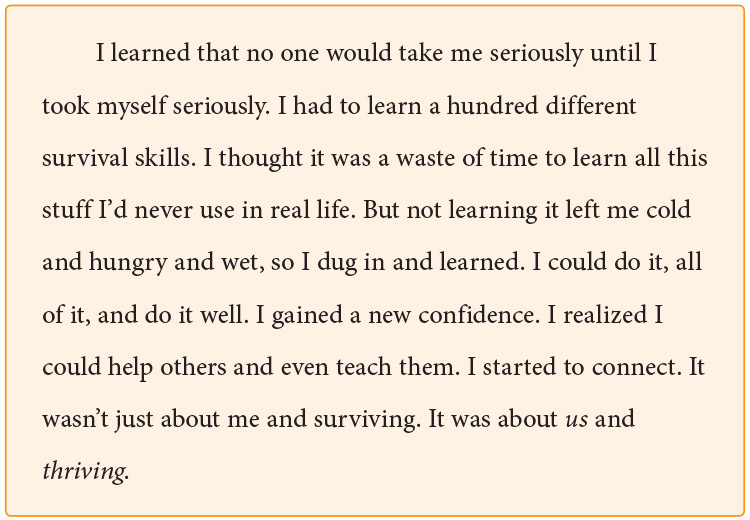
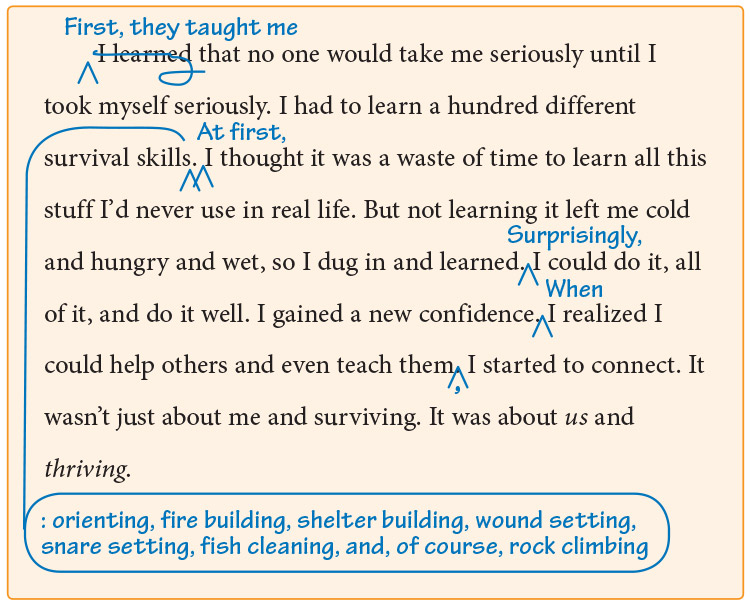
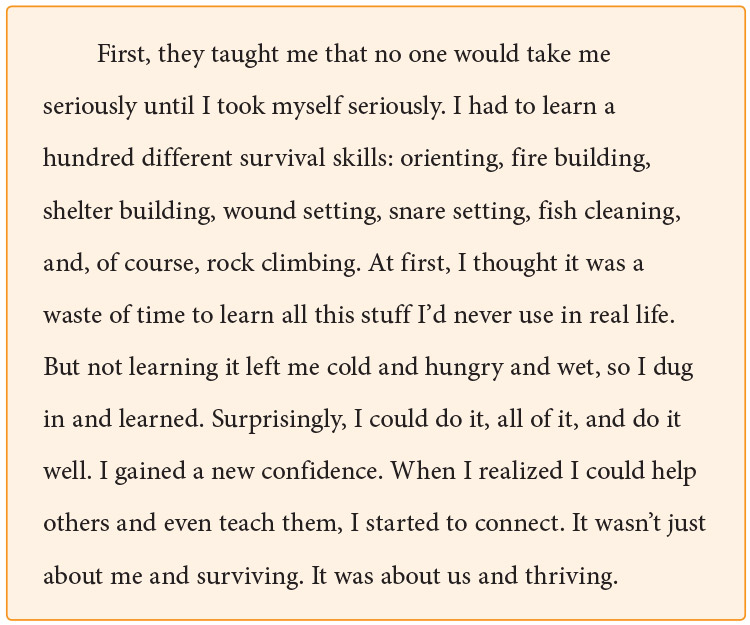
When you revise, you add, delete, rewrite, and rearrange your writing to make it clearer. Here are some revisions to the college-entrance essay about rock climbing.
-
Paragraph Before Revisions
-
Specific details make a passage vivid, and changes improve the variety of sentences.
-
Paragraph After Revisions
Revise with a checklist.
As you revise your college-entrance essay, ask yourself the questions on this checklist. When you can answer a question yes, check it off. Continue revising until all questions are checked off.
- Does the essay address the Subject and Purpose in the prompt? Does it connect to the Audience? Is it the correct Type of writing?
- Does the essay have a strong lead that catches the interest of college-admissions officers?
- Does the thesis statement clearly focus the paper?
- Does each body paragraph develop a main point in support of the thesis statement?
- Do specific details make the essay vivid for the reader?
- Do the sentences have varied beginnings (not all starting with "I")?