Editing Nonfiction Reviews
After revising your nonfiction review, you need to edit it to correct any remaining errors. You'll look closely at sentences, punctuation, capitalization, grammar, usage, and spelling. The following activities will help you edit your review.
Editing for Comma Splices
A comma splice is a sentence error that happens when you join (splice) two sentences using a comma. A comma alone is not strong enough to join two sentences. You can correct the error in one of three ways: (1) replacing the comma with end punctuation, (2) replacing the comma with a semicolon, or (3) adding a coordinating conjunction after the comma.
Comma Splice
People used to believe that there were people on Mars, they made up stories about Martians.
Corrected with End Punctuation
People used to believe that there were people on Mars. They made up stories about Martians.
Corrected with a Semicolon
People used to believe that there were people on Mars; they made up stories about Martians.
Corrected with a Coordinating Conjunction
People used to believe that there were people on Mars, so they made up stories about Martians.
Correct comma splices.
Fix the comma splices in the following sentences.
- Mars shines with red and orange light, it is often called the Red Planet.
- The Romans named Mars after their god of war, its red color reminded them of blood and war.
- Mars is only one-half the size of Earth, the Red Planet actually has more moons than Earth.
- Someday, astronauts will go to Mars, they will live on the planet for a while and check for signs of life.
- Mars is much colder than Earth, the astronauts will need food and heated suits.
Editing the Punctuation of Titles
Different types of titles need different types of punctuation. Titles of shorter pieces of writing—such as short stories, articles, and poems—should be placed in quotation marks. Titles of longer pieces—such as books and magazines—should be italicized. Can you recognize the difference in these examples?
Nonfiction book
The Diary of Ann Frank
Nonfiction article
“How Anne Frank's Diary Survived”
Punctuate titles.
Choose the correct punctuation for the titles in parentheses.
- S.E. Hinton wrote a novel called (The Outsiders, The Outsiders"The Outsiders") when she was 16 years old.
- An article called the (Descent of Skydiving, "Descent of Skydiving" "Descent of Skydiving" ) appeared in (Sports Illustrated, Sports Illustrated"Sports Illustrated") magazine.
- My favorite poem is (Stopping by Woods on a Snowy Evening, "Stopping by Woods on a Snowy Evening""Stopping by Woods on a Snowy Evening") by Robert Frost.
- (I Am Malala, I Am Malala "I Am Malala") is a powerful autobiography by Malala Yousafzai.
- I read an interesting article the other day called (Egyptian Clothing Facts, "Egyptian Clothing Facts""Egyptian Clothing Facts") about fashion in Ancient Egypt.
Editing in Action
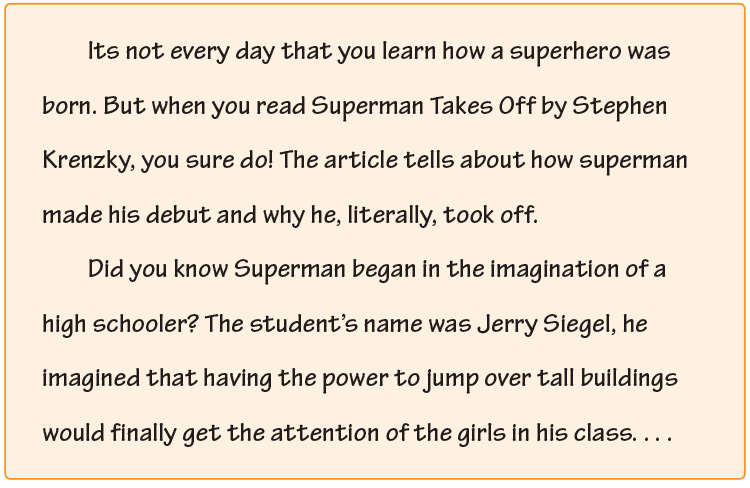
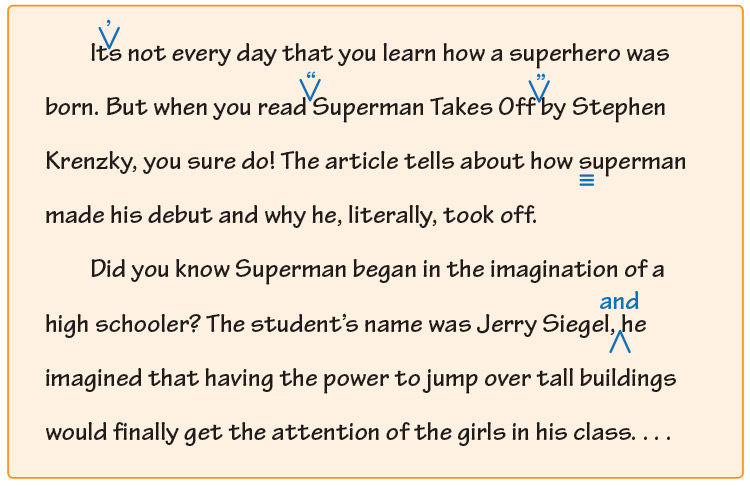
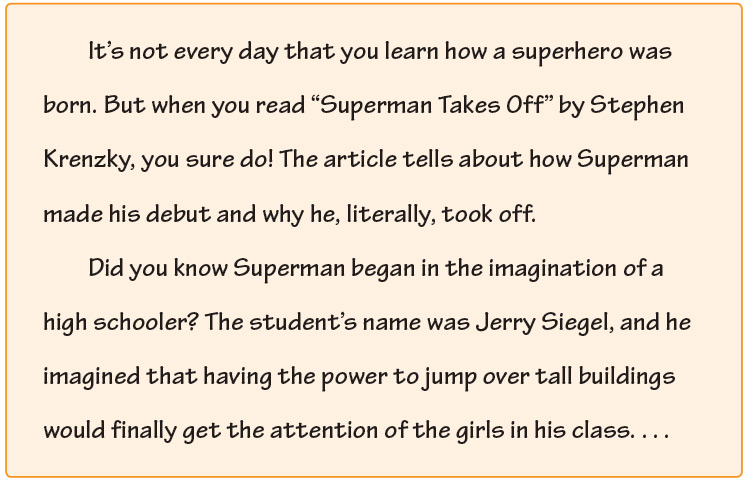
When you edit, you check to make sure your review is correct.
-
Paragraph Before Edits
-
Usage and punctuation errors are fixed as well as missing capital letters and a comma splice.
-
Paragraph After Edits
Edit with a checklist.
Read each line. When you can answer each question with a yes, check it off.
Punctuation
- Did I close each sentence with an end punctuation mark?
- Do commas appear before coordinating conjunctions (and, but, or, nor, for, so, yet) in compound sentences?
- Do I put quotation marks around exact words taken from the book or article I'm reviewing?
- Do I italicize (or underline) book titles and put quotation marks around article titles?
Capitalization
- Are the first words in sentences capitalized?
- Are proper names of people, places, and things capitalized?
Grammar
- Do all subjects and verbs agree?
- Are sentences complete (no fragments or run-ons)?
Usage
- Are words used correctly (your/you’re, their/they’re, its/it’s)?
Spelling
- Did I check for spelling?
- Did I use a dictionary or the spell checker on my computer?
Publishing Nonfiction Reviews
When you publish your review, you share it with others. First, you need to make a clean final copy of your work. Then you should find ways to share your writing with classmates, your teacher, your family, and your friends.
Publishing a Final Copy
Create a final copy of your review.
Include your revising and editing changes and read over your work a final time. (If you are working on a computer, spell-check your work.)
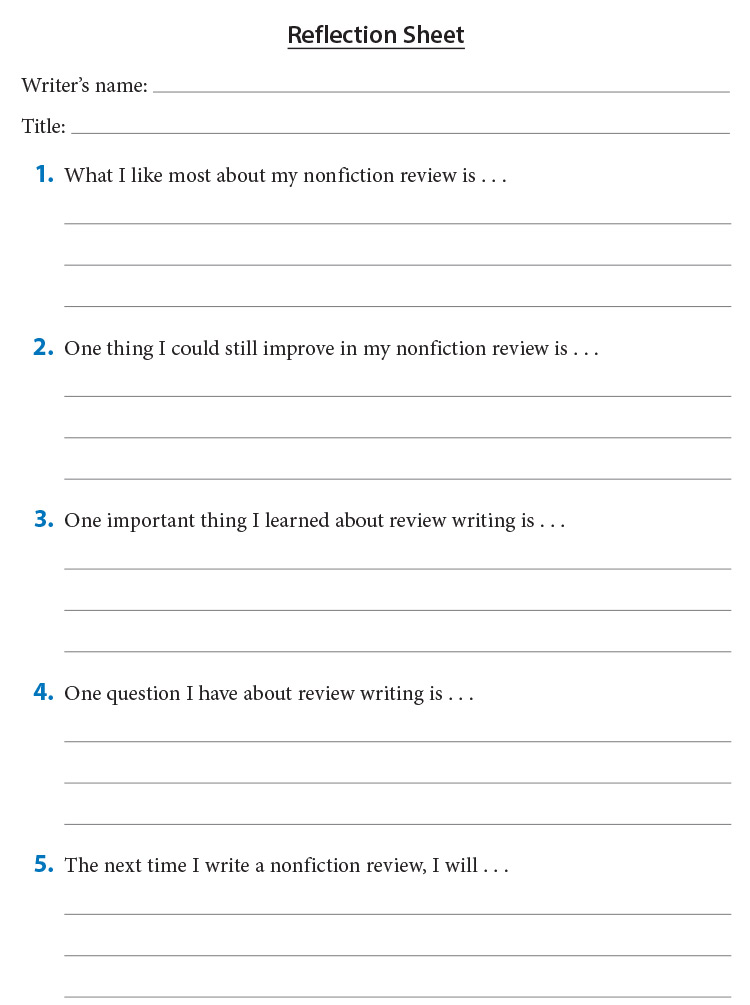
Reflecting on Your Writing
Reflect on your writing.
Complete the following form to think about what you learned.