Revising Résumés and Cover Letters
So you've done the hard part, actually writing the résumé and cover letter. Take a little break if you can. Then come back to them. You want to make sure these two documents do the best job of representing you to a potential employer. Is there some critical piece of information that you forgot to include? Is there some extraneous piece of information that you don't need? In revision, you can make sure your documents have all the "right stuff."
Revising for Key Details
Remember that your cover letter and résumé are really meant for the employer, not for you. You already know who you are. The employer needs to know, so these documents should provide the key details without distraction. You can check for details by reviewing item 3 on the prewriting activity "Take the Employer's Perspective."
3. What kind of employee would make life better for this contact person?
A part-time reporter who can take any assignment, attend an event, interview those involved, take photos, research carefully, check facts, write a news article or feature article, create an effective headline, and digitally submit materials on or before deadline.
What employer needs did you fail to address in your cover letter and résumé? For example, Joyce realized that she forgot to mention that she is a skilled photographer, so she can provide images for her articles. She added a line to the "Skills and Qualifications" section of her résumé.
- Eloquent, prolific, hard-working, determined, friendly, cooperative
- Skilled photographer with a Nikon and extensive experience in Photoshop
- Proficient in Google docs, In-Design, HTML, and Drupal
In her cover letter, Joyce also decided to feature her photography and copywriting skills.
As my résumé shows, I am editor in chief of my high school newspaper and have also worked as a writer, copy editor, and proofreader. I write objective, feature, and editorial articles as well as captions and headlines. Photos taken with my Nikon and processed with Photoshop accompany my writing. I design many articles, pages, and spreads for the paper using InDesign, and I am proficient in HTML and Drupal coding for online design. . . .
To make room for these additions, Joyce deleted lines about her hobbies of hiking and horseback riding. She originally included these details to show that she was physically fit but realized this trait wasn't a primary concern of the employer.
Check your details.
Review your answers to the prewriting activity "Take the Employer's Perspective." Have you addressed each of the employer's basic needs? What details should you add? What details should you remove? Revise your cover letter and résumé to make sure they focus on the employer's perspective.
Revising for Precise Word Choice
Every job has its own vocabulary. Using it correctly shows that you are experienced in the field. Using it incorrectly or not at all signals that you are not prepared for the job. Note the difference in impact created by imprecise word choice instead of precise word choice.
Imprecise Terminology
Editor in Cheif—High School Paper, 2017 to present: Work with 10 people, tell them what to write about, make sure they do what they're supposed to do on time
Precise Terminology
Editor in Chief—Burlington High School Gazette, 2017 to present: Manage staff of 10 writers, establish beats, run schedule, enforce deadlines
Correctly spelling the job title "Editor in Chief" and using journalism-specific terminology convinces the reader that the writer knows the trade.
In addition to correctly using terminology, you should check your other word choice for effective connotation. The connotation of a word is the feeling it creates beyond the dictionary definition, or denotation. Note how Joyce replaces aggressive-sounding words with ones that connote fairness and positivity.
Negative Connotations
I've stalked nerds, jocks, and theatre geeks alike in high school and the community. Assignments from the Daily Bugle will help me snare even more community members in my editorial web.
Positive Connotations
I've developed strong relationships with leaders in high school, regional sports teams, and community theater. I look forward to broadening my community connections with any beats I would cover as a part-time reporter.
Revise for terminology and connotation.
Review your résumé and cover letter, replacing imprecise terminology with correct, job-specific terms. Also review the connotation of your word choices. Make sure words have positive, confident, and friendly connotations.
Teaching Tip
Help students understand that terminology and word choice function as "passwords." If they know the right words, they get through the door. If they don't, they'll be left standing outside. Carefully reviewing word choice in a cover letter and résumé can make the difference between employment and a continued job search.
Revising with a Peer Response
Share your writing.
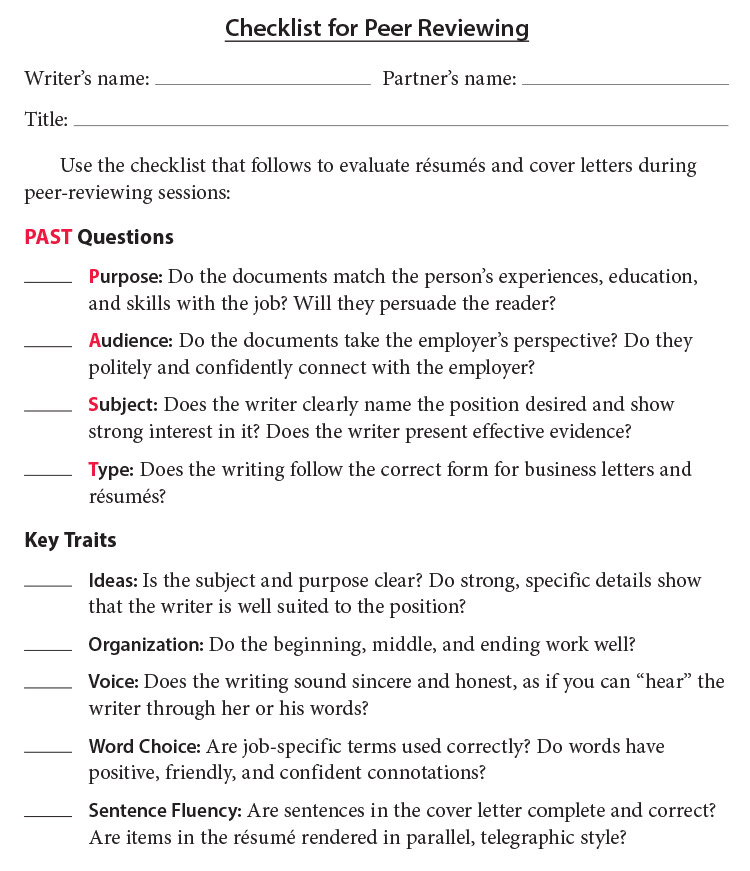
Have a trusted classmate read your job-application documents and complete the form.
Revising in Action
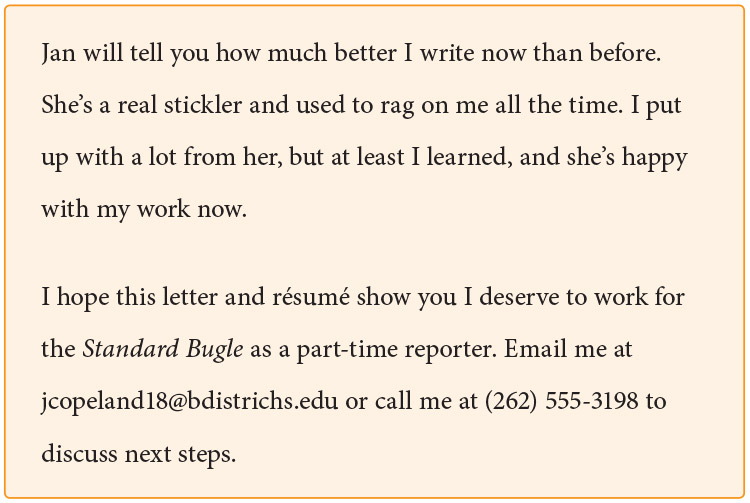
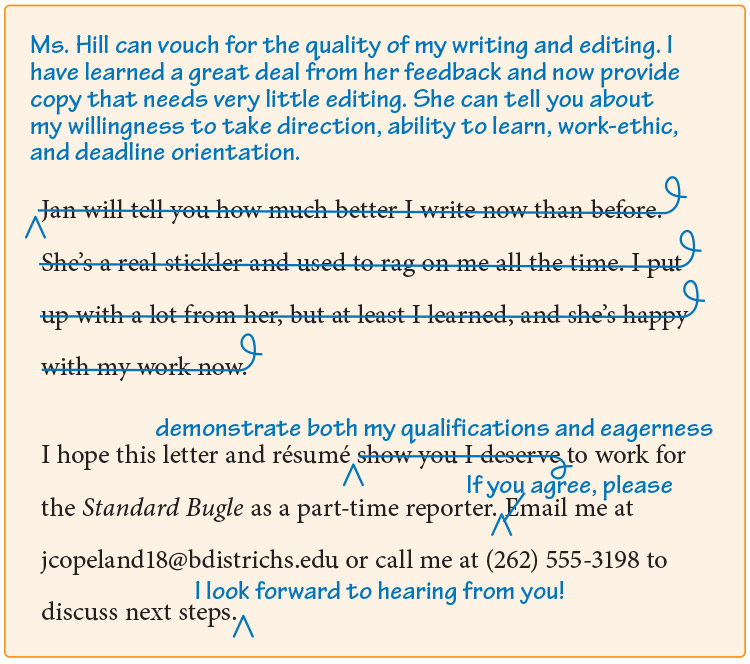
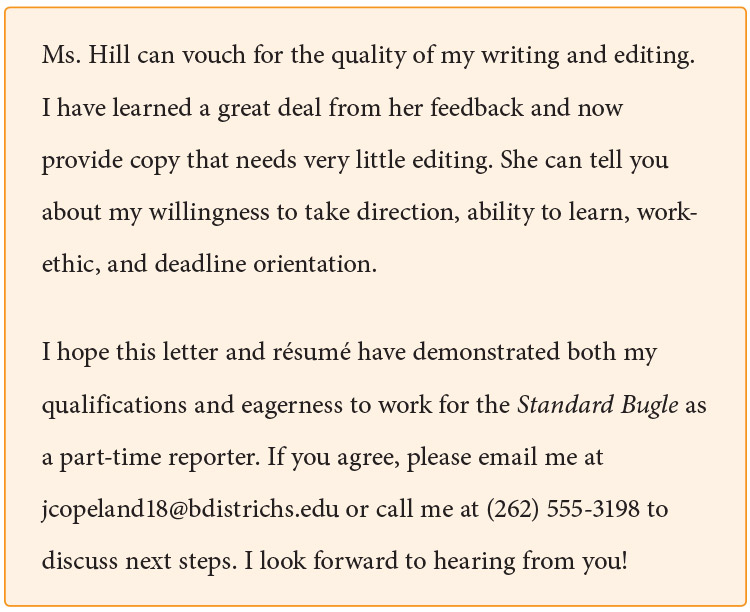
When you revise, you add, delete, rewrite, and rearrange your writing to make it clearer. Here are some revisions that Joyce made to her cover letter.
-
Paragraph Before Revisions
-
Positive connotations replace negative connotations, and precise terminology is used.
-
Paragraph After Revisions
Revise with a checklist.
As you revise your résumé and cover letter, ask yourself the questions on this checklist. When you can answer a question yes, check it off. Continue revising until all questions are checked off.
- Do the documents clearly name the job position and indicate the applicant's interest in it?
- Does the résumé accurately represent the applicant's experience, skills and qualifications, and education? Does it fully present key details and omit unimportant information?
- Are bullets in the résumé parallel? Are items listed in telegraphic style?
- Does the cover letter connect to the employer, point to the résumé, and highlight the key ways in which the applicant is suited for the job?
- Are all sentences in the cover letter complete and correct?
- Do both documents correctly use job-specific terminology and use words with effective connotation?
- Do the documents end by suggesting next steps (call for interview and request for references)?