Editing Narrative Arguments
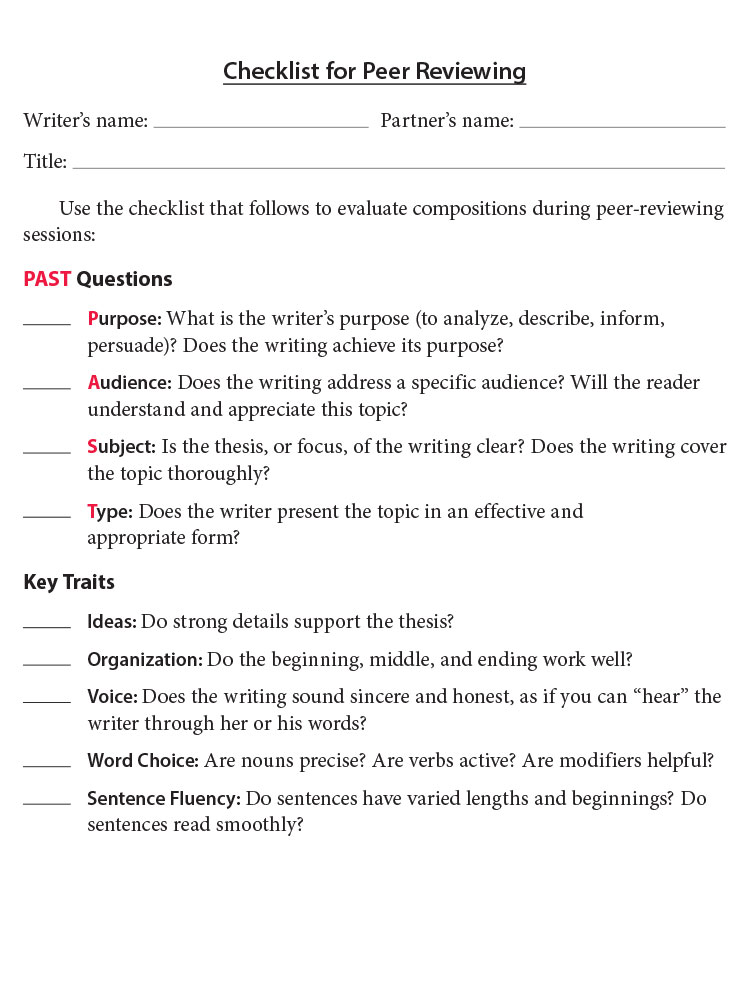
After you complete major revisions to your narrative argument, you should edit it to make sure every word and punctuation mark is correct. Among other issues, you'll want to look closely at pronoun agreement and punctuation of dialogue. The activities that follow will help. You'll also use a checklist to finalize your editing.
Editing for Pronoun Agreement
A pronoun is a word that stands in the place of a noun or another pronoun (its antecedent). The most familiar pronouns are I, me, my; we, us, our, ours; you, your, yours; he, she, it, they, their, theirs. A pronoun needs to agree with its antecedent. That means both need to have the same person (first, second, or third), the same number (singular or plural), and the same gender (masculine, feminine, neuter, or indeterminate).
Agreement
Merida drove her car. (Merida and her are both third person, singular, and feminine: they agree.)
I rode my bike. (I and my are both first person, singular, and indeterminate.)
Other friends relied on ride-share apps using their phones. (Other friends and their are both third-person, plural, and indeterminate.)
Some antecedents (anybody, anyone, everybody, everyone, nobody, no one, somebody, someone) need a third-person, singular, indeterminate pronoun—but English has no such personal pronoun. Errors often result:
Agreement Errors
Someone left their assignment here. (Someone is singular but their is plural.)
Someone left his assignment here. (Someone is indeterminate but his is masculine.)
You can fix the problem by using alternate pronouns (her or his) or rewriting the sentence to avoid the problem.
Corrected Agreement
Someone left her or his assignment here.
I found someone's assignment here.
Students should make sure they didn't leave their assignments behind.
Fix pronoun use.
In each sentence below, fix pronoun usage. Afterward, review your essay and correct any pronoun errors that you find.
-
Students are not in theiryour best frame of mind when they arrive to school hungry.
-
Children experiencing hunger are more likely to have problems with concentration because theyyou do not have the required energy.
-
Ask anyone to share her or histheir opinion about school lunches, and you'll likely receive mixed reviews.
-
Teachers understand theirher students benefit from nutritious lunches.
-
Each member of the legislature should feel a duty to cast his or hertheir vote in favor of subsidies for school-lunch programs.
-
Healthy lunch programs have needed to adjust theiryour menus to fit the taste preferences of students.
-
Each citizen can make up his or hertheir own mind about lunch selections.
-
He and Kareem decided theyhe wanted a few extra tater tots.
-
I asked Ms. Jacobs, "Do youshe eat lunch in the teacher's lounge?"
-
At the beginning of the 20th century, most students went to school near home, so they werehe was able to go home for lunch.
Editing Dialogue
One key component of an effective narrative is dialogue—the words people say. Handling dialogue can be tricky.
When two or more people are having a conversation, start a new paragraph whenever you have a new speaker:
“Did you hear about Shelly?” I asked Kristin.
“No, what happened?”
“The softball field monster got her. A grounder hit a divot and popped up in her face.”
“Not again.”
“Yup, needed stitches.”
When one person speaks, or the spoken words are details included in a larger idea, you can embed them in the paragraph.
I shared my concerns with my girlfriends, many of whom stopped playing sports after freshmen year. “You see the types of girls that still play,” they said. “I’m not getting judged like that.” Then, in no uncertain terms, they told me that boys’ teams deserve better resources because they are more popular.
Place quotation marks before and after quoted material. When periods or commas follow quoted material, always put them inside the close quotation marks. When exclamation points or question marks follow quoted material, place them inside if they punctuate the quotation and outside if they punctuate the whole sentence. Note the correct punctuation in the following dialogue.
“Box it or toss it,” Dad said, dragging the shrieking tape gun over yet another box. “We're going to have to ship everything to storage while I look for a place. You'll stay with Grandpa till then.”
“Grandpa,” I echoed. I didn't know much about him. He was on Facebook, but not Snapchat, so we were not in each others' worlds. He lived in Ohio, but not in Columbus—in a little city called Marion. “How long?”
“However long it takes,” Dad replied, flashing an apologetic smile.
What did he mean, “However long it takes”?
Check dialogue.
In the dialogue below, correct punctuation where needed. Afterward, check the dialogue in your narrative argument to make sure punctuation and paragraphing are correct.
-
“What is in the box?” asked Ms. Adams.
-
“It's the injured squirrel I found in the park”,,” Rachel responded.
-
“Ew!” she exclaimed. “That thing's got to have fleas.”
-
“I'll use Pepper's flea powder on it,” Rachel responded, opening the box.
-
Her mom glanced inside. “Rach, he's not going to make it,” she said.
-
“Don't say that!” she exclaimed. “I'll revive him.”
-
“Oh, yeah. How so?”
-
“I have some ideas,” I said. “I told you I want to be a veterinarian. Well, this squirrel's my first patient.”
-
“Well,” Ms. Adams hesitated, “as long as you keep him outside. I suppose you have named him already?”
-
“Of course,” Rachel said. “He goes by Reepicheep.”
Editing in Action
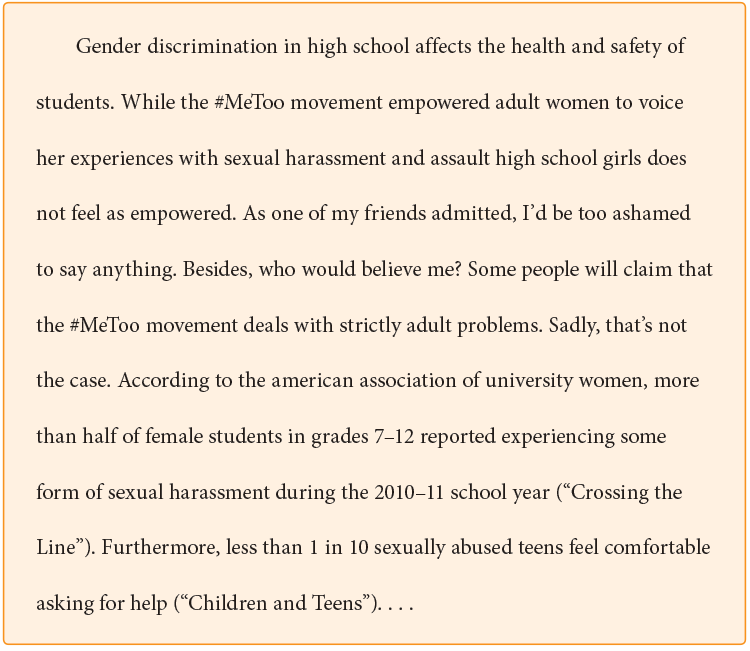
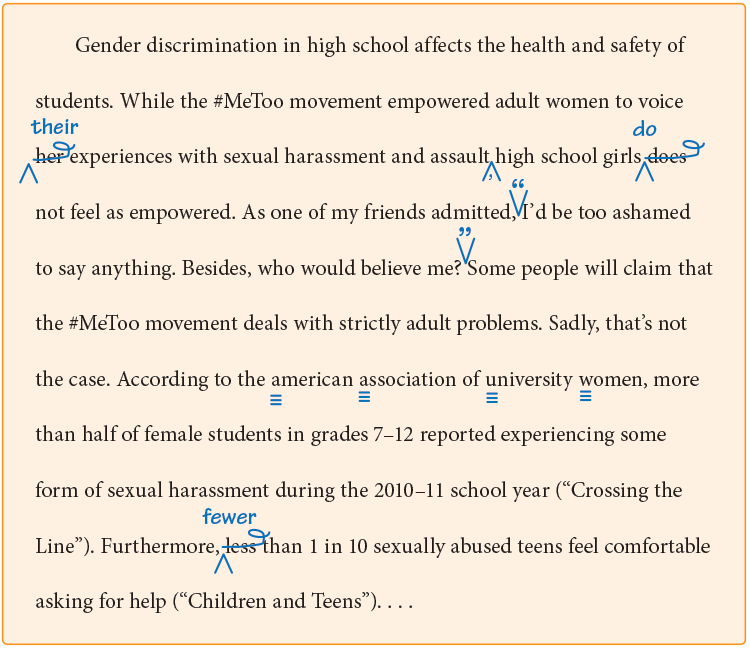
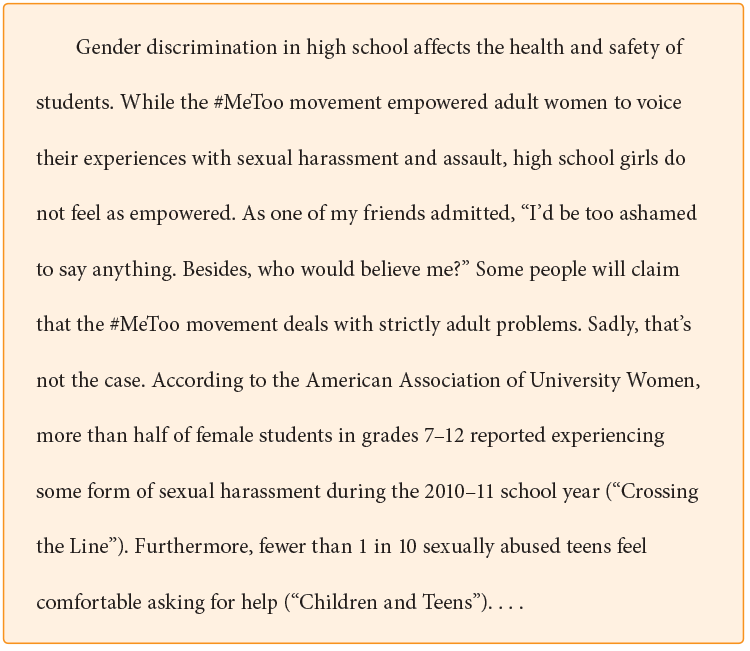
When you edit, you check sentences, punctuation, capitalization, spelling, usage, and grammar. You make corrections to ensure that your work is error free.
-
Paragraph Before Edits
-
Edits are made to fix errors in agreement, capitalization, word usage, and punctuation.
-
Paragraph After Edits
Edit with a checklist.
Read each line. When you can answer each question with yes, check it off.
Punctuation
- Do I close each sentence with an end punctuation mark?
- Do I enclose dialogue in quotation marks?
- Do I place commas and end punctuation properly near quotation marks?
- Do I use commas to separate equal adjectives?
- Do I use commas after introductory clauses and long introductory phrases?
Capitalization
- Do I start all sentences with capital letters?
- Do I capitalize the names of people and places?
Grammar
- Are my sentences free of run-ons and comma splices?
- Do the subjects and verbs agree in number? (The sun rises; birds sing.)
- Do the pronouns agree with their antecedents?
Usage
- Do I correctly use commonly confused words (its/it's)?
Spelling
- Have I checked for spelling errors?
Publishing Your Narrative Argument
Now that you have drafted, revised, and edited your narrative argument, you'll want to create a clean final copy before you submit it for a grade and share it with classmates and family members.
Publishing a Final Copy
Create a clean final copy.
Include your revising and editing changes and read over your work a final time. Spell-check your essay. Then share your work with your instructor and other important people in your life.
Reflecting on Your Writing
Reflect on your writing.
Complete the following sheet to reflect on writing a narrative argument.