CCSS.ELA-LITERACY.W.9-10.2.D

By Anonymous (not verified), 12 March, 2026

Assessing with Rubrics

Test graders will use a rubric to judge the quality of your writing for assessment. They typically provide a score of 0–4, 0–6, or even 0–8 for each category on the rubric, such as Focus, Organization, Evidence, Language, and Conventions. Then they add up these scores and divide by the number of categories to get the overall average score. By using the following rubrics to judge your own assessment writing, you can become aware of what testers are looking for and can improve your scores in the future.

Assess with an argument rubric.

Use the following rubric to score argument or persuasive essays for assessment.

By Anonymous (not verified), 12 March, 2026

Editing Literary Research Papers

Once you complete major improvements to your research paper, you can focus on every word, letter, and punctuation mark. Editing helps you correct errors in punctuation, mechanics, spelling, grammar, and usage. You'll also want to make sure that you have correctly used Modern Language Association (MLA) style. The following activities will help you.

Editing In-Text Citations for MLA Style

Whenever you use ideas or direct quotations from others, you need to credit the source. You do so to show who originated an idea, to avoid plagiarism, and to allow readers to explore the same materials in their own research.

All credits begin with an in-text citation that names the source and page number (if there is one) and refers to a complete entry on the works-cited page. The simplest citation names the title and author in the text and provides the page number in parentheses after the borrowed material, before the period.

In "On Faerie Stories," Tolkien argues that Alice's Adventures in Wonderland and Through the Looking Glass are not actually fantasy because they are framed by a dream. Everything in Wonderland is unreal, and the reader knows that it is. Also, Gulliver's Travels is not fantasy because the tiny people and giants Gulliver encounters are in the Primary World, simply removed by distance (5).

By Anonymous (not verified), 12 March, 2026

Revising Literary Research Papers

After you complete the first draft of your research paper, take a break. Then you'll be able to return to it and see it with fresh eyes. That's what the word revision means—seeing your work anew. When you revise, you check the "big picture," looking at the ideas, organization, and voice of your writing. The following activities will help you.

Revising to Elaborate Details

Your research paper should be more than just a list of details: First of all . . . Second of all . . . Thirdly . . . Fourthly . . . . Instead, you should elaborate ideas. You can do so by introducing a concept, looking more carefully at it, defining the terms you are using, giving examples, telling an anecdote, providing historical context, and so on. Note how each of these types of details further "unpacks" the concept, allowing readers to understand it more fully.

In the following paragraph from "The Mind Behind Middle-earth," note how the topic sentences introduce two main points, and the writer explores each point separately, using a variety of details to unfold the picture for the reader. Click on the callouts to view each part.

By Anonymous (not verified), 12 March, 2026

Writing a Literary Research Paper

If you have thoroughly researched your topic, you should have plenty of information to share in your first draft. Relax. Your job at this point is just to get your ideas down on the page. You don't have to get everything perfect right from the start. Instead, write freely, exploring ideas, relating concepts, quoting sources, paraphrasing, making connections. Once you get your ideas on the page, you'll have time to work with them and shape them. Right now, you should just focus on expressing what you've learned about your topic and doing so in a way that makes your curiosity infectious.

Writing the Beginning Paragraph

If you're having trouble deciding how to start, you can experiment with different strategies for catching your reader's interest. (If you'd rather just plunge in to writing your middle paragraphs, go ahead, and circle back to this step later.) Your lead sentence will begin your first paragraph and help to introduce your thesis statement.

Write a lead sentence.

Try out some of these strategies for introducing your research paper. Read the examples for ideas.

By Anonymous (not verified), 12 March, 2026

Revising Comparison-Contrast Essays

Drafting is done! You've bootstrapped yourself from having no idea what to write about to having a complete essay in its initial form. Congratulations! Writers often find prewriting and drafting to be the most challenging steps because they have to start with a blank page. Now you have a full page or more, so the work from here on out should be easier.

By Anonymous (not verified), 12 March, 2026

Writing a Comparison-Contrast Essay

You've chosen two topics to compare and contrast, conducted research about them, and created a working thesis statement. You're ready to draft your comparison-contrast essay. The following activities will help you build a strong beginning, develop middle paragraphs, and create an ending that effectively wraps up your essay.

Writing the Beginning Paragraph

The first sentence or two of your comparison-contrast essay needs to grab your reader's interest. You can experiment with a number of different strategies to write an effective lead.

Write a lead sentence.

Experiment with leads for your essay using each strategy below. Read the examples for ideas. Then choose your favorite lead to start your essay.

  1. Start with a fascinating question.

    Would you rather be completely normal, with all the typical abilities and disabilities, or exceptional in one or two areas but impaired in others?

  2. Start with a thoughtful quotation.

    "Nobody realizes that some people expend tremendous energy merely to be normal."

    —Albert Camus

  3. Provide an anecdote.

    We've all been stuck on a slow bus, starting and stopping in heavy traffic, crammed with others just waiting to get to a destination. When the patent clerk Albert Einstein was stuck on such a bus, he imagined instead riding on a photon at the speed of light . . . and came up with the Special Theory of Relativity.

  4. Make a shocking statement.

    People with synesthesia process sound with the part of their brains meant to see pictures. As a result, they see music. When the rest of us hear a D major chord, they might see a bright blue mountain or a vibrantly orange rabbit.

By Anonymous (not verified), 12 March, 2026

Warm-Up for Reading and Writing Assessments

Writing a Personal Narrative
© Thoughtful Learning 2016

Reading is the process of turning 26 letters and a dozen punctuation marks into meaning. Viewed that way, it's almost a form of magic. You decode symbols and transform them into thoughts. But how did those symbols get there in the first place? Writing, of course. Someone had a set of insights and rendered them on the page using just 26 letters and a dozen punctuation marks. The encoding process of writing is just as magical and powerful as the decoding process of reading.

Reading and writing help you learn and think about any subject. They let you succeed in high school, college, and career. Not surprisingly, these skills loom large in all of the key assessments you take now and into the future: the Common Core assessments for high school English, the ACT and SAT, and the AP English assessments. Don't worry. Reading and writing might seem like magic, but you can practice these skills using the specific strategies in this unit. They will help you succeed on assessments and launch into a bright and thoughtful future.

What Is Assessment?

Listen to "What Is Assessment?"

Your browser does not support the audio tag.

Hide audio

The word assess means to "judge the value" of something. It originally meant "sit beside a judge" to determine the value of a piece of property for tax purposes. In its modern sense, an assessment is a test to measure the value of a set of skills, in this case reading and writing. You've been reading and writing from your earliest days in school, and all that work will help you succeed on the coming assessments you will face. You can also hone your skills with the specific strategies in this unit.

In the following activities, you’ll learn about close reading—reading to understand the thesis statement, topic sentences, details, and vocabulary of the nonfiction texts you’re assigned. You’ll also learn about writing for assessment—writing to express your own ideas during a test. Strong reading skills help you write and vice versa.

In this unit, you’ll learn the reading and writing skills that you need to succeed in nonfiction assessment. If you’d like to use these skills on a simulated assessment, see the unit “Practice Test for Reading and Writing.”

Thinking About Close Reading

To read closely, you need to think about the ideas in a text. You can do this by asking and answering questions:

  • Who wrote this text? Who was meant to read it?
  • What is it about?
  • Why did the person write it (to provide information, to argue for a position, to tell a story, to make people laugh or think)?
  • How does the writer communicate the ideas in the text?
  • Where and when did this text originally fit? Where and when does it fit now?
By Anonymous (not verified), 12 March, 2026

Revising Research Papers

Congratulations! You've completed a first draft of your research paper, pouring your ideas out onto the pages. Take a short break, or at least a long breath. Now that you have a first draft, you have something to work with. Some parts may be great just as they are. Some parts may need more details, or better wording, or rearranging, or rewriting. That's okay! Revision helps you improve your first draft in major ways. The following activities will guide you.

Revising to Elaborate Details

In the warm-up to this unit, you discovered that basic research answers questions like who, what, where, and when, but rigorous research moves on to deeper questions like why, how, could, would, and should. You can answer basic questions with facts. To answer deeper questions, you'll need many other types of details: explanations, statistics, anecdotes, quotations, reflections, and even visuals. You need to elaborate your ideas.

In the following paragraphs from "The Man Writ Large," note how the topic sentence introduces the key event. Afterward, the writer uses a variety of details to fully elaborate the event, helping readers understand the why, how, could, and should of the situation. Click on the callouts to view each part.

Topic Sentence That indomitable spirit would have its greatest test a week later on July 1. Explanation While most of the regular army troops focused on a siege at Santiago, the Rough Riders, the Buffalo Soldiers, and a few regular army regiments sought to dislodge Spanish control at El Canarey. Doing so would prevent attacks on the American flanks during the siege ("Spanish"). Roosevelt would once again lead his troops uphill into the face of an entrenched foe with superior weaponry. Statistic Roosevelt, however, had a 10 to 1 advantage of soldiers against the 500 Spanish defenders. Just as he had done at the docks at Tampa Bay, Roosevelt jostled his Rough Riders forward to bypass the regular-army regiments and begin the assault on Kettle Hill. Anecdote A Buffalo Soldier asked, "Who do you think you are?" and was told, "Rough Riders going to take that hill. Get out of the way or fall in with us." The Buffalo Soldier replied, "I'll be damned if those Rough Riders will get ahead of me!" Roosevelt thus ended up effectively commanding his own men and that of the separate regiment. Quotation A Rough Rider said of that sudden battlefield brotherhood, "I most positively assert that every face I looked into, both white and black, had a broad grin upon it"(Gardner 161).

The regiments ground forward, eventually taking Kettle Hill, but gunfire still rained down on them from San Juan Hill. Amid the withering fire, Roosevelt raised his pistol and shouted, "Now by God, men! Let's charge 'em!" He jumped a fence and ran down Kettle Hill toward San Juan Hill, but in the noise and confusion, only five of his own men followed. He had to retreat to gather the others, as Roosevelt remembered it: "Even while I taunted them bitterly for not having followed me, it was all I could do not to smile at the look of injury and surprise that came over their faces" (Gardner 167-169). Mounting his horse Little Texas, Roosevelt led his soldiers in the charge up San Juan Hill, and to victory. Diary Entry In his July 1 diary entry, Roosevelt scribbled in pencil, "Rose at 4. Big battle. Commanded regiment. Helped extreme front of firing line. Under shell and rifle fire."Reflection Later, he would dub the charge up San Juan Hill "the great day of my life" ("T.R."). A battle that had been expected to take two hours stretched to twelve, with 300 Spanish casualties to the 500 U.S. casualties ("Spanish").
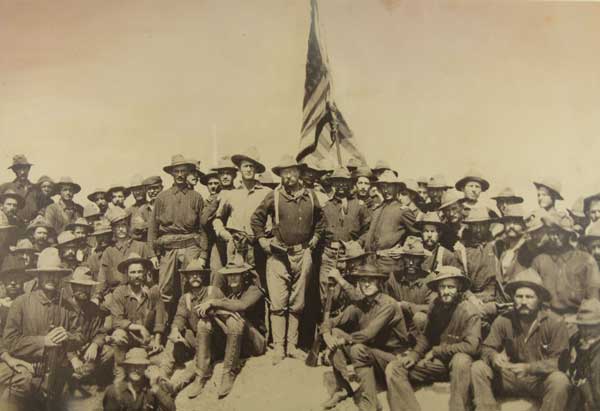
Roosevelt and the Rough Riders atop San Juan Hill. Theodore Roosevelt Birthplace National Historic Site.

Photo and Caption Roosevelt and the Rough Riders atop San Juan Hill. Theodore Roosevelt Birthplace National Historic Site.

By Anonymous (not verified), 12 March, 2026

Writing a Research Paper

After fully engaging your sources, you have plenty of remarkable information to convey to your reader. The problem may be figuring out where to begin. What do you share first?

The following activities will suggest many starting points and ending points and other points in between. The strategies below will prime the pump of your ideas, getting them to flow easily into your first draft.

Writing the Beginning Paragraph

Your first job in writing a research paper is to catch your reader's interest. You can experiment with a number of strategies to form an interesting lead sentence.

Write a lead sentence.

Try out some of these strategies for introducing your research paper. Read the examples for ideas.

  1. Start with a fascinating quotation.

    "Do things. Be sane. Don't fritter away your time; create, act, take a place wherever you are, and be somebody; get action.”
    —Theodore Roosevelt, Sr.

  2. Express what is most interesting about the subject.

    Teddy Roosevelt transformed himself from an asthmatic weakling to a brawler who won in Cuba and Panama, in Washington and on Mount Rushmore.

  3. Provide an anecdote.

    As they charged up San Juan Hill into the teeth of machine-gun fire, Teddy Roosevelt turned to a fellow soldier and shouted, "Holy Godfrey, what fun!"

  4. Ask an engaging question.

    Are heroes born, or are they made?