CCSS.ELA-LITERACY.W.11-12.2.D

By Anonymous (not verified), 16 March, 2026
In this fair statistical analysis, a student compares poverty rates and percentage of non-Hispanic white populations to votes for the Republican candidate in the 2016 presidentential election.
By Anonymous (not verified), 16 March, 2026
In this poor statistical analysis, a student records data but does not explain it.
By Anonymous (not verified), 16 March, 2026
In this strong research report, a high school student thoroughly details a recent wave of American immigration.
By Anonymous (not verified), 16 March, 2026
This good research paper focuses on the history of Hmong immigration and assimilation in the United States.
By Anonymous (not verified), 16 March, 2026
In this fair research paper, a student outlines the migration and settlement patterns of a group of American immigrants.
By Anonymous (not verified), 16 March, 2026
This poor research report about the Hmong needs more development and more sources.
By Anonymous (not verified), 12 March, 2026

Assessing with Rubrics

Test graders will use a rubric to judge the quality of your writing for assessment. They typically provide a score of 0–4, 0–6, or even 0–8 for each category on the rubric, such as Focus, Organization, Evidence, Language, and Conventions. Then they add up these scores and divide by the number of categories to get the overall average score. By using the following rubrics to judge your own assessment writing, you can become aware of what testers are looking for and can improve your scores in the future.

Assess with an argument rubric.

Use the following rubric to score argument or persuasive essays for assessment.

By Anonymous (not verified), 12 March, 2026

Revising Comparison-Contrast Essays

Drafting is done! You've bootstrapped yourself from having no idea what to write about to having a complete essay in its initial form. Congratulations! Writers often find prewriting and drafting to be the most challenging steps because they have to start with a blank page. Now you have a full page or more, so the work from here on out should be easier.

By Anonymous (not verified), 12 March, 2026

Writing a Comparison-Contrast Essay

You've chosen two topics to compare and contrast, conducted research about them, and created a working thesis statement. You're ready to draft your comparison-contrast essay. The following activities will help you build a strong beginning, develop middle paragraphs, and create an ending that effectively wraps up your essay.

Writing the Beginning Paragraph

The first sentence or two of your comparison-contrast essay needs to grab your reader's interest. You can experiment with a number of different strategies to write an effective lead.

Write a lead sentence.

Experiment with leads for your essay using each strategy below. Read the examples for ideas. Then choose your favorite lead to start your essay.

  1. Start with a fascinating question.

    Would you rather be completely normal, with all the typical abilities and disabilities, or exceptional in one or two areas but impaired in others?

  2. Start with a thoughtful quotation.

    "Nobody realizes that some people expend tremendous energy merely to be normal."

    —Albert Camus

  3. Provide an anecdote.

    We've all been stuck on a slow bus, starting and stopping in heavy traffic, crammed with others just waiting to get to a destination. When the patent clerk Albert Einstein was stuck on such a bus, he imagined instead riding on a photon at the speed of light . . . and came up with the Special Theory of Relativity.

  4. Make a shocking statement.

    People with synesthesia process sound with the part of their brains meant to see pictures. As a result, they see music. When the rest of us hear a D major chord, they might see a bright blue mountain or a vibrantly orange rabbit.

By Anonymous (not verified), 12 March, 2026

Revising Research Papers

Congratulations! You've completed a first draft of your research paper, pouring your ideas out onto the pages. Take a short break, or at least a long breath. Now that you have a first draft, you have something to work with. Some parts may be great just as they are. Some parts may need more details, or better wording, or rearranging, or rewriting. That's okay! Revision helps you improve your first draft in major ways. The following activities will guide you.

Revising to Elaborate Details

In the warm-up to this unit, you discovered that basic research answers questions like who, what, where, and when, but rigorous research moves on to deeper questions like why, how, could, would, and should. You can answer basic questions with facts. To answer deeper questions, you'll need many other types of details: explanations, statistics, anecdotes, quotations, reflections, and even visuals. You need to elaborate your ideas.

In the following paragraphs from "The Man Writ Large," note how the topic sentence introduces the key event. Afterward, the writer uses a variety of details to fully elaborate the event, helping readers understand the why, how, could, and should of the situation. Click on the callouts to view each part.

Topic Sentence That indomitable spirit would have its greatest test a week later on July 1. Explanation While most of the regular army troops focused on a siege at Santiago, the Rough Riders, the Buffalo Soldiers, and a few regular army regiments sought to dislodge Spanish control at El Canarey. Doing so would prevent attacks on the American flanks during the siege ("Spanish"). Roosevelt would once again lead his troops uphill into the face of an entrenched foe with superior weaponry. Statistic Roosevelt, however, had a 10 to 1 advantage of soldiers against the 500 Spanish defenders. Just as he had done at the docks at Tampa Bay, Roosevelt jostled his Rough Riders forward to bypass the regular-army regiments and begin the assault on Kettle Hill. Anecdote A Buffalo Soldier asked, "Who do you think you are?" and was told, "Rough Riders going to take that hill. Get out of the way or fall in with us." The Buffalo Soldier replied, "I'll be damned if those Rough Riders will get ahead of me!" Roosevelt thus ended up effectively commanding his own men and that of the separate regiment. Quotation A Rough Rider said of that sudden battlefield brotherhood, "I most positively assert that every face I looked into, both white and black, had a broad grin upon it"(Gardner 161).

The regiments ground forward, eventually taking Kettle Hill, but gunfire still rained down on them from San Juan Hill. Amid the withering fire, Roosevelt raised his pistol and shouted, "Now by God, men! Let's charge 'em!" He jumped a fence and ran down Kettle Hill toward San Juan Hill, but in the noise and confusion, only five of his own men followed. He had to retreat to gather the others, as Roosevelt remembered it: "Even while I taunted them bitterly for not having followed me, it was all I could do not to smile at the look of injury and surprise that came over their faces" (Gardner 167-169). Mounting his horse Little Texas, Roosevelt led his soldiers in the charge up San Juan Hill, and to victory. Diary Entry In his July 1 diary entry, Roosevelt scribbled in pencil, "Rose at 4. Big battle. Commanded regiment. Helped extreme front of firing line. Under shell and rifle fire."Reflection Later, he would dub the charge up San Juan Hill "the great day of my life" ("T.R."). A battle that had been expected to take two hours stretched to twelve, with 300 Spanish casualties to the 500 U.S. casualties ("Spanish").
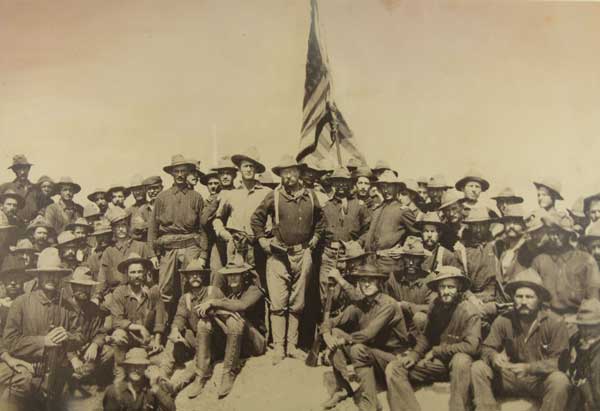
Roosevelt and the Rough Riders atop San Juan Hill. Theodore Roosevelt Birthplace National Historic Site.

Photo and Caption Roosevelt and the Rough Riders atop San Juan Hill. Theodore Roosevelt Birthplace National Historic Site.