CCSS.ELA-LITERACY.W.9-10.4

By Anonymous (not verified), 12 March, 2026

Editing Research Papers

You're almost there! You've conducted research, drafted your paper, and made major improvements. Now you're ready for editing, focusing on every word, letter, and punctuation mark. You can start by making sure you have correctly used Modern Language Association (MLA) style. You'll also want to correct errors in punctuation, mechanics, spelling, grammar, and usage. The following activities will help you.

By Anonymous (not verified), 12 March, 2026

Revising Research Papers

Congratulations! You've completed a first draft of your research paper, pouring your ideas out onto the pages. Take a short break, or at least a long breath. Now that you have a first draft, you have something to work with. Some parts may be great just as they are. Some parts may need more details, or better wording, or rearranging, or rewriting. That's okay! Revision helps you improve your first draft in major ways. The following activities will guide you.

Revising to Elaborate Details

In the warm-up to this unit, you discovered that basic research answers questions like who, what, where, and when, but rigorous research moves on to deeper questions like why, how, could, would, and should. You can answer basic questions with facts. To answer deeper questions, you'll need many other types of details: explanations, statistics, anecdotes, quotations, reflections, and even visuals. You need to elaborate your ideas.

In the following paragraphs from "The Man Writ Large," note how the topic sentence introduces the key event. Afterward, the writer uses a variety of details to fully elaborate the event, helping readers understand the why, how, could, and should of the situation. Click on the callouts to view each part.

Topic Sentence That indomitable spirit would have its greatest test a week later on July 1. Explanation While most of the regular army troops focused on a siege at Santiago, the Rough Riders, the Buffalo Soldiers, and a few regular army regiments sought to dislodge Spanish control at El Canarey. Doing so would prevent attacks on the American flanks during the siege ("Spanish"). Roosevelt would once again lead his troops uphill into the face of an entrenched foe with superior weaponry. Statistic Roosevelt, however, had a 10 to 1 advantage of soldiers against the 500 Spanish defenders. Just as he had done at the docks at Tampa Bay, Roosevelt jostled his Rough Riders forward to bypass the regular-army regiments and begin the assault on Kettle Hill. Anecdote A Buffalo Soldier asked, "Who do you think you are?" and was told, "Rough Riders going to take that hill. Get out of the way or fall in with us." The Buffalo Soldier replied, "I'll be damned if those Rough Riders will get ahead of me!" Roosevelt thus ended up effectively commanding his own men and that of the separate regiment. Quotation A Rough Rider said of that sudden battlefield brotherhood, "I most positively assert that every face I looked into, both white and black, had a broad grin upon it"(Gardner 161).

The regiments ground forward, eventually taking Kettle Hill, but gunfire still rained down on them from San Juan Hill. Amid the withering fire, Roosevelt raised his pistol and shouted, "Now by God, men! Let's charge 'em!" He jumped a fence and ran down Kettle Hill toward San Juan Hill, but in the noise and confusion, only five of his own men followed. He had to retreat to gather the others, as Roosevelt remembered it: "Even while I taunted them bitterly for not having followed me, it was all I could do not to smile at the look of injury and surprise that came over their faces" (Gardner 167-169). Mounting his horse Little Texas, Roosevelt led his soldiers in the charge up San Juan Hill, and to victory. Diary Entry In his July 1 diary entry, Roosevelt scribbled in pencil, "Rose at 4. Big battle. Commanded regiment. Helped extreme front of firing line. Under shell and rifle fire."Reflection Later, he would dub the charge up San Juan Hill "the great day of my life" ("T.R."). A battle that had been expected to take two hours stretched to twelve, with 300 Spanish casualties to the 500 U.S. casualties ("Spanish").
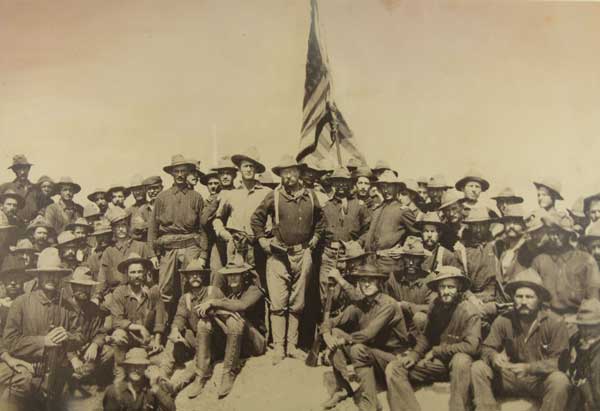
Roosevelt and the Rough Riders atop San Juan Hill. Theodore Roosevelt Birthplace National Historic Site.

Photo and Caption Roosevelt and the Rough Riders atop San Juan Hill. Theodore Roosevelt Birthplace National Historic Site.

By Anonymous (not verified), 12 March, 2026

Writing a Research Paper

After fully engaging your sources, you have plenty of remarkable information to convey to your reader. The problem may be figuring out where to begin. What do you share first?

The following activities will suggest many starting points and ending points and other points in between. The strategies below will prime the pump of your ideas, getting them to flow easily into your first draft.

Writing the Beginning Paragraph

Your first job in writing a research paper is to catch your reader's interest. You can experiment with a number of strategies to form an interesting lead sentence.

Write a lead sentence.

Try out some of these strategies for introducing your research paper. Read the examples for ideas.

  1. Start with a fascinating quotation.

    "Do things. Be sane. Don't fritter away your time; create, act, take a place wherever you are, and be somebody; get action.”
    —Theodore Roosevelt, Sr.

  2. Express what is most interesting about the subject.

    Teddy Roosevelt transformed himself from an asthmatic weakling to a brawler who won in Cuba and Panama, in Washington and on Mount Rushmore.

  3. Provide an anecdote.

    As they charged up San Juan Hill into the teeth of machine-gun fire, Teddy Roosevelt turned to a fellow soldier and shouted, "Holy Godfrey, what fun!"

  4. Ask an engaging question.

    Are heroes born, or are they made?

By Anonymous (not verified), 12 March, 2026

Warm-Up for Research Writing

You live at a fortunate time. Before the Internet, people had no easy way to find out what they wanted to know. Friends had heated arguments about which actor played a part or when Czechoslovakia broke up or why there are 360 degrees in a circle. To find answers, people had to go to a library, search through thousands of cards in a big set of drawers, search through hundreds of shelves to find the right book, and search through hundreds of pages to find the right information. That's a lot of work. Not surprisingly, many people just chose to remain ignorant.

These days, you say, "Hey, Alexa, when did Czechoslovakia break up?" In seconds, she tells you that the former nation dissolved into the Czech Republic and Slovakia on January 1, 1993.

Still, many people choose to remain ignorant. One fifth of millennials know little of the Holocaust. (If you are one of them, ask Alexa about it.)

So, research in the Information Age is more important than ever. And rigorous research reaches beyond the free Internet to scholarly publications that only your library makes available. In this unit, you will conduct research about a topic that you care about, uncovering reliable and surprising information that you'll want to share with others. That's the key to an effective research paper.

What Is Rigorous Research?

Listen to "What Is Rigorous Reseach?"

Your browser does not support the audio tag.

Hide audio

Writing Literary Analysis
© Thoughtful Learning 2018

Rigorous research digs deeply into a topic, discovering many surprising answers but also new, challenging questions. Rigorous research can start with Alexa and Wikipedia, but it certainly doesn't end with them. It can start with the top Google search result, but it must go much further than that.

Basic research finds reliable answers to who, what, where, and when:

  • What was the Holocaust? The Holocaust was the state-sponsored persecution and murder of people deemed inferior by the Nazi regime in Germany.
  • Who was targeted in the Holocaust? Six million Jews (two thirds of the European population) were murdered along with millions more Roma, Slavs, and Russians as well as homosexuals and those with disabilities.
  • When did the Holocaust occur? The Holocaust occurred from the rise of Nazis in Germany in 1933 through the conclusion of World War II in 1945.
  • Where did the Holocaust occur? The Holocaust occurred throughout Nazi-controlled territories in Europe, with numerous concentration camps in Germany and Poland.
By Anonymous (not verified), 12 March, 2026

Editing Character Analyses

After revising your character analysis, you should edit it for style and correctness. Now is the time to carefully review sentences, punctuation, capitalization, spelling, usage, and grammar. Use the following activities to edit your analysis.

Editing to Combine and Punctuate Sentences

When you combine sentences to create better flow, you need to make sure the sentences still have correct punctuation. You can join two sentences (independent clauses) together, but you need to use both a comma and a coordinating conjunction (and, but, or, nor, for, so, yet). You can also use just a semicolon.

Simple Sentences

Gatsby can’t change the past. Tom can’t make Daisy love him again.

Compound Sentences

Gatsby can’t change the past, and Tom can’t make Daisy love him again.

Gatsby can’t change the past; Tom can’t make Daisy love him again.

Leaving out the coordinating conjunction creates an error called a comma splice. Leaving out both the comma and the conjunction creates an error called a run-on sentence.

You can also combine two sentences using a subordinating conjunction (although, because, when, since, after, etc.). When the conjunction starts the sentence, place a comma after the clause. When the conjunction comes in the middle of the sentence, you usually don't need to set off the clause with a comma.

Simple Sentences

Myrtle is killed. Wilson loses everything else in his life.

Complex Sentences

After Myrtle is killed, Wilson loses everything else in his life.

Wilson loses everything else in his life after Myrtle is killed.

By Anonymous (not verified), 12 March, 2026

Revising Character Analyses

After you have completed a first draft of your analysis, set it aside awhile. Once you get some distance from it, you'll be able to more objectively make improvements. Start by focusing on the large-scale issues: the ideas and organization in your writing. The following activities will help you.

Revising to Connect Characters to Themes

An effective character analysis should show how the words and actions of the characters demonstrate larger themes. Often themes express life lessons, social or cultural realities, or moral dilemmas. Answering questions about the literature can help you identify themes:

  1. Why is this character so interesting?

    George Wilson is interesting because he seems so powerless all the way through but does the one action that changes everything.

  2. What is the most critical moment for this character?

    After his wife is killed by Gatsby's car, Wilson shoots Gatsby in his pool.

  3. If this character could do one thing over, what would it be?

    Wilson would not let his wife go with Tom Buchanan, which would save her life and Gatsby's as well.

  4. What emotion best defines this character?

    Wilson goes through a number of emotions, from blissful ignorance to growing suspicion, then grief and desperation, and finally fury. He feels that he has been wronged and will work to right it.

  5. What does this character's life say about life in general?

    Rich, powerful people often take away the little that poor, powerless people have. However, if the rich ignore this injustice, the poor often rise up to take revenge.

Discover themes.

Answer the following questions about the character(s) you analyzed. After you have answers, consider what thematic connections you might add to your first draft.

By Anonymous (not verified), 12 March, 2026

Writing a Character Analysis

After you've gathered many pieces of evidence and written a working thesis statement about your character, you are ready to create the first draft of your analysis. Start by writing a compelling lead sentence and using it to introduce a beginning paragraph. Or you can develop the middle paragraphs first and return to write the beginning and ending. If you need inspiration along the way, look at the end of this lesson to find another student's character analysis based on Wilson from The Great Gatsby.

Writing the Beginning Paragraph

Start your essay with a lead that gets readers' attention and orients them to the piece of literature you will analyze. After your lead sentence, you will develop a paragraph that ends with your thesis statement.

Write a lead sentence.

Try out at least two of these strategies for introducing the topic of your analysis. Read the examples for ideas.

  1. Name the work and author and summarize its importance.

    Cry, the Beloved Country by Alan Paton unflinchingly portrays the deep societal divisions in 1948 South Africa, divisions that would lead to apartheid.

  2. Ask a compelling question about the work.

    Why do most people consider The Great Gatsby by F. Scott Fitzgerald to be the quintessential "Great American Novel?"

  3. Provide a powerful quotation from the author.

    “Show me a hero and I’ll write you a tragedy.”
    —F. Scott Fitzgerald

  4. Share a historical reference that provides a context for the work.

    Nelson Mandela spent his youth as a political dissident, his middle age as a political prisoner, and his old age as president of a post-apartheid South Africa.

Write your beginning paragraph.

Start with your lead, and then provide background and develop a paragraph leading to your thesis statement.

By Anonymous (not verified), 12 March, 2026

Prewriting for Character Analyses

Did you ever sit down and stare at a blank screen and think, "I have no idea what to write about"? Prewriting helps you know what to write about. During prewriting, you gather ideas, think, plan, outline, scribble, and do whatever else you need to do so that you do know what to write about. These activities will help you fill that blank screen.

By Anonymous (not verified), 12 March, 2026

Revising Problem-Solution Essays

Okay, you have your first draft. Congratulations! You might feel tempted just to spell-check it and hand it in, but remember that a great first draft is often a lousy final draft. Revision lets you make big improvements to your writing. In this lesson, you'll elaborate your key explanations and arguments, using transitions to connect ideas. You'll also use a peer response and a checklist to improve your work.

By Anonymous (not verified), 12 March, 2026

Writing a Problem-Solution Essay

You've selected a problem, explored your prior knowledge about it, and conducted research to discover additional details. Now it's time to write your problem-solution essay. This two-part essay first analyzes a problem with definitions, examples, causes, and effects. Then it proposes and argues for a specific solution or set of solutions. The following activities will help you write your essay.

Writing the Beginning Paragraph

The beginning first needs to grab the reader's attention. Then it introduces the topic and provides background leading up to your opinion statement. To get started with your beginning paragraph, you can experiment with different lead-writing strategies.

Write a lead sentence.

Write a different lead sentence for each strategy to capture the reader's attention. Use the examples as inspiration.

  1. Present a startling statistic.

    According to the National Institute of Mental Health, 1 in 10 Americans had a mood disorder last year, and 21 percent will experience one during their lifetimes.

  2. Open with an engaging quotation.

    “I try not to worry about the future—so I take each day just one anxiety attack at a time.” 
    ― Tom Wilson, American Cartoonist

  3. Create an interesting scenario.

    Imagine that your life had a movie soundtrack. Now imagine that it was the nerve-racking soundtrack to a suspenseful movie. That's what anxiety and depression feel like.

  4. Focus on causes.

    Adrenaline is great for fight-or-flight situations, when you need to energize muscles and put nerves on high alert. Adrenaline is less great when there's no threat, but you feel jittery and paranoid anyway, all the time.