CCSS.ELA-LITERACY.RI.4.2

By Anonymous (not verified), 12 March, 2026

Writing a Fiction Review

Once you finish prewriting, you are ready to create the first draft of your review. These writing activities will help you create strong beginning, middle, and ending parts. You'll also read another student's review to see how all of the parts work together.

Writing the Beginning Paragraph

The purpose of your beginning paragraph is to grab your reader's attention, introduce the title and author of your book, and tell something interesting about it. The paragraph should start with a lead sentence, which gets the reader interested in the book. You can introduce the title and author in the lead or in a new sentence. Then, to close out the paragraph, introduce the big challenge the main character must face in the book. But don't spoil the ending!

Write a lead sentence.

Try out at least two of these strategies for introducing the topic of your review. Read the examples for ideas.

1. Ask a question related to the work.

Have you ever felt like a stranger in your school or community?

2. Talk directly to your readers.

You never know when you will meet someone who will change your life.

3. Provide a suspenseful detail from the story.

Just when Lucy thought she was getting her very own room, a stranger showed up and changed everything.

4. Share a feeling you have about the work.

The Great Wall of Lucy Wu by Wendy Wan-Long Shang changed the way I think about my heritage.

Write your beginning paragraph.

Start with your lead sentence. Follow with one or two sentences that identify the title and author of the book and introduce the biggest challenge facing the main character.
By Anonymous (not verified), 12 March, 2026

Viewing for Assessment

Some tests ask you to watch a video and respond to it in a paragraph or essay. Often, you'll need to refer to details from the video and any readings you have done. The following activities will help you practice viewing for assessment.

Carefully watch this video.

Pay close attention as you watch this video about monarchs and milkweed, produced by the federal government.

Watch the video "Monarchs and Milkweed"

Hide video

Respond to the video.

Answer the questions to test your understanding of the video “Monarchs and Milkweed.” Circle the letter of the best answer.

By Anonymous (not verified), 12 March, 2026

Practicing for Assessment

Reading and writing tests measure important learning skills. You can do your best on such tests by reading and writing every day. You can also get a better score if you practice for assessment.

How Can I Practice for Assessment?

Writing a Process Essay
© Thoughtful Learning 2016

Listen to "How Can I Practice for Assessment?"

Your browser does not support the audio tag.

Hide audio

The best way to practice for a reading and writing assessment is to take a practice test. This unit asks you to closely read information and write about it, just as you will do on actual assessments.

You’ll find interesting articles to read and respond to. You’ll also get to watch a video. In the end, you’ll need to take the information you discover and use it to write an informational essay of your own.

If you would like more help with close reading and informational writing, see the unit “Reading and Writing for Assessment.”

Reading a Practice Assessment

Some tests ask you to closely read and respond to explanatory articles and then use them to write an essay. One technique for reading closely is SQ3R:

  • Survey the headings, illustrations, beginning, and ending of the text.
  • Question what the text is about and what you expect to learn from it.
  • Read the text carefully.
  • Recite the main points covered in the text.
  • Review the material, thinking about how it relates to other things you have learned.

Closely read source 1.

Use SQ3R to closely read the following text.

Listen to "Source 1: King of the Butterflies"

Your browser does not support the audio tag.

Hide audio

Source 1

By Anonymous (not verified), 12 March, 2026

Finding Supporting Details

Each controlling sentence in a text is supported with different types of details. Note how the following focus statement is supported by different details.

Focus statement: Most people don’t give much thought to umbrellas, but these marvels of engineering have an interesting history.

Supporting Details

Example

Facts are ideas that can be proven true or false.

The first collapsible umbrella belonged to Wang Mang in China in 21 C.E.

Statistics are ideas expressed in numbers.

According to the Guinness Book of World Records, the world’s largest umbrella is 56 feet wide and weighs 4,850 pounds.

Definitions tell what a word means.

The word umbrella comes from the Latin word umbra, meaning “shadow.” The word parasol comes from the Italian word para for “protecting against” and the word sole for “sun.”

Examples show how an idea works in specific situations.

Life guards, picnickers, and even the Pope use parasols to block the sun.

Descriptions tell what something looks, feels, smells, tastes, or sounds like.

Ancient Egyptians made umbrellas from palm fronds or giant feathers attached to central posts.

Anecdotes tell little stories to make a big point.

Umbrellas fell out of fashion when the umbrella-toting Neville Chamberlain became infamous for giving in to Hitler.

Quotations give the exact words of someone.

The politician Al Smith once noted, “The American people never carry an umbrella. They prepare to walk in eternal sunshine.”

By Anonymous (not verified), 12 March, 2026

Understanding Controlling Sentences

As you read, watch for two types of controlling sentences:

A focus statement tells what an essay or article is about. It usually appears at the end of the first paragraph.

Many features of games make them powerful tools for learning.

A topic sentence tells what a paragraph is about. It usually appears at the start of a middle paragraph.

To start with, games are fun, and fun actually promotes learning.

Find controlling sentences.

In the following brief article, underline each controlling sentence.

Listen to "The Game's the Thing"

Your browser does not support the audio tag.

Hide audio

By Anonymous (not verified), 12 March, 2026

Closely Reading Nonfiction

To read closely, remember SQ3R—Survey, Question, Read, Recite, Review.

Survey, question, and read.

Use these instructions to closely read the following essay.

  1. Survey the text: Highlight the title, author, and headings.
  2. Question the topic and purpose: Write comments on the document.
  3. Read the text: Underline the focus statement and topic sentences.

Listen to "What Does the Fox Say?"

Your browser does not support the audio tag.

Hide audio

By Anonymous (not verified), 12 March, 2026

Warm-Up for Reading and Writing Assessments

Writing a Personal Narrative
© Thoughtful Learning 2016

Reading helps you learn any subject. Writing helps you share what you've learned. That's why these two skills are critical in all your classes. That's also why major assessments test your ability to read and write.

What Is Assessment?

Listen to "What Is Assessment?"

Your browser does not support the audio tag.

Hide audio

Assessment is another word for test. Some assessments will test your ability to read and write. The reading and writing you do every day at school and home will help you get ready for these assessments. This unit will also help.

In the following activities, you’ll learn about close reading—reading to understand the focus statement, topic sentences, details, and vocabulary of the nonfiction texts you’re assigned. You’ll also learn about on-demand writing—writing to develop your own ideas during an assessment. Strong reading skills help you write and vice versa.

In this unit, you’ll learn the reading and writing skills that you need to succeed in nonfiction assessment. If you’d like to try out these skills, see the unit “Practice Test for Reading and Writing.”

Thinking About Close Reading

To read closely, you need to think about the ideas in a text. You can do this by asking and answering questions. For starters, use the 5 W’s and H.

By Anonymous (not verified), 12 March, 2026

Reading a Problem-Solution Paragraph and Essay

Now that you've warmed up your thinking about problems and solutions, you can read a sample paragraph and essay. Note how each writer explains a problem and argues for a specific solution.

Reading a Problem-Solution Paragraph

A problem-solution paragraph has three main parts. The topic sentence introduces the solution to a problem. The body sentences explain the problem and solution. The ending sentence calls readers to action.

Listen to "Helping New Students Fit In"

Your browser does not support the audio tag.

Hide audio

Sample Paragraph

Helping New Students Fit In

Topic SentenceComing to a new school is hard, so we should figure out how to make new students feel welcome. New students have to fit in with new classmates in an unfamiliar place with unfamiliar rules. Body SentencesThis problem can make them feel lonely. Instead of just expecting new students to make all the effort, we can help them fit in. One of us can volunteer to show the new student around and sit with him or her at lunch. The rest of us can introduce ourselves, learn the new student’s name, and share something about our school or ourselves. Ending Sentence Together, let’s make our school a friendlier place to be.

By Anonymous (not verified), 12 March, 2026

Reading an Opinion Paragraph and Essay

Before you write your own essay, you can read an opinion paragraph and essay that others wrote. As you read, think about how the writers put ideas together and how you might support an opinion in your essay.

Reading an Opinion Paragraph

An opinion paragraph has three main parts. The topic sentence states the opinion. The body sentences support the opinion with reasons. The ending sentence restates or emphasizes the opinion.

Listen to “Keep Art.”

Your browser does not support the audio tag.

Hide audio

Sample Paragraph

Keep Art

Topic Sentence:
Opinion
Waterford schools must keep the art program. The School Board has said that art may be cut because of money issues. Before they decide, the board members need to understand certain things about art. First of all, art helps students learn. When students work on an art project, they plan, experiment, and make choices. Working like this will help them learn in all their classes. Body Sentences:
Reasons
Second, art helps students express themselves. In art classes, students create their own projects rather than answer questions or read chapters. And finally, art helps students understand their world. Art is part of our culture, and students need to participate in this culture.
Because of its value, the School Board should Ending Sentence:
Call to Action
think of creative ways to keep art rather than just cutting it.

By Anonymous (not verified), 12 March, 2026

Editing Summaries

After revising your summary, you need to make little changes (editing) to correct any remaining errors. You'll look for problems with sentences, punctuation, capitalization, grammar, usage, and spelling. The following instructions will help you edit and publish your writing.

Editing in Action

When you edit, you check to make sure your paragraph is correct.

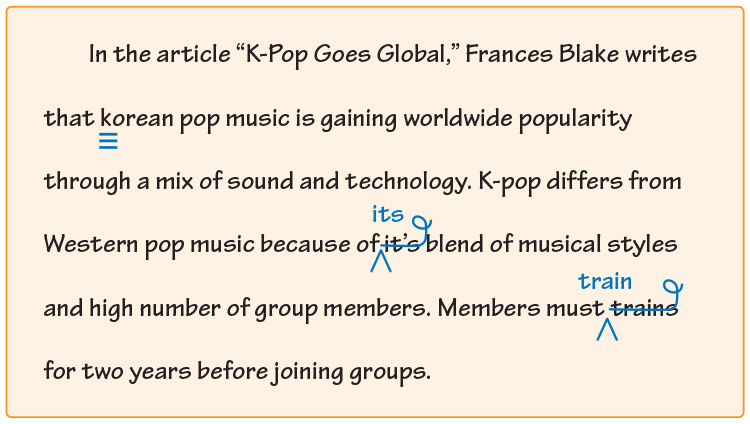
  • Paragraph Before Edits

    Editing
  • A proper noun was capitalized and a usage and agreement error was fixed.

    Editing
  • Paragraph After Edits

    Editing