CCSS.ELA-LITERACY.W.11-12.9

By Anonymous (not verified), 12 March, 2026

Writing for Literature Assessment

When you respond to a writing prompt, you should start by carefully reading and analyzing the prompt using the PAST questions. Then you should jot down a quick outline of your response. Do these activities in the first five minutes or so of the time you have. (If the prompt includes a reading, take more time with this step.) You'll spend the bulk of your time creating a beginning, a middle, and an ending. Afterward, you'll want to review your answers to the PAST questions and read your response, making sure it is on target. In the last five minutes or so, revise and edit your work. This abbreviated version of the writing process needs to fit into the total time you are given (often between 30 and 90 minutes).

Viewing a Sample Prompt and Response

Read the following prompt, and view one student's PAST analysis, outline, and beginning, middle, and ending. Then you'll get a chance to read and respond to a prompt of your own.

Sample Writing Prompt

"Romance Sonambulo" by Federico Garcia Lorca focuses on the color green. What does it mean in this poem? How does the poet use it to construct images and tell a story? Write an essay that analyzes the use of green in "Romance Sonambulo" and cites evidence from the poem.

By Anonymous (not verified), 12 March, 2026

Answering Multiple-Choice Questions

High-stakes assessments often include multiple-choice questions, which can be graded by machine. Questions may ask about character and conflict, symbol and theme, literary and poetic devices, or anything in between. Follow these guidelines to score your best on multiple-choice questions:

  • Read questions first. Then you know what to watch for.
  • Note question order. Often the first question asks about the first part of the reading. Usually questions follow the order of the passage.
  • Treat each passage separately. You usually answer a bank of multiple-choice questions for each passage before being prompted to write about a set of passages together.
  • Analyze characters and conflict. For literature, questions often focus on what characters desire and fear, which creates conflict that drives plot.
  • Analyze narration, descriptions, action, and dialogue. Questions may also ask about how the writer creates a piece of literature, focusing on one or more of these components.
  • Be patient with poems. They may take as long or longer to analyze than pieces of literature.
  • Analyze words, sounds, images, thoughts, and emotions. For poetry, questions may ask you to focus on devices the poet has used to achieve a given effect.
  • Answer easy questions first. Eliminate obviously wrong answers.

Answering Multiple-Choice Questions About a Text

Often, high-stakes assessments will present you with a text, asking you to read it and analyze it by responding to multiple-choice questions.

By Anonymous (not verified), 12 March, 2026

Inferring and Analyzing Theme

Have you heard the expression, "You can't see the forest for the trees"? Sometimes it's easy to see the details but hard to make out the big picture. So far, you've taken a close look at details such as character and conflict as well as literary and poetic devices. Now you need to take a step back to see the larger pattern, or theme, contained within those details. Theme refers to the meaning of a work—what it says about life. Finding theme can be as challenging as seeing the forest, but you have multiple paths you can follow.

Inferring Themes

Just as every tree and creature is part of a given forest, so every character, description, action, conversation, and literary or poetic device in a work contributes to the theme of the work. The writer has chosen all parts purposely to create a larger meaning. So, you can follow any of these pathways to discover themes.

For example, note how analyzing the parts of "Their Eyes Were Watching God" can lead to discovering themes (in italics):

This rural Florida farm in the early 1900s is a halfway point between the world ruled by white men (where Joe Stark made his money) and the community that African Americans were setting up (where Joe Stark intends to become a "big voice"). Janie Mae can stay put on the farm, move to the white man's world to seek her fortune, or move to the black man's world to do so. The decision that faces her is not unlike that facing most modern people, whether to stay home in a familiar middle place or venture into a very different world.

  • Character: How does this person represent people in general? How does this character change during the story and why?

    Janie Mae is young and hardworking, with little experience beyond her farm outside of the family members who have variously passed her around as she came of age, and the man to whom she is married. Like all young people, she has dreams of exploring a larger world, dreams that will never be realized if she stays where she is. Perhaps she represents the theme that to find your true self, you must leave home and risk everything.

  • Conflict: What sort of conflict is this (person vs. self, vs. other, vs. society, vs. nature, vs. supernatural, vs. machine)? What does this conflict tell us about life?

    Janie Mae is torn between the security of her farm life and the possibilities presented by Joe Stark—money, fine clothes, leisure, and most importantly, having a "big voice." She can't make up her own mind (person vs. self) and also would face serious social consequences if she runs off with this stranger (person vs. society). Janie Mae would like to be someone rather than no one, and Joe promises to let her reap the benefits of his success. But Joe can't make her into someone. Like all of us, Janie Mae has to make herself whatever she will become.

  • Setting: How does the place and time shape the characters? How does it shape the story? What does it say about our place and time?
  • The setting of Janie Mae's farm is absolutely critical. It is halfway between the white'man's world where Joe has made his fortune and the new African-American community where he and she hope to become important. The farm is the world that Janie Mae knows, closely in contact with nature and hard labor and removed from the "far horizon" she dreams of. In this way, the setting represents the central conflict that she faces—whether to remain in the familiar confines of farm and family or to venture into the unknown with this slick-talking stranger.

  • Plot: What does this sequence of events teach the main character?

    Janie Mae's conversations with Joe Starks paint a picture of a larger world that she wishes to be part of. She imagines herself sitting on a porch, enjoying potatoes that someone else had planted for her. She imagines a life of prestige and ease that starkly contrasts the farm life she has. These conversations awaken in Janie Mae desires she didn't know she had. Perhaps the only way to eventually find herself is first to lose herself.

  • Literary Devices: What symbols and metaphors does the writer use and why?

    Joe Starks' clothing symbolizes his status, relative wealth, and ambition. The water pump that Janie Mae vigorously works to catch Joe's attention, symbolizes their conversation together. Janie and Joe mix the cool water with syrup from the barn and sit and sip and talk about the future. The sweetened water shows how simple social interchanges can lead to relationships, which can in turn lead to a whole world of other possibilities.

Infer themes.

Read the following excerpt, and then answer the questions about it. After each question, write a single sentence that suggests a possible theme related to your answer.

By Anonymous (not verified), 12 March, 2026

Analyzing Literary and Poetic Devices

Authors and poets use a number of devices to create their works. You can analyze these devices to more fully understand a story or poem.

Analyzing Devices in Literature

Writers use narration, description, action, dialogue, and a host of other devices as they create their stories.

By Anonymous (not verified), 12 March, 2026

Analyzing Characters

Almost all literature contains characters, the answer to who? in the 5 W's and H. Characters in literature are just like people in real life. You can describe them physically—their facial expressions, body posture, hair color, eye color, build, race, age, and sex. You can describe them psychologically—personality, intellect, education, role in society, desires, and fears. In fact, what characters desire and what they fear tend to be the sources of conflict for them, striving to get what they want and overcome what they dread.

Analyzing Characters in Literature

Sometimes authors describe characters outright, but often they show who characters are through their words and deeds. Your job as the reader is to analyze characters by finding outright evidence in the text and inferring other traits through dialogue and action.

Analyze literary characters.

Closely read the following excerpt from the great American novel Their Eyes Were Watching God. Then answer the questions that follow about the two main characters, Janie Mae Killicks and Joe Starks.

By Anonymous (not verified), 12 March, 2026

Closely Reading Literature and Poetry

Start your close read by carefully working through the text. Then, you can analyze the work by thinking about the parts of it. You've seen how the 5 W's and H relate to the key parts of any story. Now you'll use these parts to analyze a piece of literature.

Reading Literature

You can analyze literature by focusing on these common elements of stories:

  • Characters Who are the main people involved? Are they protagonists (struggling for something) or antagonists (struggling against something) or supporting characters?
  • Setting Where and when does the literature take place? How do the place and time affect what is happening in the story?
  • Conflict What is the problem that the character faces? How does the conflict arise from the person's desires and fears?
  • Plot What series of events brings the character into confrontation with the conflict? Does the character succeed? How do the events change the person?
  • Theme What does the literature have to say about life in general? What is the deeper meaning of the work?

You'll find these elements not just in works of fiction but also in biography and historical nonfiction. For example, the following reflection by Mark Twain contains all of these elements to one degree or another. Think about them as you read the literature and prepare to answer questions about each part afterward.

Read literature closely.

Closely read the following biographical reflection by novelist and riverboat pilot Mark Twain. Then analyze the literature by answering the questions.

By Anonymous (not verified), 12 March, 2026

Warm-Up for Reading and Writing About Literature

Writing a Personal Narrative
© Thoughtful Learning 2018

Numerous tests in high school assess your ability to read and understand literature and poetry. The Common Core assessments for high school English, the ACT and SAT, and the exam for AP English Literature and Composition ask you to read works of literature, answer questions about them, and write thoughtful responses. The activities in this unit will help you develop the skills you need to succeed on these assessments. If you’d like to use these skills on a simulated assessment, see the unit “Practice Test for Reading and Writing About Literature.”

What Is Literature?

Listen to "What Is Literature?"

Your browser does not support the audio tag.

Hide audio

We all tell stories—what happened during fifth hour, how the team came back 14 points to win, what the doctor said about your broken arm. . . . These everyday stories help us understand our lives and what is happening around us.

Over thousands of years, some of the best stories have risen to the top as "literature." Despite the lofty title, literature performs the same basic function as everyday storytelling. It helps readers understand what it's like to be alive—where we have been and where we are going. Reading literature also allows you to spend time with some of the most amazing storytellers who have ever lived.

Thinking About Stories

When reporters go out searching for news stories, they try to answer the 5 W's and H. You can use these same questions to think about the basic parts of any story, fiction or nonfiction:

By Anonymous (not verified), 12 March, 2026

Analyzing Writing Prompts

Often tests contain writing prompts that you must respond to. A writing prompt is a specific set of instructions that you must follow to write a well-targeted essay. If you write an excellent response that does not answer the prompt, you will score poorly. To succeed on writing assessments, you must start by analyzing the writing prompt.  You can use the PAST questions:

  • Purpose? Why am I writing? (To argue for a position? To compare two concepts? To define key terms?)
  • Audience? Who is my reader? (Tester? Classmates? Other citizens?)
  • Subject? What topic should I write about? (A problem that must be solved? A key period or discovery?)
  • Type? What type of writing should I create? (Position essay? Letter to the editor? Proposal?)

Sample Writing Prompt

"The founders of a new colony, whatever Utopia of human virtue and happiness they might originally project, have invariably recognised it among their earliest practical necessities to allot a portion of the virgin soil as a cemetery, and another portion as the site of a prison."—Nathaniel Hawthorne

This single sentence has a great deal to say about human society. Unpack the ideas. What is Hawthorne saying? Do you agree or disagree? Write an essay that explains Hawthorne's position before stating your position. Argue using logic and historical evidence to convince Hawthorne of your position.

Answers to PAST Questions

  • Purpose?

    To explain Hawthorne's position and state and support my own position using logic and evidence

  • Audience?

    Hawthorne as well as readers of the test responses

  • Subject?

    Human societies (specifically Utopias) and the problems that they face

  • Type?

    Position/argument essay

By Anonymous (not verified), 12 March, 2026

Revising Research Papers

Congratulations! You've completed a first draft of your research paper, pouring your ideas out onto the pages. Take a short break, or at least a long breath. Now that you have a first draft, you have something to work with. Some parts may be great just as they are. Some parts may need more details, or better wording, or rearranging, or rewriting. That's okay! Revision helps you improve your first draft in major ways. The following activities will guide you.

Revising to Elaborate Details

In the warm-up to this unit, you discovered that basic research answers questions like who, what, where, and when, but rigorous research moves on to deeper questions like why, how, could, would, and should. You can answer basic questions with facts. To answer deeper questions, you'll need many other types of details: explanations, statistics, anecdotes, quotations, reflections, and even visuals. You need to elaborate your ideas.

In the following paragraphs from "The Man Writ Large," note how the topic sentence introduces the key event. Afterward, the writer uses a variety of details to fully elaborate the event, helping readers understand the why, how, could, and should of the situation. Click on the callouts to view each part.

Topic Sentence That indomitable spirit would have its greatest test a week later on July 1. Explanation While most of the regular army troops focused on a siege at Santiago, the Rough Riders, the Buffalo Soldiers, and a few regular army regiments sought to dislodge Spanish control at El Canarey. Doing so would prevent attacks on the American flanks during the siege ("Spanish"). Roosevelt would once again lead his troops uphill into the face of an entrenched foe with superior weaponry. Statistic Roosevelt, however, had a 10 to 1 advantage of soldiers against the 500 Spanish defenders. Just as he had done at the docks at Tampa Bay, Roosevelt jostled his Rough Riders forward to bypass the regular-army regiments and begin the assault on Kettle Hill. Anecdote A Buffalo Soldier asked, "Who do you think you are?" and was told, "Rough Riders going to take that hill. Get out of the way or fall in with us." The Buffalo Soldier replied, "I'll be damned if those Rough Riders will get ahead of me!" Roosevelt thus ended up effectively commanding his own men and that of the separate regiment. Quotation A Rough Rider said of that sudden battlefield brotherhood, "I most positively assert that every face I looked into, both white and black, had a broad grin upon it"(Gardner 161).

The regiments ground forward, eventually taking Kettle Hill, but gunfire still rained down on them from San Juan Hill. Amid the withering fire, Roosevelt raised his pistol and shouted, "Now by God, men! Let's charge 'em!" He jumped a fence and ran down Kettle Hill toward San Juan Hill, but in the noise and confusion, only five of his own men followed. He had to retreat to gather the others, as Roosevelt remembered it: "Even while I taunted them bitterly for not having followed me, it was all I could do not to smile at the look of injury and surprise that came over their faces" (Gardner 167-169). Mounting his horse Little Texas, Roosevelt led his soldiers in the charge up San Juan Hill, and to victory. Diary Entry In his July 1 diary entry, Roosevelt scribbled in pencil, "Rose at 4. Big battle. Commanded regiment. Helped extreme front of firing line. Under shell and rifle fire."Reflection Later, he would dub the charge up San Juan Hill "the great day of my life" ("T.R."). A battle that had been expected to take two hours stretched to twelve, with 300 Spanish casualties to the 500 U.S. casualties ("Spanish").
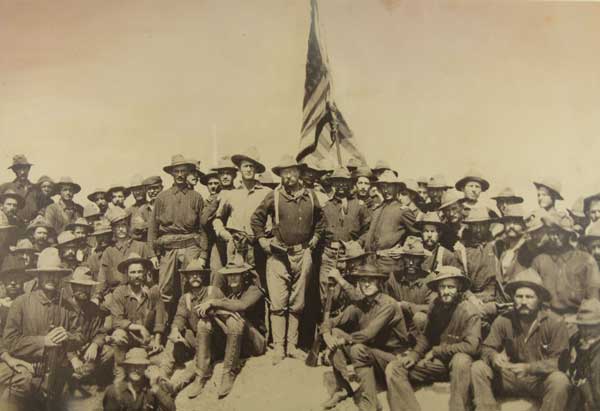
Roosevelt and the Rough Riders atop San Juan Hill. Theodore Roosevelt Birthplace National Historic Site.

Photo and Caption Roosevelt and the Rough Riders atop San Juan Hill. Theodore Roosevelt Birthplace National Historic Site.

By Anonymous (not verified), 12 March, 2026

Writing a Research Paper

After fully engaging your sources, you have plenty of remarkable information to convey to your reader. The problem may be figuring out where to begin. What do you share first?

The following activities will suggest many starting points and ending points and other points in between. The strategies below will prime the pump of your ideas, getting them to flow easily into your first draft.

Writing the Beginning Paragraph

Your first job in writing a research paper is to catch your reader's interest. You can experiment with a number of strategies to form an interesting lead sentence.

Write a lead sentence.

Try out some of these strategies for introducing your research paper. Read the examples for ideas.

  1. Start with a fascinating quotation.

    "Do things. Be sane. Don't fritter away your time; create, act, take a place wherever you are, and be somebody; get action.”
    —Theodore Roosevelt, Sr.

  2. Express what is most interesting about the subject.

    Teddy Roosevelt transformed himself from an asthmatic weakling to a brawler who won in Cuba and Panama, in Washington and on Mount Rushmore.

  3. Provide an anecdote.

    As they charged up San Juan Hill into the teeth of machine-gun fire, Teddy Roosevelt turned to a fellow soldier and shouted, "Holy Godfrey, what fun!"

  4. Ask an engaging question.

    Are heroes born, or are they made?