Revising Personal Essays
After completing a first draft of your personal essay, you should set it aside for a time if you can. Just as you can more easily understand a long period of time by reflecting on it afterward, you can better understand your writing when you get some distance. Then return to revise with fresh eyes.
Revising for Pace
You can't go into great depth about everything that happened over a few months' time. The essay would turn into an endless novel. Imagine Jake's journey across the Great Plains if he reported every excruciating detail.
Too Much Detail
. . . We pass mile marker 193 in Kansas. The road goes on without a bend as far as the eye can see. Only the heat coming off makes it waver. On both sides, corn stretches to the horizon. A farm clusters to the left. An exit leads to a county road. We stay on the Interstate. We pass mile marker 194. . .
Appropriate Detail
. . . then the even longer plains. It was as if the world was saying, "You really want to keep going? There's pretty much nothing that direction." Finally, we left the brown lands and got where things were greening up. Flat gave way to hills, and they to the mighty Mississippi. . .
On the other hand, you can't tell an effective story if you just gloss over everything. Imagine Jake's whole personal essay rendered that way.
Too Little Detail
After Dad lost his job in San Francisco, I lived with Grandpa in Marion, Ohio, until we could find a place to rent just outside of Columbus.
You need to dive into deep detail in an important moment and then provide a quick summary of other action before diving into detail again. Focus on significant events. The trip to the library, the trip to Goodwill—these changed the writer, while mile marker 193 in Kansas did not.
Review your pacing.
Reread your personal essay. If an important event gets glossed over, add details that bring it alive for readers, slowing down the pace so they can experience it firsthand. If an unimportant event drags on, delete some details, or replace the passage with a single summary sentence. Continue working until all parts have effective pacing.
Revising for Transitions
Your narrative takes place over an extended period of time and probably over multiple settings. As you shift from one time and location to another, you need to signal the reader. Transitions can serve as sign posts.
In the first passage below, the writer just reports events without transitioning from time to time and place to place, leaving the reader disoriented. In the second passage, note how transition words, phrases, and whole sentences help the reader shift in time and place.
No Transitions
Dad got laid off from his tech startup. "We're fine, buddy," he told me. We had money enough to find something new. A friend from the old firm landed a job in a "lifeboat" in Columbus—a family-owned business that needed a couple of Silicon Valley geniuses to take them to the future. Dad jumped on board, and I jumped with him.
Transition Words, Phrases, and Clauses
It all began six months earlier in San Francisco when Dad got laid off from his tech startup. He'd ridden the wave from the early days to the eventual fold-up and collapse. "We're fine, buddy," he told me. Between a high former salary and severance, we had money enough to find something new. . . . We thought. Months passed, and still nothing in the Valley. Rent isn't cheap in San Francisco. Then a friend from the old firm landed a job in a "lifeboat" in Columbus—a family-owned business that needed a couple of Silicon Valley geniuses to take them to the future. Dad jumped on board, and I jumped with him.
When you build your transition material, consider months, days, years, and specific location names. Often transition phrases start with words that show time or place:
Words That Show Time
about
after
as soon as
at
before
during
finally
first
in the end
later
meanwhile
next
second
soon
then
to begin
today
tomorrow
until
yesterday
Words That Show Place
above
across
against
along
among
around
behind
below
beneath
beside
between
by
down
in back of
in front of
inside
into
near
next to
on top of
outside
over
throughout
to the right
under
Revise for transitions.
Review your personal essay, making sure readers always know where and when events are taking place. Add transition words, phrases, and clauses as needed to clarify the settings of different events.
Teaching Tip
Narrators control time. They make it fly by or creep along, as their stories require. They jump back ten years or forward a hundred years. They spin time in circles, returning again and again to some powerful moment. Help students realize that transitions aren't just filler for potholes but are instead the roads themselves, getting readers from one place and time to another.
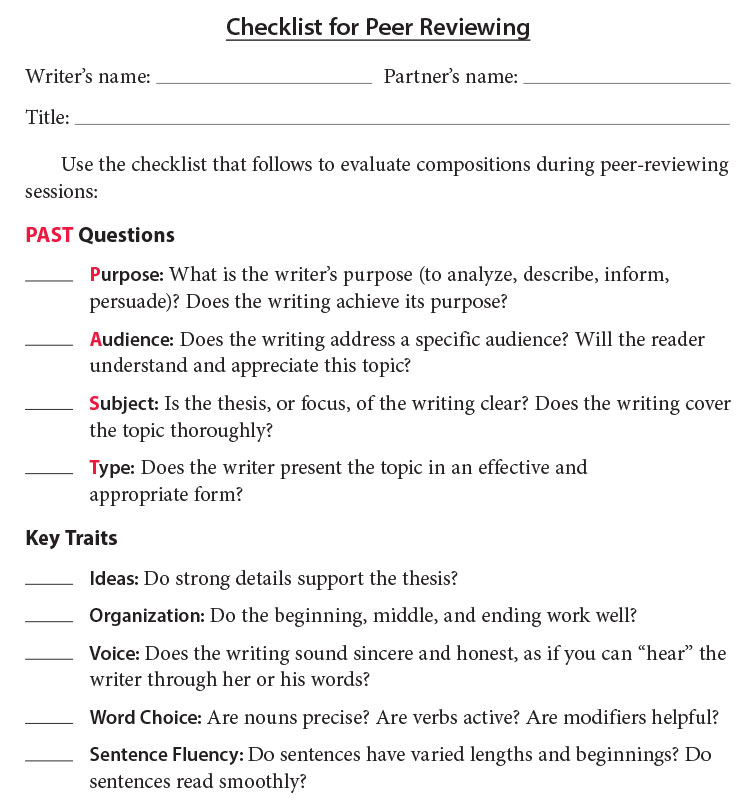
Revising with a Peer Response
Share your writing.
Have a trusted classmate read your personal essay and complete the form.
Revising in Action
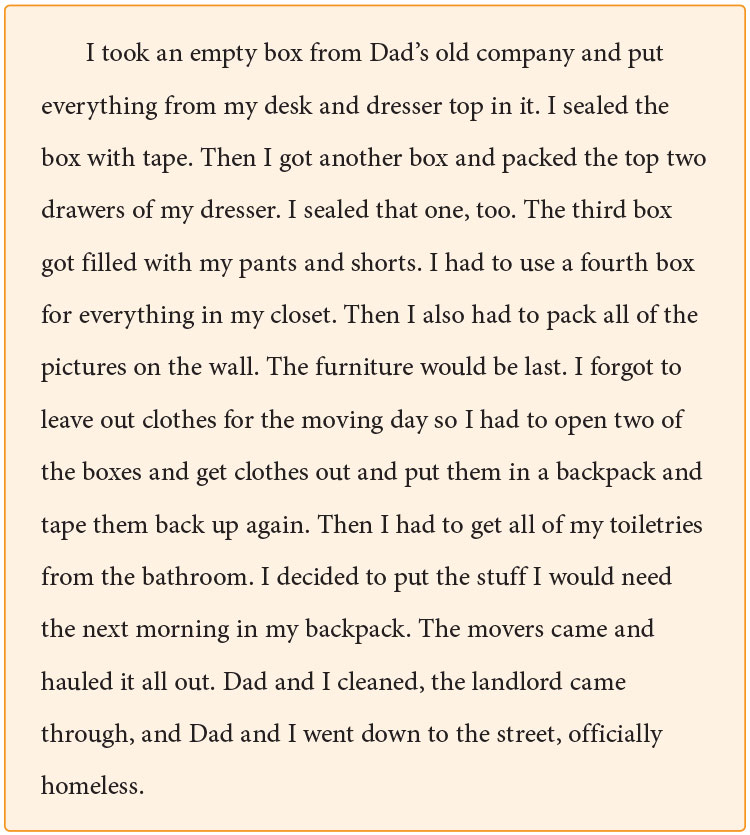
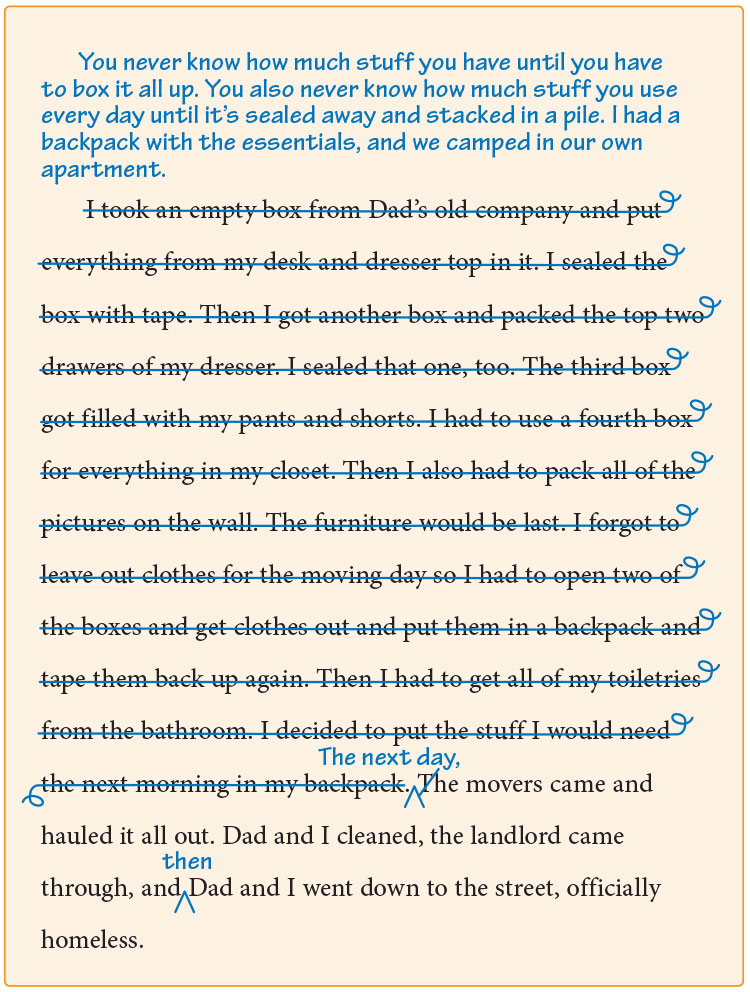
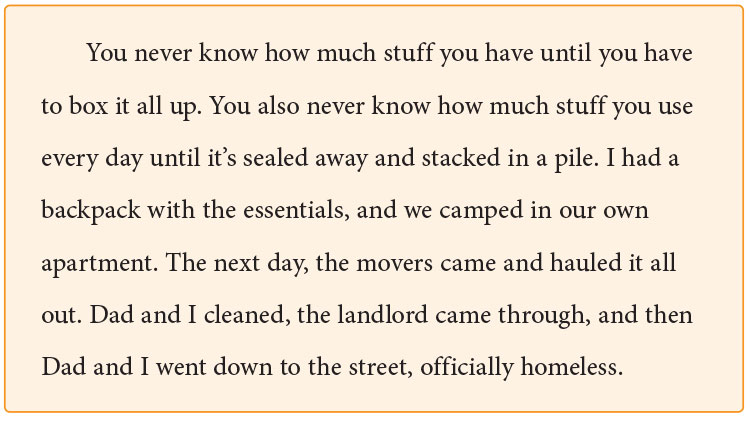
When you revise, you add, delete, rewrite, and rearrange your writing to make it clearer. Here are some revisions to "Flyover Country."
-
Paragraph Before Revisions
-
Pacing is improved, and transitions orient the reader.
-
Paragraph After Revisions
Revise with a checklist.
As you revise your personal essay, ask yourself the questions on this checklist. When you can answer a question yes, check it off. Continue revising until all questions are checked off.
- Does the essay focus on an extended period of time that helped shape the person I have become?
- Do descriptions, actions, dialogue, explanations, and other details help the reader experience events firsthand?
- Does the narrative slow down to describe important events in detail and speed up to quickly arrive at the next important point?
- Do transition words, phrases, and clauses help to connect events in time and place?
- Does the narrative voice invite the reader in to the time period?
- Are nouns specific, verbs active, and modifiers vivid?
- Do sentences read smoothly and vary in lengths and beginnings?